This guide covers the practical side in detail: tickets and the Tuesday closure, opening hours by season, the free English tours and the audio guide, the changing of the guard at Gwanghwamun, how the night opening works if you hold a foreign passport, the two free museums inside the walls, a route through the grounds, where the good photographs are and how long to allow. Prices and times were checked in October 2026; confirm anything critical on the palace’s official site (royal.khs.go.kr) before a special trip, because the Korea Heritage Service adjusts hours and night-opening windows every year. For the other four palaces and Jongmyo Shrine, and for help choosing between them, start with our guide to all of Seoul’s palaces.
Gyeongbokgung at a glance
| What | Detail (October 2026) |
|---|---|
| Adult ticket | ₩3,000 |
| Free entry | Under-7s, foreign visitors aged 18 and under, everyone aged 65 and over (foreign visitors included) and anyone wearing hanbok; Gyeongbokgung is not part of the Wednesday Culture Day free entry |
| Integrated palace ticket | ₩6,000 for Gyeongbokgung, Changdeokgung, Changgyeonggung, Deoksugung and Jongmyo |
| Closed | Tuesdays |
| Hours | From 09:00; closes at 17:00, 18:00 or 18:30 depending on the month; last entry one hour before closing |
| Free English tours | 11:00, 13:30 and 15:30, not on Tuesdays |
| Audio guide | Available to rent; ask at the palace for the price |
| Changing of the guard | 10:00 and 14:00 at Gwanghwamun, about 20 minutes, not on Tuesdays |
| Night opening | ₩3,000; spring and autumn windows, Wednesday to Sunday, 19:00–21:30 |
| Time needed | 2–3 hours for the palace on the route below; the museums need extra time of their own |
| Nearest stations | Gyeongbokgung (Line 3), Exit 5; Gwanghwamun (Line 5), Exit 2 |
The short version: arrive at nine on a weekday that is not a Tuesday, walk straight up the central axis before the coaches arrive, double back to the front gate for the ten o’clock guard ceremony if you want it, and save the museums for the middle of the day, when the courtyards are at their hottest and busiest.
Gyeongbokgung tickets and what they cover
A standard adult ticket costs ₩3,000, and you buy it at the palace on the day. Staffed windows and ticket machines both take cards. There is no advance booking for day tickets and no need for one: even on a busy spring weekend the queue at the window rarely takes more than a few minutes, because the crush is inside, not at the gate. For the same reason, paying a third-party platform a mark-up for a “skip-the-line” Gyeongbokgung ticket makes no sense. There is no line worth skipping. Keep your ticket until you leave, since staff check it at Heungnyemun.
Who gets in free
- Children aged six and under. The accompanying adult still needs a ticket.
- Visitors aged 65 and over. This applies to foreign visitors as well as Koreans, so carry your passport as proof.
- Anyone wearing hanbok, the traditional Korean dress, whether it is your own or rented. This is why the palace is so colourful on any given afternoon.
- Visitors with disabilities. Bring documentation if you have it.
- Foreign visitors aged 18 and under, with a passport as proof. Culture Day, now every Wednesday, does not apply here: it waives fees at the other palaces and Jongmyo, but not at Gyeongbokgung.
Most other concessions you will see listed are aimed at Korean residents. Teenagers travelling on a foreign passport are covered by the 18-and-under rule above, so bring their passports.
The integrated palace ticket: does it pay?
The integrated palace ticket costs ₩6,000 and covers Gyeongbokgung, Changdeokgung, Changgyeonggung, Deoksugung and Jongmyo Shrine. Bought one at a time, those five come to ₩9,000. The arithmetic is refreshingly simple. Gyeongbokgung and Changdeokgung cost ₩3,000 each, so the pass pays for itself the moment you visit both of the big two, and everything else you add is free. If Gyeongbokgung is the only palace on your list, buy the single ticket and move on.
One trap: the integrated ticket does not include the Secret Garden at Changdeokgung, which is a separate ₩5,000 guided visit that you book on its own. The ticket is valid for six months from purchase, with one visit to each site, which is more than enough for any trip. If you are weighing up city passes more generally, our guide to Seoul discount passes explains why none of the multi-attraction cards make sense for palaces alone at these prices.
Is hanbok worth it just for free entry?
No, but that is the wrong question. A basic hanbok rental near the palace costs ₩15,000 to ₩20,000 for a few hours, so the ₩3,000 you save on the ticket covers perhaps a fifth of it. People rent hanbok at Gyeongbokgung for the photographs and for the sheer fun of it, and on those terms it is good value: the courtyards and pavilions were practically designed for this kind of picture, and nobody treats it as fancy dress or disrespect. Koreans do it too, especially in spring and autumn. The rental shops cluster on the lanes just outside the palace’s west and east walls and dress you in outfits that meet the free-entry rule. Very short or heavily modernised “fusion” costumes have occasionally been questioned at the gate, so if you have your eye on something unconventional, ask the shop whether it qualifies before you pay.

Gyeongbokgung opening hours
The palace opens at 09:00 and closes on Tuesdays, unless the Tuesday is a public holiday: then it stays open and closes on the next non-holiday day instead. Closing time moves with the seasons, and last entry is always an hour before closing:
| Months | Opening hours | Last entry |
|---|---|---|
| January–February | 09:00–17:00 | 16:00 |
| March–May | 09:00–18:00 | 17:00 |
| June–August | 09:00–18:30 | 17:30 |
| September–October | 09:00–18:00 | 17:00 |
| November–December | 09:00–17:00 | 16:00 |
The Tuesday closure trips up more visitors than anything else on this page. If Tuesday is the only day you have in the palace district, it is a perfectly good day for Changdeokgung, which closes on Mondays instead. Jongmyo Shrine also closes on Tuesdays, so do not pair those two. Around the big national holidays, Seollal and Chuseok, the palace sometimes opens on a Tuesday it would normally close and shuts on another day instead. The notice on the official site is the only reliable word on that.
The best time of day
Nine o’clock on a weekday is the golden hour, in terms of crowds rather than light. Tour coaches start unloading from about ten, school groups arrive mid-morning during term, and the peak runs from roughly eleven until three. The last ninety minutes before closing are quieter again, and much more pleasant in summer, when the open granite courtyards throw the heat back at you and there is almost no shade along the main axis. Weekends are busier than weekdays at every hour, and Saturday afternoons in April, May, September and October are the busiest of all.
The best time of year
Spring and autumn are the palace’s best seasons, for the same reasons they are Seoul’s best seasons generally. Blossom arrives in early April around the royal residences and Hyangwonjeong; our cherry blossom guide has the usual timing. Late October and early November bring the maples and ginkgoes, which are at their best around Hyangwonjeong and the northern compounds, and the autumn foliage guide covers the rest of the city’s colour. Winter is underrated. After a snowfall, Gyeonghoeru’s roofline and the white courtyard of Geunjeongjeon are about as beautiful as Seoul gets, and the crowds thin out dramatically, although the cold on those open courtyards is serious in January. Summer is the season to plan around: hot, humid and, in July, wet. See Seoul weather by month for the numbers.
Getting to Gyeongbokgung
- Gyeongbokgung Station (Line 3), Exit 5. The exit comes up inside the palace precinct beside the National Palace Museum, a short walk from the ticket booths. This is the most direct route by far.
- Gwanghwamun Station (Line 5), Exit 2. This brings you up on Gwanghwamun Square, past the statues of King Sejong and Admiral Yi Sun-sin, with the gate at the northern end. It takes five to ten minutes on foot and is the most dramatic way to arrive.
- Anguk Station (Line 3), Exit 1. Better if you are coming from, or heading on to, Bukchon, since it sits nearer the palace’s east side and the National Folk Museum.
Subway fares start at ₩1,550 with a T-money card for trips up to 10 km, a little more for longer rides, and our Seoul subway guide explains transfers and the colour-coded lines. If you take a taxi, “Gwanghwamun” is the word every driver knows.
A short history that explains what you are looking at
Gyeongbokgung was the first and principal palace of the Joseon dynasty, built in 1395, three years after the general Yi Seong-gye founded the dynasty and a year after he moved the capital to Hanyang, the Seoul of today. Its name, chosen by the dynasty’s chief ideologue Jeong Do-jeon from a line in an ancient Chinese book of poems, translates roughly as “palace greatly blessed by heaven”. The site was picked by geomancy: a mountain behind (Bugaksan), guardian hills to either side and open land in front.
The blessing did not hold. The palace burned in 1592, in the chaos of the Japanese invasions, and lay in ruins for about 270 years while the kings lived at Changdeokgung. It was rebuilt on a colossal scale from 1865 by the Heungseon Daewongun, the regent for the young King Gojong, as a statement of royal authority at a time when that authority was draining away. The project nearly bankrupted the state. Within three decades the palace was the scene of the dynasty’s darkest moment: in 1895 Japanese agents murdered Empress Myeongseong in Geoncheonggung, the private royal compound at the northern end of the grounds, and the following year Gojong fled to the Russian legation.
During the colonial period, most of the palace’s buildings were demolished or sold off, and in 1926 the Japanese Government-General Building, a huge domed stone block, was completed directly in front of Geunjeongjeon, hiding the throne hall from the city. Gwanghwamun itself was moved aside. The Government-General Building was finally demolished in 1995 and 1996, and restoration has been running ever since. Heungnyemun, the second gate, returned in 2001. Gwanghwamun was rebuilt in timber on its original line in 2010. The royal terrace in front of the gate was restored in 2023, and the bridge to Hyangwonjeong pavilion was moved back to its original position in 2021. Work continues.
That history matters on the ground. A large share of what you see is careful reconstruction from the last few decades, built on original foundations and from historical records. That is why the paint looks so bright and the timber so crisp, and why a few areas of the grounds are still open lawn or fenced off for work.
The changing of the guard at Gyeongbokgung
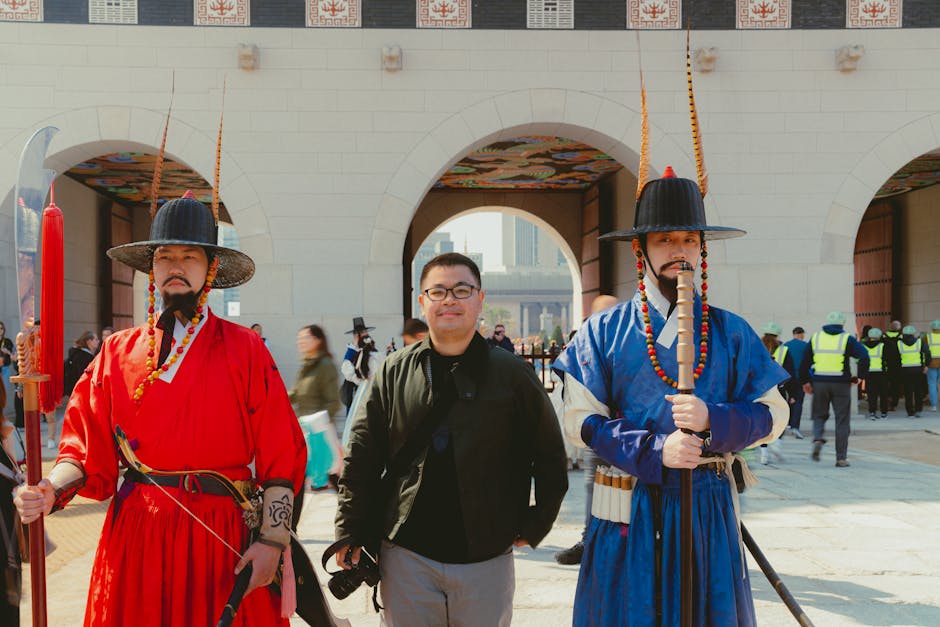
The Royal Guard Changing Ceremony takes place in front of Gwanghwamun at 10:00 and 14:00 every day except Tuesday, and each performance lasts about twenty minutes. It is free and happens outside the ticket gate, so you can watch it without buying anything. The pageant re-creates the formal handover between units of the Joseon royal guard: a drum signals the start, the relieving unit marches in with banners and weapons, the commanders go through the ritual of taking over the gate, and the outgoing guard marches away. The costumes are the draw, deep red, blue and yellow silk with feathered hats, and the whole thing is well paced and genuinely photogenic.
Practical tips for the changing of the guard at Gyeongbokgung: stand at the front edge of the forecourt facing the gate, arrive ten minutes early for a spot at the rope, and do not expect it to run in heavy rain or on the hottest summer days, when it is sometimes cut or cancelled. Deoksugung, near City Hall, runs its own smaller ceremony at Daehanmun twice a day, which is a good alternative if your timing is off or it is a Tuesday.
A route through the palace
The palace is laid out on a north–south axis: public ceremonial buildings in front, the king’s working office behind them, then the royal living quarters, and finally the private gardens and pavilions at the back, against the mountain. The route below follows that logic, walking up the central spine first while it is quiet and then looping west, north and east through the areas most people rush or miss. Allow about two and a half hours at an unhurried pace.
1. Gwanghwamun and the royal terrace
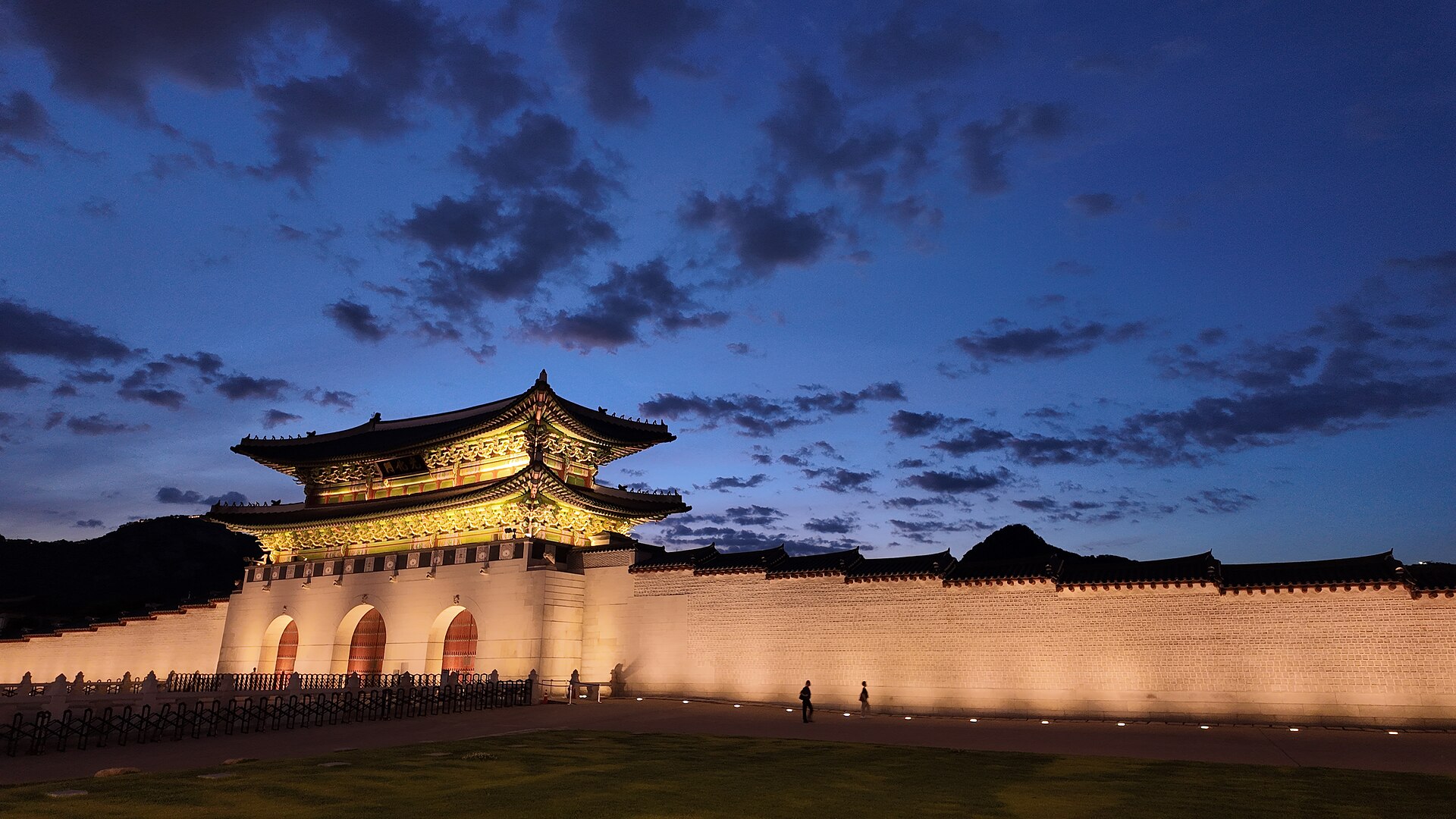
Gwanghwamun is the palace’s main gate and one of the most photographed structures in Seoul. The current gate is the 2010 timber reconstruction, sitting on its original alignment after nearly a century of being moved, burned and rebuilt in concrete. In 2023 the long stone platform in front of it, the woldae, where the king once met his subjects, was excavated and restored, and the stone haechi, the lion-like guardian creatures that became the city’s mascot, stand watch in front of it. The gate’s name board was replaced at the same time in black with gold lettering, following research into its original appearance, so older photographs show a different sign.
2. Heungnyemun and Yeongjegyo Bridge
Past the ticket booths, the second gate, Heungnyemun, opens onto a courtyard crossed by a stone bridge, Yeongjegyo, over a channel called the Geumcheon. The channel marked a symbolic boundary between the outside world and the royal domain. Look down at the stone creatures carved along its embankments: they were meant to guard the palace from evil spirits, and one of them, to the delight of every child who spots it, is sticking its tongue out. The English tours start from the information centre in this area.
3. Geunjeongjeon, the throne hall
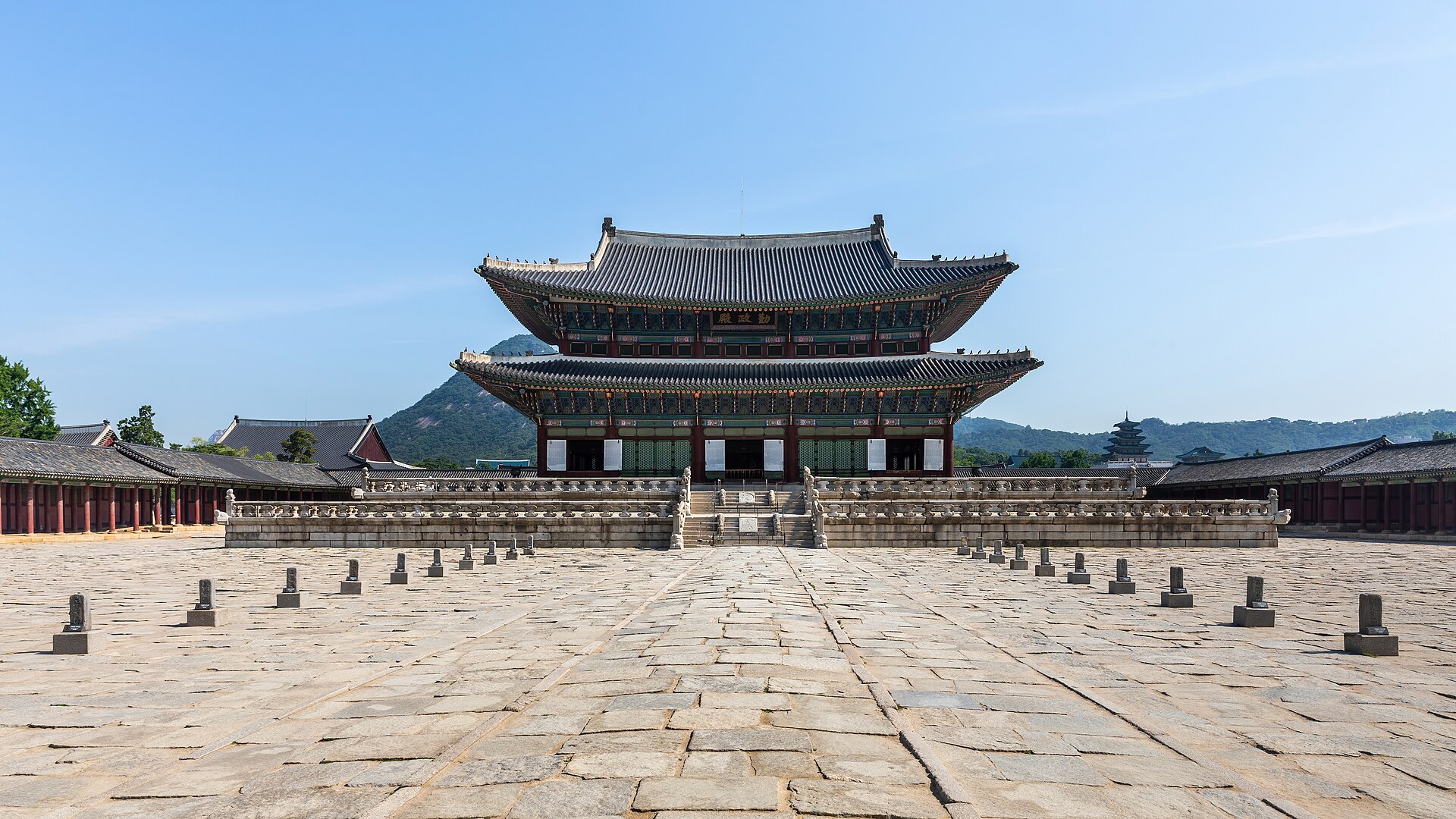
Geunjeongmun, the third gate, frames the view that most people come for: Geunjeongjeon, the throne hall, where coronations, royal audiences and the great state ceremonies were held. It is a National Treasure and the grandest building in the palace, a two-storey hall on a double stone terrace, although inside it is a single soaring space. The stone railings of the terrace are carved with guardian animals, including the creatures of the Chinese zodiac. Look through the open doors to the throne, which stands in front of the Irworobongdo, the painted folding screen of the sun, the moon and five peaks.
The courtyard in front is the detail that rewards a closer look. It is paved with deliberately rough granite slabs, said to cut glare and stop officials in formal dress from slipping. Two lines of small stone markers run up it, the pumgyeseok, which showed officials of each rank where to stand during ceremonies, with civil officials on the east side and military officials on the west. The iron rings set into the paving held the ropes for the great awnings put up over the courtyard for ceremonies.
4. Sajeongjeon and the king’s office
Directly behind the throne hall, Sajeongjeon was the king’s everyday office, where he met ministers, reviewed documents and held lectures on the classics. It is smaller and more human in scale than Geunjeongjeon, and the two side halls, which could be heated with underfloor ondol, were used in winter. Most visitors walk straight through; spend a minute in the courtyard and it is easy to picture a working government.
5. Gangnyeongjeon, Gyotaejeon and the Amisan garden
Next comes the king’s residence, Gangnyeongjeon, and behind it the queen’s, Gyotaejeon. Look at the roofs of both: they have no ridge beam along the top, a feature found on royal sleeping quarters and explained in several ways, the most popular being that the king, as the dragon, should not sleep under another dragon. Behind Gyotaejeon, climb the stepped terraces of Amisan, a small artificial hill made from the earth dug out for Gyeonghoeru’s pond and planted as the queen’s garden. Its four hexagonal brick chimneys, decorated with plum, bamboo, cranes and other auspicious motifs, are some of the finest pieces of decorative brickwork in the country and are easy to miss.
6. Gyeonghoeru Pavilion
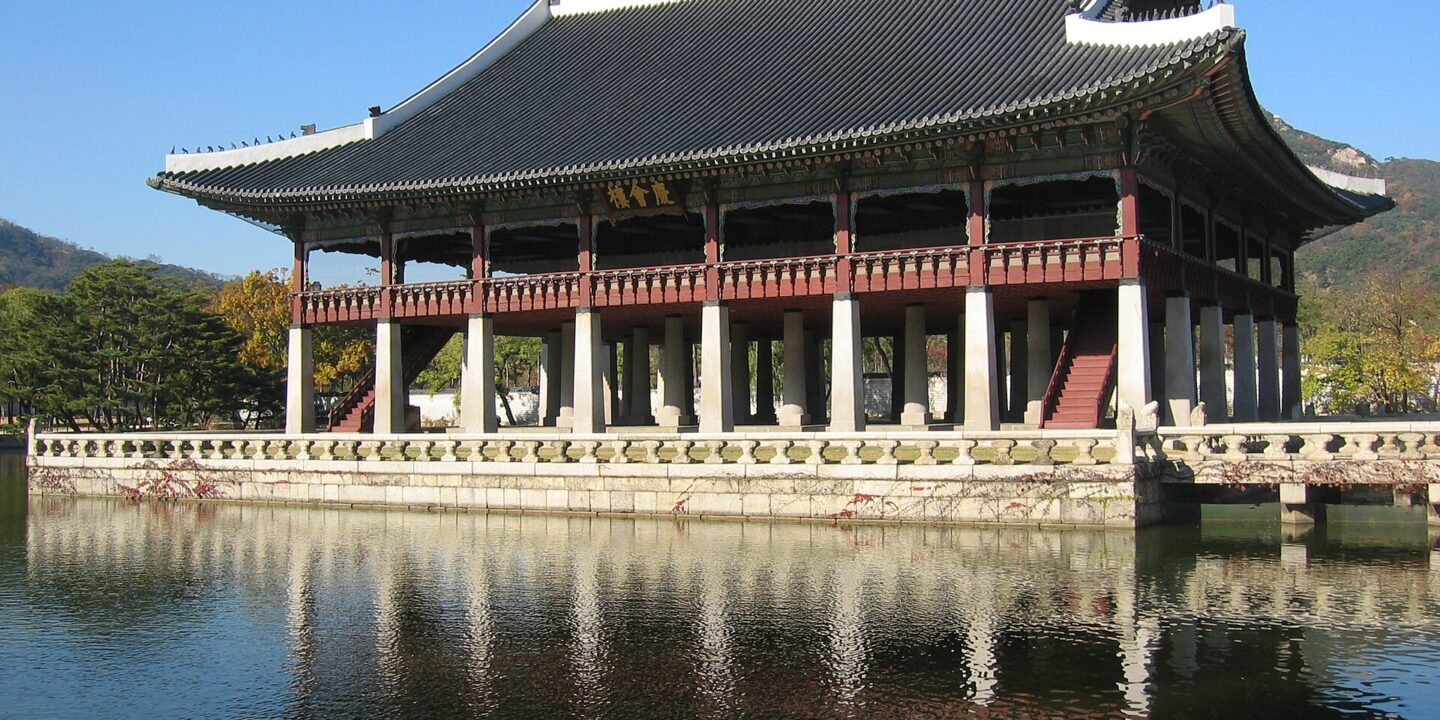
Loop west to the pond and you reach the palace’s most famous view. Gyeonghoeru is a raised banquet pavilion standing on 48 stone pillars over a rectangular lake, first built in 1412 and rebuilt in the 1860s. It was used for state banquets and for receiving foreign envoys, and its upper floor could hold a very large gathering while looking out over the water to Inwangsan and Bugaksan. The classic photograph is from the south-east corner of the pond, with the pavilion and its reflection lined up; it is at its best on a still morning or in the last hour before closing. In some years the upper floor has opened to small, pre-booked tours in the warmer months, so check the palace website if you would like to go up.
Just south of the pond, Sujeongjeon stands on the site of the Jiphyeonjeon, the royal research institute where scholars under King Sejong worked in the fifteenth century during the era that produced Hangeul, the Korean alphabet. During the night openings, traditional court music and dance are performed near here on selected evenings.
7. Jagyeongjeon
Heading north-east, you reach Jagyeongjeon. It is one of the few residential buildings to survive from the nineteenth-century reconstruction, and it has two treasures of its own: a flower-patterned wall on its west side and, in the rear courtyard, a chimney panel decorated with the ten symbols of longevity, including cranes, deer, turtles and pine trees. It is quieter than the areas around it and worth a few minutes.
8. Hyangwonjeong and Geoncheonggung
At the northern end of the grounds, Hyangwonjeong is a small, hexagonal, two-storey pavilion on an island in a lotus pond, reached by a wooden bridge. It was built during Gojong’s reign, between 1867 and 1873, and, framed by Bugaksan, it is arguably the prettiest corner of the palace. The bridge, Chwihyanggyo, spent decades on the south side of the pond after it was rebuilt following the Korean War, and was only moved back to its original position on the north side, facing Geoncheonggung, in 2021. Spring and autumn are the seasons for it.
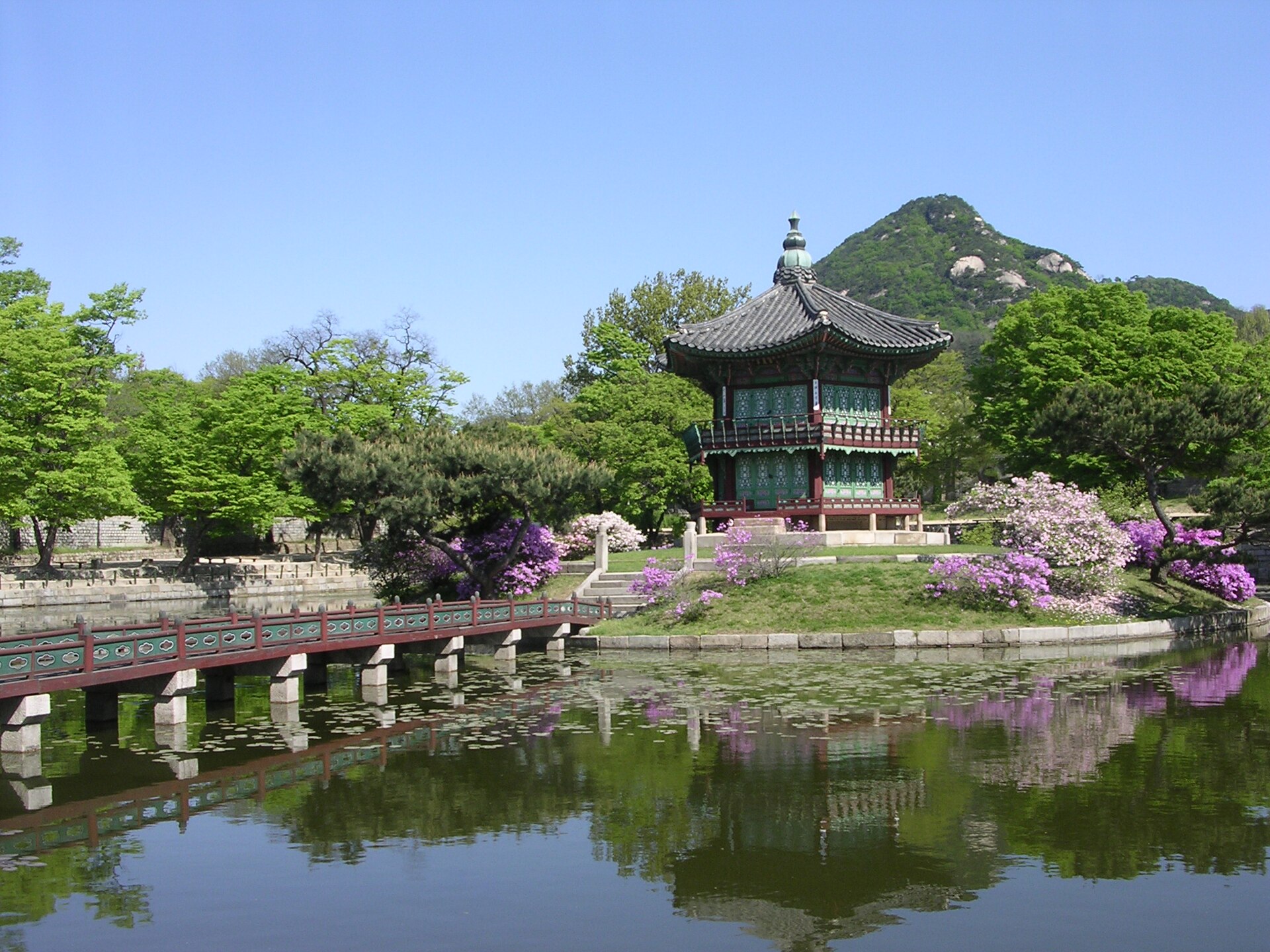
Behind the pond, Geoncheonggung is a compound Gojong built as a private retreat, designed in the plain, unpainted style of a scholar’s house rather than a palace. It carries two very different pieces of history. In 1887 it became the first place in Korea to be lit by electric light. Eight years later, in 1895, it was the scene of the assassination of Empress Myeongseong. There is a small plaque, and the compound is worth seeing precisely because it is so modest.
9. Jibokjae and the northern edge
West of Hyangwonjeong, Jibokjae was King Gojong’s library and reception hall, and its brick side walls borrow noticeably from Chinese architecture of the period, which makes it look unlike anything else in the palace. From here the Taewonjeon shrine compound and the north gate, Sinmumun, lie further on. Cheong Wa Dae, the former presidential compound across the road, was open for public visits from 2022 until July 2025, when the presidential office began moving back there, so do not plan around a tour without checking current access. Most people walk back south along the eastern side of the grounds, past the National Folk Museum.
Free English tours and the audio guide
Free guided tours in English start at 11:00, 13:30 and 15:30 every day the palace is open. Bring your palace ticket and ask staff inside the gate where the tour meets. Tours run for about an hour, sometimes longer when the group is engaged, and cover the central axis, Gyeonghoeru and the royal residences, with the stories that turn a row of handsome buildings into a place where things happened. Tours in other languages run at their own times.
You can also rent an audio guide; check the price and the languages on offer when you arrive. It is fine, and it lets you go at your own pace, but the honest verdict is that the free tour is the better deal. The guides are good storytellers and you can ask questions. The downsides of the tour are timing, since you have to fit your visit around the start times, and crowd size: on a busy spring afternoon the group can be large enough that the back half struggles to hear. If you arrive at nine for the quiet courtyards, a sensible compromise is to walk the axis alone first and join the 11:00 tour for the stories afterwards.
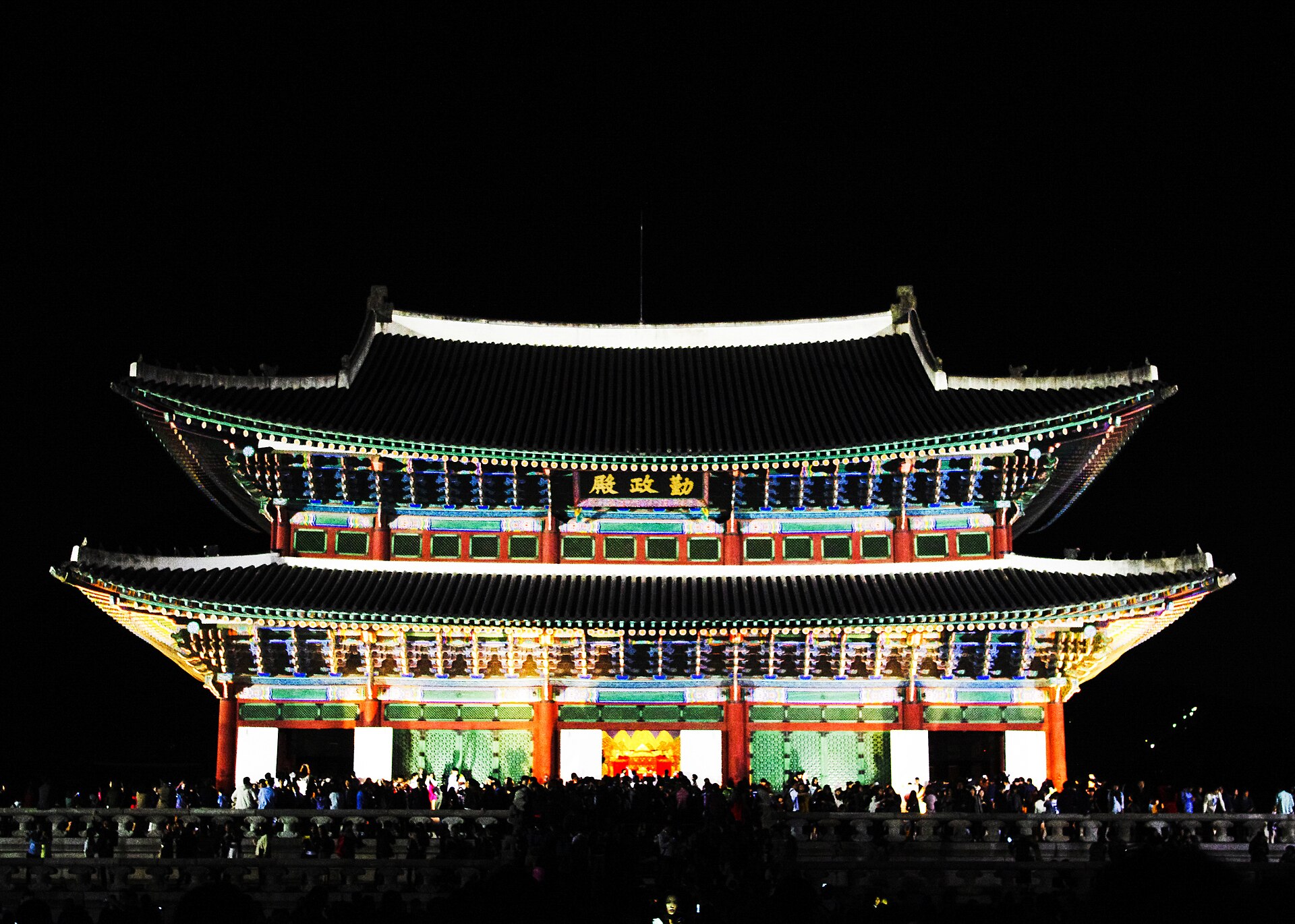
Gyeongbokgung night viewing
For a few weeks in spring and again in autumn, the palace opens in the evening with the main buildings lit up. It is one of the most popular events on Seoul’s calendar, and the rules are different for foreign visitors, which is where most of the confusion comes from.
- When: two windows a year, one in spring and one in autumn, Wednesday to Sunday only.
- Hours: 19:00 to 21:30, with last entry at 20:30.
- Price: ₩3,000. The usual free categories apply: anyone wearing hanbok, and foreign visitors aged 18 and under or 65 and over.
- How domestic visitors book: online through the Korean NOL (Interpark) Ticket site, first come first served, with sales opening about a week before each window. There are 3,000 online tickets a day, with a maximum of four per person.
- How foreign visitors get in: a separate allocation of 300 tickets a day is sold on site on the day itself, to foreign visitors who show a passport or other ID, with a maximum of two per person.
- What is open: the central axis from Gwanghwamun and Heungnyemun through Geunjeongjeon and Sajeongjeon, the royal residences, the Amisan garden and Gyeonghoeru. Hyangwonjeong and the northern compounds stay dark.
Is it worth the effort? For most people, yes, once. Gyeonghoeru lit up and reflected in its pond is one of the great sights of Seoul, and the atmosphere of the throne-hall courtyard at night is completely different from the daytime scrum. It is busy, though, not serene. For the on-site tickets, check the sale details on royal.khs.go.kr or ask at the ticket office, and be early, particularly at weekends. The next spring window is normally announced a few weeks ahead, in April or May.
A separate and pricier programme, the Starlight Tour, has combined an after-hours walk with a royal-style meal in some seasons and sells out quickly. If you miss both, remember that Deoksugung and Changgyeonggung stay open until 21:00 (last entry 20:00) every day except their Monday closing day, with no booking at all. They are smaller, but a palace after dark is a palace after dark.
The museums inside the walls
Two national museums sit within the palace precinct. Both are free, both can be visited without a palace ticket and both keep their own hours, which differ from the palace’s, so check their websites. They are the obvious answer to a wet morning or a scorching midday, and our guide to Seoul’s museums and galleries puts them in context with the rest of the city.
National Palace Museum of Korea
Beside the Gyeongbokgung Station exit in the south-west corner, the National Palace Museum holds the objects that the reconstructed palace cannot show you: royal seals, court paintings and Irworobongdo screens, ceremonial robes, the scientific and time-keeping instruments of King Sejong’s reign, and the royal family’s early twentieth-century motor cars. It is well laid out, air-conditioned and has English labelling throughout. An hour is enough for the highlights, and it makes far more sense after you have walked the palace than before.
National Folk Museum of Korea
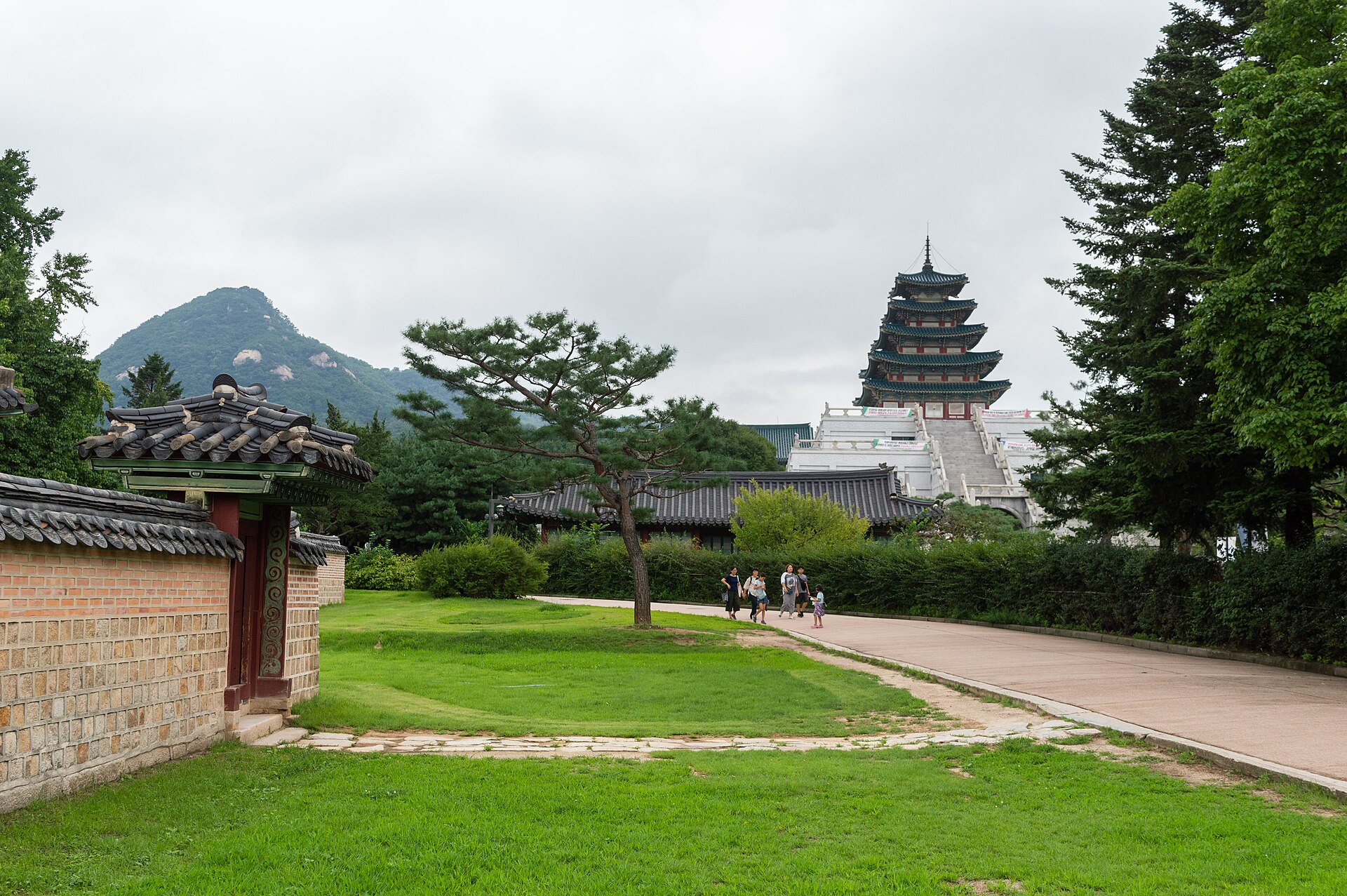
The five-storey, pagoda-style building on the east side of the grounds, visible from much of the palace, houses the National Folk Museum. Its galleries cover everyday life on the peninsula from prehistory to the twentieth century: farming, food, the rituals of the life cycle, the seasons and their festivals. Outside, an open-air area includes traditional houses and a recreated shopping street from the 1960s and 70s that Korean visitors of a certain age find hilarious. A separate Children’s Museum runs timed sessions that are worth booking ahead at busy times. Of the two museums, this is the one to pick if you are curious about ordinary Korean life rather than royalty.
The best photo spots
- Gyeonghoeru from the south-east corner of the pond. The classic reflection shot, best on a windless morning or at dusk during a night opening.
- Hyangwonjeong from the south bank. The pavilion, the pond and Bugaksan in one frame. Best in April and late October.
- Geunjeongjeon from Geunjeongmun. Stand in the gateway for the symmetrical shot with the rank stones leading your eye up to the hall and the mountain above it.
- The corridors around the throne-hall courtyard. The covered walkways that enclose the courtyard give endless framed shots of the hall through red columns, and they are shaded, which counts for a lot in July.
- The Amisan chimneys. For detail rather than grandeur, especially in spring when the terraces are in flower.
- Gwanghwamun from the square at blue hour. The gate lit up with Bugaksan fading behind it. It is outside the ticket line, so it works after closing.
- The walls along Samcheong-ro. The tree-lined road along the palace’s east wall is one of Seoul’s best autumn walks.
Tripods can be restricted when the palace is busy, and drones are banned outright, since central Seoul sits inside a no-fly zone. For hanbok portraits, the royal residences and the corridors behind Gyeonghoeru are calmer than the throne-hall courtyard, where you will be sharing the frame with a hundred other people.
How long to spend at Gyeongbokgung
- 90 minutes: the central axis from Gwanghwamun to the royal residences, plus Gyeonghoeru. This is what most tour groups do.
- 2.5–3 hours: the full loop in this guide, including Hyangwonjeong, Geoncheonggung and Jagyeongjeon. This is the right amount for most independent travellers.
- Half a day: add the guard ceremony, the English tour and one museum.
- A full day: pair the palace with Bukchon and Samcheong-dong to the east, or with Seochon and Tongin Market to the west, finishing in Insadong. Our one-day Seoul itinerary is built around exactly this morning.
Eating and drinking nearby
There is nowhere to have a proper meal inside the walls, so eat before or after. The good news is that the palace is surrounded by three of the most enjoyable eating neighbourhoods in central Seoul.
- Seochon, to the west. The lanes west of the palace are full of small restaurants and cafes. Tosokchon, a couple of minutes from Gyeongbokgung Station, is the famous name for samgyetang, ginseng chicken soup, and has a queue at lunchtime to match. Tongin Market, ten minutes further on, runs a lunchbox system in which you buy a tray and a strip of old-fashioned brass coins and trade them for side dishes at the stalls.
- Samcheong-dong and Bukchon, to the north-east. Cafes with palace-wall views, hand-torn noodle soup and a steady stream of galleries. For a quieter break, our guide to traditional tea houses in Seoul lists several within walking distance.
- Gwanghwamun, to the south. The office district serves fast, good-value weekday lunches in the basements of the big towers, and it is the easiest option if the weather has turned.
Visiting with children, a pushchair or limited mobility
Children under seven get in free, and the palace works well for families as long as you keep the visit short and let them run in the open courtyards, which is exactly what Korean children do. The stone creatures at Yeongjegyo, the guard ceremony and the Folk Museum’s Children’s Museum are the reliable hits. Our guide to Seoul with kids has more ideas for the same area.
The grounds are largely flat, but the main courtyards are paved with uneven granite and many paths are gravel, which makes pushchairs and wheelchairs hard work in places. The buildings themselves are viewed from outside, and the raised terraces are reached by steps. Ask at the information centre whether a wheelchair or pushchair is available to borrow, and see our accessible Seoul guide for step-free routes around the city.
Etiquette and palace rules
- Do not climb on the stone terraces, railings or sculptures, however good the photograph would be.
- Most halls are viewed from their doorways; do not step inside unless a door is explicitly open to visitors.
- Smoking is banned throughout the grounds, and eating is best kept to the rest areas.
- No drones, and be considerate with tripods and selfie sticks in crowded courtyards.
- Hanbok is welcome and normal. Dressing up is not seen as cultural appropriation here; Koreans are generally delighted to see visitors in it.
Combining Gyeongbokgung with the rest of the area
Gyeongbokgung is the anchor of Seoul’s historic core, and almost everything in the old city is within a twenty-minute walk. East of the palace, the hanok lanes of Bukchon Hanok Village climb the hill towards Changdeokgung, which is about twenty-five minutes on foot through the village. South-east, Insadong is the obvious place for an afternoon of tea and craft shops. South, Gwanghwamun Square leads down to Cheonggyecheon stream and City Hall, where Deoksugung sits. Our Jongno district guide ties the whole area together, and the Seoul travel guide is the place to start if you are still shaping the wider trip.
Is Gyeongbokgung worth it? The honest verdict
Yes, with caveats. If you visit only one palace in Seoul, most people should make it this one. It is the grandest, the most symbolic and the one whose story explains the rest of the city’s history, and ₩3,000 for a morning of this quality is one of the great bargains in Asian travel. The guard ceremony, the night openings and the two free museums add depth that the other palaces cannot match.
The caveats are real, though. Much of what you see is recent reconstruction, the huge open courtyards are hot, glaring and busy for most of the day, and the crowds between eleven and three can drain the magic out of it. If what you want is atmosphere rather than grandeur, buildings sitting in woodland rather than on granite, Changdeokgung and its Secret Garden will probably move you more. Many visitors who do both end up preferring Changdeokgung. The ideal, if you have two free half-days, is to do both, on the integrated ticket. If you have one, arrive at Gyeongbokgung at nine and you will see it at its best.
If you are torn between the two big palaces, it helps to know how different Changdeokgung is: smaller, fitted into wooded hills rather than laid out on granite, with a Secret Garden that can only be seen on a capped, timed tour. Our Changdeokgung Palace and Secret Garden guide explains how to book that tour, and has a side-by-side comparison with Gyeongbokgung for anyone who can only fit in one.
If the ten o’clock ceremony at Gwanghwamun does not fit your day, Deoksugung runs its own at Daehanmun at 11:00 and 14:00 (not on Mondays), and the palace behind it stays open until 21:00. Our Deoksugung Palace guide explains where to stand for the ceremony and why it is the easiest palace in Seoul to see after dark.
Planning to go in hanbok? Our hanbok rental Seoul guide covers the shops around Gyeongbokgung Station, what a four-hour rental actually includes, which outfits qualify for free entry, and how to time it so you reach the palace courtyards before the crowds do.
Frequently asked questions
How much does it cost to enter Gyeongbokgung Palace?
An adult ticket costs ₩3,000. Children six and under, foreign visitors aged 18 and under, visitors aged 65 and over (foreigners included) and anyone wearing hanbok get in free. The weekly Wednesday Culture Day, which opens the other palaces free of charge, does not cover Gyeongbokgung. The ₩6,000 integrated palace ticket covers Gyeongbokgung plus three other palaces and Jongmyo Shrine.
What day is Gyeongbokgung closed?
Tuesday. The palace is open 09:00 to 17:00, 18:00 or 18:30 on every other day, depending on the month, with last entry an hour before closing. The guard ceremony does not run on Tuesdays either.
Is Gyeongbokgung free if you wear hanbok?
Yes. Anyone wearing hanbok, foreign visitors included, gets free entry to Gyeongbokgung and the other grand palaces. Rental costs far more than the ticket, so it only makes financial sense if you wanted the hanbok experience anyway.
What time is the changing of the guard at Gyeongbokgung?
The Royal Guard Changing Ceremony runs at 10:00 and 14:00 in front of Gwanghwamun, lasts about twenty minutes and is free to watch. It does not run on Tuesdays and may be cancelled in heavy rain or extreme heat.
Can foreigners buy tickets for the Gyeongbokgung night viewing?
Yes, but not through the online sale, which is on a Korean ticketing site aimed at domestic visitors. On the day itself, foreign visitors can buy up to two tickets each on site, from a daily allocation of 300; bring your passport or other ID. The night viewing runs only in spring and autumn windows, Wednesday to Sunday.
How long do you need at Gyeongbokgung?
Ninety minutes covers the central axis and Gyeonghoeru. Two and a half to three hours lets you see the whole palace properly, and half a day covers the palace, the guard ceremony and one of the two museums.
Do I need to book Gyeongbokgung tickets in advance?
No. Day tickets are sold at the palace and the queue is short. The only things worth booking are the night opening, if you can use the Korean site, and hanbok rental in peak season if you want a particular shop or style.
Gyeongbokgung or Changdeokgung: which is better?
Gyeongbokgung is grander and more historically central; Changdeokgung is more atmospheric and has the Secret Garden. For a first visit with time for one, choose Gyeongbokgung for scale or Changdeokgung for beauty. With time for two, do both on the ₩6,000 integrated ticket, which pays for itself on those two alone.
Final thoughts
Gyeongbokgung rewards a little planning more than most sights in Seoul. Avoid Tuesdays, arrive at opening, walk the axis before the crowds, catch the ten o’clock guard change, and then slow down in the northern half of the grounds, where the pavilions and residences are quieter and more beautiful than the famous courtyard. Do that and a ₩3,000 ticket buys one of the best mornings the city has to offer. When you are ready to add more, the Seoul palaces guide will help you choose the next one.
Photo Credits
Gyeonghoeru Pavilion reflected in its pond: Gyeongbokgung-Gyeonghoeru-02 by eimoberg (a flickr user), CC BY 2.0, via Wikimedia Commons.
Gwanghwamun and the palace wall at dusk: Gyeongbokgung Palace at Night by Lunisaa, CC BY 4.0, via Wikimedia Commons.
Geunjeongjeon courtyard and rank stones: Front view of the Imperial Throne Hall Geunjeongjeon at Gyeongbokgung Palace with blue sky in Seoul by Basile Morin, CC BY-SA 4.0, via Wikimedia Commons.
Hyangwonjeong pavilion in spring: Gyeongbokgung-HyangWonJeong-01 by Joon-Young Kim (Seoul, Korea), CC BY-SA 3.0, via Wikimedia Commons.
Geunjeongjeon during a night opening: Geunjeongjeon Hall in Gyeongbokgung Palace by Hhk1201, CC BY-SA 4.0, via Wikimedia Commons.
National Folk Museum of Korea and Bugaksan: Bugaksan and National Folk Museum of Korea by Tristan Surtel, CC BY-SA 4.0, via Wikimedia Commons.