It is also the palace that most rewards planning, because the garden, known as Huwon or the Secret Garden, is visited in timed sessions with capped numbers, and the English sessions sell out. This guide explains exactly how the booking works and what to do if you miss out, what the two separate tickets cover, a route through the palace that ends at the garden gate, what you will see on the tour, the best seasons, and how Changdeokgung compares with Gyeongbokgung. Prices and session times were checked in October 2026; treat them as the right order of magnitude and confirm on the official royal palaces booking site before you travel. For the bigger picture across all five palaces, see our Seoul palaces guide.
Changdeokgung at a glance
| What | Detail (September 2026) |
|---|---|
| Palace ticket | ₩3,000 adults. Covered by the ₩6,000 integrated palace ticket; free in hanbok and every Wednesday for Culture Day. None of these covers the Secret Garden |
| Secret Garden (Huwon) | ₩5,000 adults, ₩2,500 ages 7–18, under-7s free, on top of the palace ticket. Not covered by hanbok, the integrated ticket or Culture Day |
| How the garden works | Timed entry with a guide, 100 places per session; follow the commentary or explore the open areas on your own. Adults pay ₩5,000 extra |
| Booking | 50 places per session online, opening at 10:00 Korea time six days ahead; 50 sold on site from 09:00 on the day |
| English garden tours | 10:30, 11:30, 14:30 and 15:30 (March–November); no 15:30 session in winter |
| Closed | Mondays |
| Palace hours | From 09:00; closes around 17:30 in winter, 18:00 in spring and autumn, 18:30 in summer; last entry one hour before |
| Time needed | Plan on about an hour for the palace and about 90 minutes for the garden, so allow half a day for both |
| Nearest stations | Anguk (Line 3), Exit 3; Jongno 3-ga (Lines 1, 3 and 5) |
If you remember one thing from this page, make it this: the Secret Garden is a separate ticket for a specific time slot, and the only way to be sure of an English slot on a busy day is to book online at 10:00 Korea time, six days before your visit.
Changdeokgung tickets: two tickets, not one
Almost every problem visitors have at Changdeokgung comes from not realising that the palace and the garden are ticketed separately. The palace ticket (₩3,000) gets you through Donhwamun, the main gate, and around the palace buildings, and you can wander freely. The garden ticket (₩5,000 for adults) gets you a place on one specific guided tour of Huwon, at one specific time, in one specific language. To see the garden you need both, so a full visit costs ₩8,000 for an adult. That is still very cheap for what you get.
The free-entry and discount routes that work elsewhere only cover the palace half:
- Hanbok gets you into the palace free, but you still pay the ₩5,000 for the garden.
- The ₩6,000 integrated palace ticket covers Changdeokgung along with Gyeongbokgung, Changgyeonggung, Deoksugung and Jongmyo, but not the garden. Older guides describe a ₩10,000 version that included Huwon; that is no longer sold.
- Culture Day, every Wednesday, makes the palace free but not the garden tour.
- Children six and under are free for both.
If you plan to see Gyeongbokgung as well, the integrated ticket pays for itself on those two palaces alone (₩3,000 each), and anything else you add is free. Our Gyeongbokgung Palace guide runs through that maths in more detail.
How to book the Secret Garden tour
This is the part that matters. Each Secret Garden session takes a maximum of 100 people. Half of those places are released online and half are held back for sale at the palace on the day, which is a fair system but one that punishes people who turn up at eleven on a Saturday in October expecting to walk in.
Booking online
- Where: the official integrated reservation site for the royal palaces (royal.khs.go.kr), in the Changdeokgung section. It has an English interface.
- When: reservations open at 10:00 Korea time, six days before your visit, and close the day before. To go on a Saturday, you book the previous Sunday at 10:00. Korea is nine hours ahead of GMT, so that is 02:00 in London during British Summer Time (01:00 in winter) and 21:00 the evening before in New York for most of the year.
- What you choose: the date, the session time and the language. English sessions run at 10:30, 11:30, 14:30 and 15:30 from March to November, and at 10:30, 11:30 and 14:30 in the winter months. Chinese and Japanese sessions run once a day on alternating days.
- How many: English sessions and autumn weekends go first, often very quickly. If you have a fixed date in the foliage season, be online at 10:00 sharp.
- On the day: follow the instructions on your confirmation about payment and ticket collection, bring your passport, and collect or show your ticket at the office by Donhwamun well before your slot.
Buying on the day
The on-site half of each session goes on sale at the palace from 09:00, first come, first served. On a weekday outside the peak seasons you can usually buy a ticket for a same-day English session without drama. On spring and autumn weekends, and throughout the foliage season from mid-October, the English sessions can be gone within an hour or two of opening, so if you are relying on the on-site allocation, be at the window before nine and have a back-up session in mind.
If the English sessions are full
Join a Korean-language session. Nobody checks your language, the route is the same, and the garden is the point, not the commentary. The Korean guide will say a lot more than you understand, but you walk the same paths and see the same ponds, and between this page and the signage you will know what you are looking at. This is the single most useful tip for anyone who has missed the English slots. Third-party platforms also sell Secret Garden tours, usually a guided palace walk bundled with a place on a public session. An adult garden ticket bought directly costs ₩5,000, so compare that with the platform’s price before you pay for a bundle.
Timing on the day
The garden tour starts at the Huwon entrance, which is inside the palace grounds rather than at Donhwamun, so allow time to walk to it. Tours leave on time and latecomers cannot tag on, so leave a margin. The simplest plan is to book a garden session about an hour and a quarter after you arrive, see the palace buildings first, and walk up to the garden gate from Nakseonjae with ten minutes to spare.
A short history
Changdeokgung was built in 1405 as a secondary palace, a place for the king to live and work away from the formal grandeur of Gyeongbokgung. Kings liked it from the start. When all of Seoul’s palaces were burned during the Japanese invasions of 1592, Changdeokgung was the first to be rebuilt, in the early 1600s, and it served as the main royal residence for more than 250 years, until Gyeongbokgung was finally reconstructed in the 1860s. More kings lived here than in any other palace.
It was also where the dynasty ended. Emperor Sunjong, the last ruler, lived here after 1907 and died here in 1926, and the palace buildings were refitted in those years with electric light, curtains, glass windows and even a porch for motor cars. After liberation, the surviving members of the royal family returned to live in the Nakseonjae compound: Princess Deokhye, the last princess, and Yi Bangja, the Japanese-born wife of the last crown prince, both lived there until they died in 1989. The UNESCO listing, in 1997, recognised the palace’s harmony with its landscape: the way the buildings follow the natural lie of the land instead of flattening it.
A route through the palace
The palace half takes about an hour. The route below runs from the main gate to the garden entrance, so it works whether you have a garden ticket or not.
1. Donhwamun and Geumcheongyo
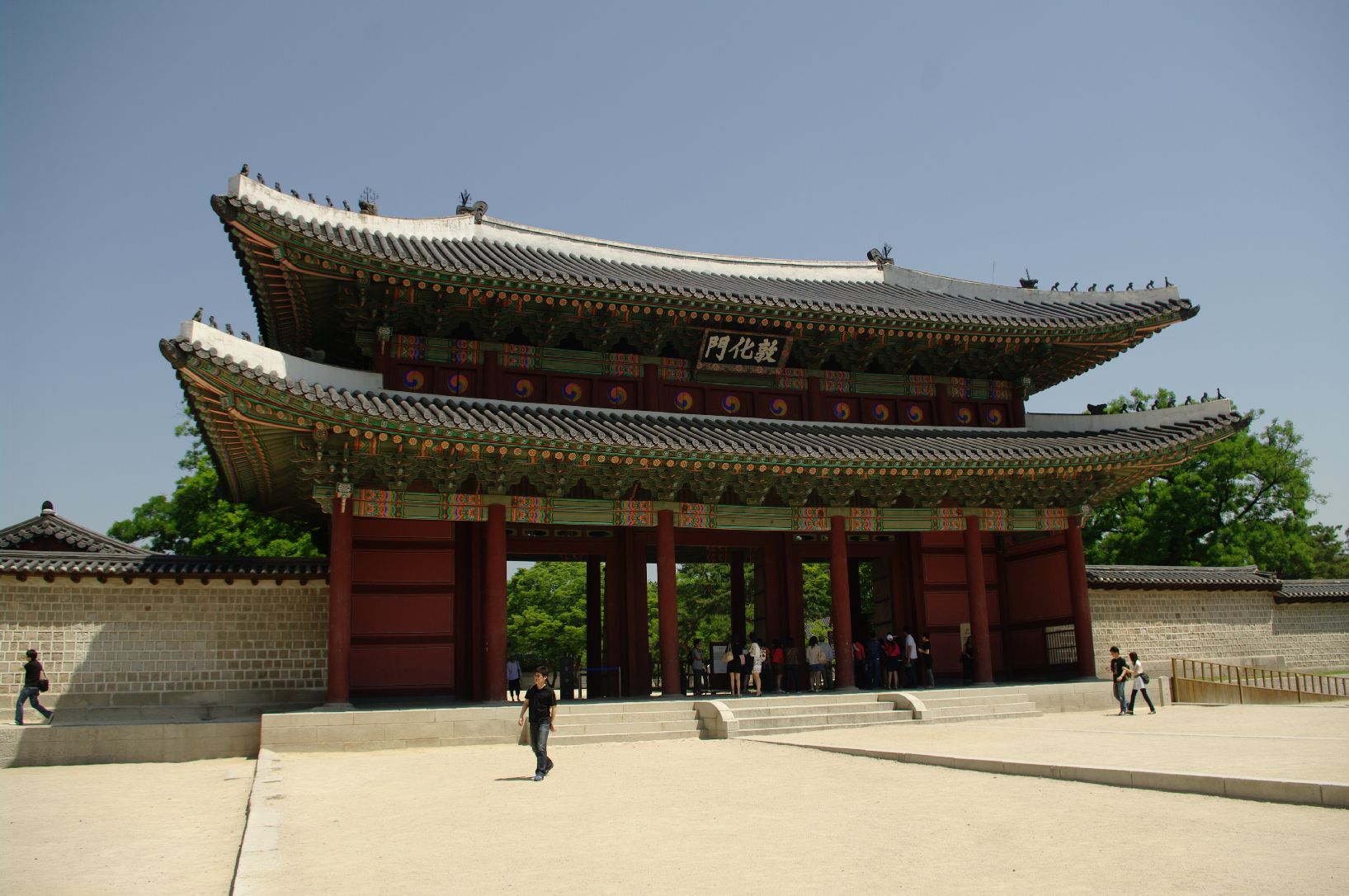
Donhwamun, the two-storey main gate, was first built in 1412 and rebuilt in the early 1600s, which makes it the oldest palace gate still standing in Seoul. Once through it, you turn right, because the main buildings are not straight ahead, to cross Geumcheongyo, a stone bridge built in 1411 and the oldest surviving bridge over a palace stream at any of the Joseon palaces. The carved creatures on its sides were placed to keep evil away from the king’s domain.
2. Injeongjeon, the throne hall
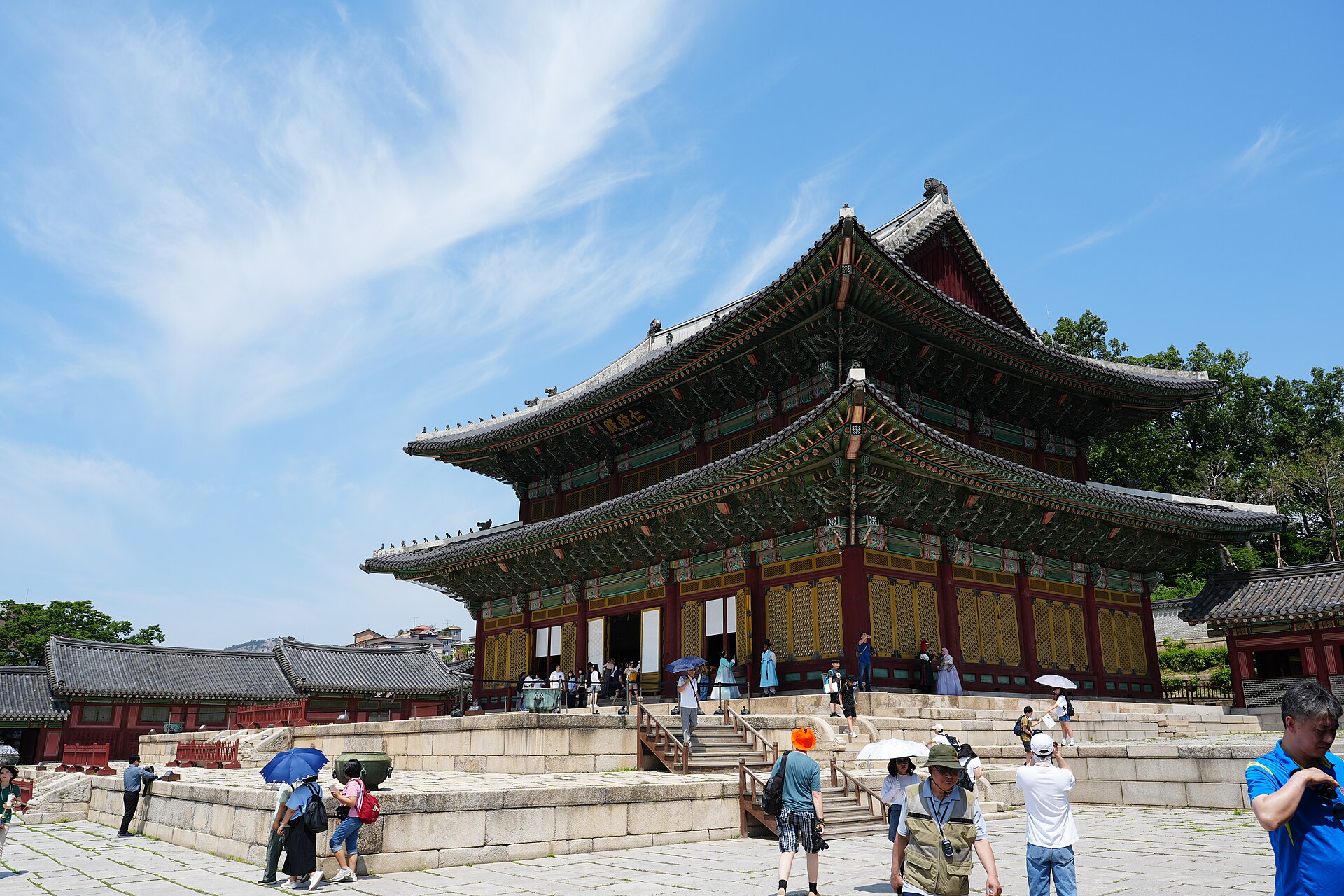
Through Injeongmun, the gate beyond the bridge, the courtyard of Injeongjeon opens up. The throne hall looks similar to Gyeongbokgung’s at first glance, two storeys on a stone terrace with rank stones in the courtyard, but it is smaller and more intimate, and the wooded hill behind it softens the whole scene. Look through the doors at the interior: the Western-style light fittings, curtains and wooden floor date from the early twentieth-century refit, and make it a snapshot of a court trying, too late, to modernise.
3. Seonjeongjeon, Huijeongdang and Daejojeon
East of the throne hall, Seonjeongjeon was the king’s council chamber, and its roof is the detail to look for: it is covered in blue glazed tiles, the only surviving palace building in Korea roofed this way. Beyond it, Huijeongdang served as the king’s residence and later his office. It was rebuilt in 1920, after a fire, using timber taken from Gyeongbokgung, and has a covered carriage porch added so that cars could draw up to the door. Behind it, Daejojeon, the queen’s residence, has Western furnishings visible through its windows and a side hall, Heungbokheon, where the last royal council met in 1910 before Korea was annexed. Most of these buildings are viewed from outside, but the glimpses of chandeliers and upholstered chairs inside a Joseon palace are one of the stranger sights in Seoul.
4. Nakseonjae
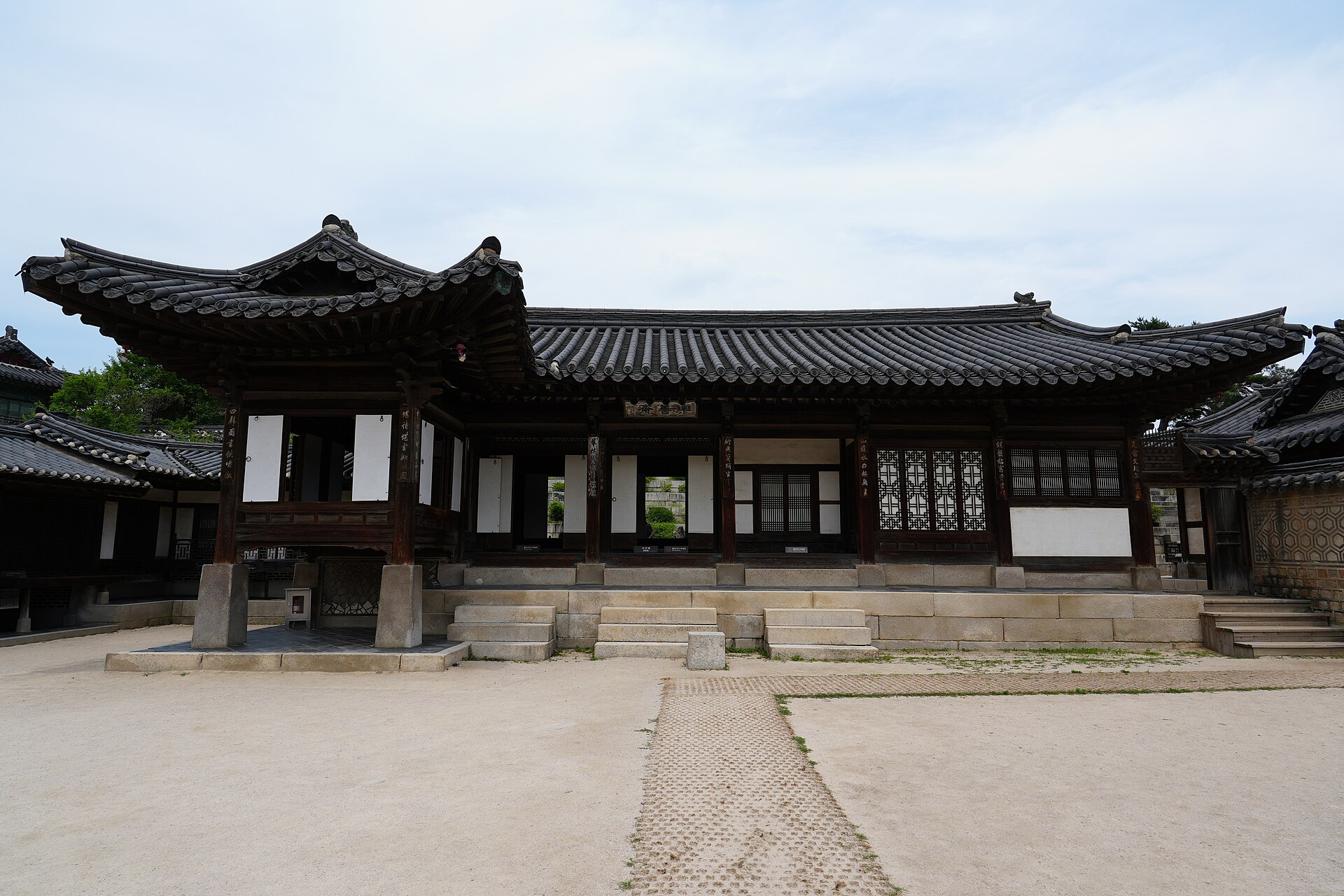
Then the mood changes completely. Nakseonjae, built in 1847 for King Heonjong, is a residential compound left deliberately unpainted, with plain timber, latticed paper windows and courtyards of raked earth, in the style of a scholar’s house rather than a palace. It feels lived-in, which it was until 1989. The walls are decorated with patterned brickwork, and the latticework on the windows is some of the finest in Seoul. Most tour groups skip it entirely, so it is often the quietest corner of the palace, and it sits right on the way to the garden entrance. Give it fifteen minutes.
What you see on the Secret Garden tour
Huwon covers more than half of the palace grounds, a fold of wooded hillside behind the palace that the kings used for study, relaxation, archery, small banquets and poetry. It was never really secret, just a royal retreat closed to commoners. The tour follows paved and earth paths that climb and dip through the woods, with regular stops at ponds and pavilions while the guide explains what you are looking at. The exact route shifts with the season and with conservation work, but these are the highlights.
Buyongji and Juhamnu
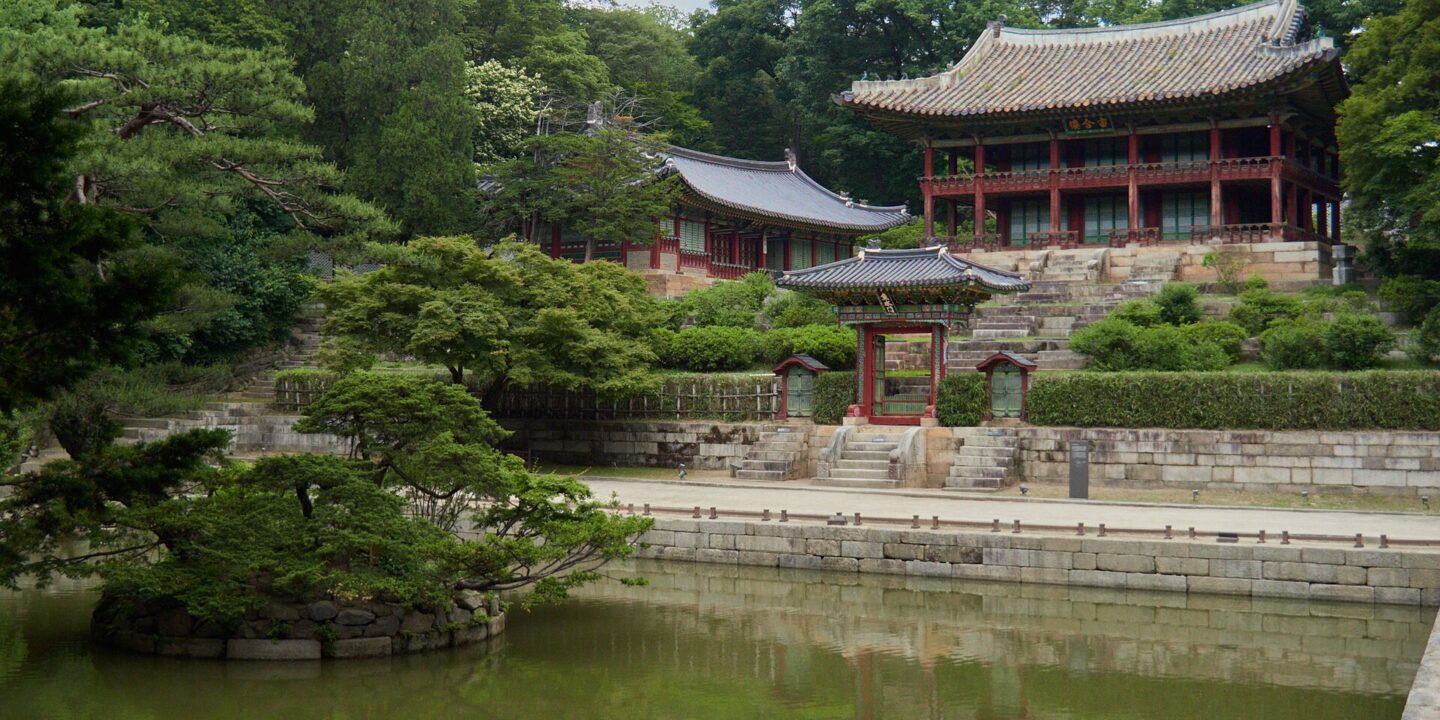
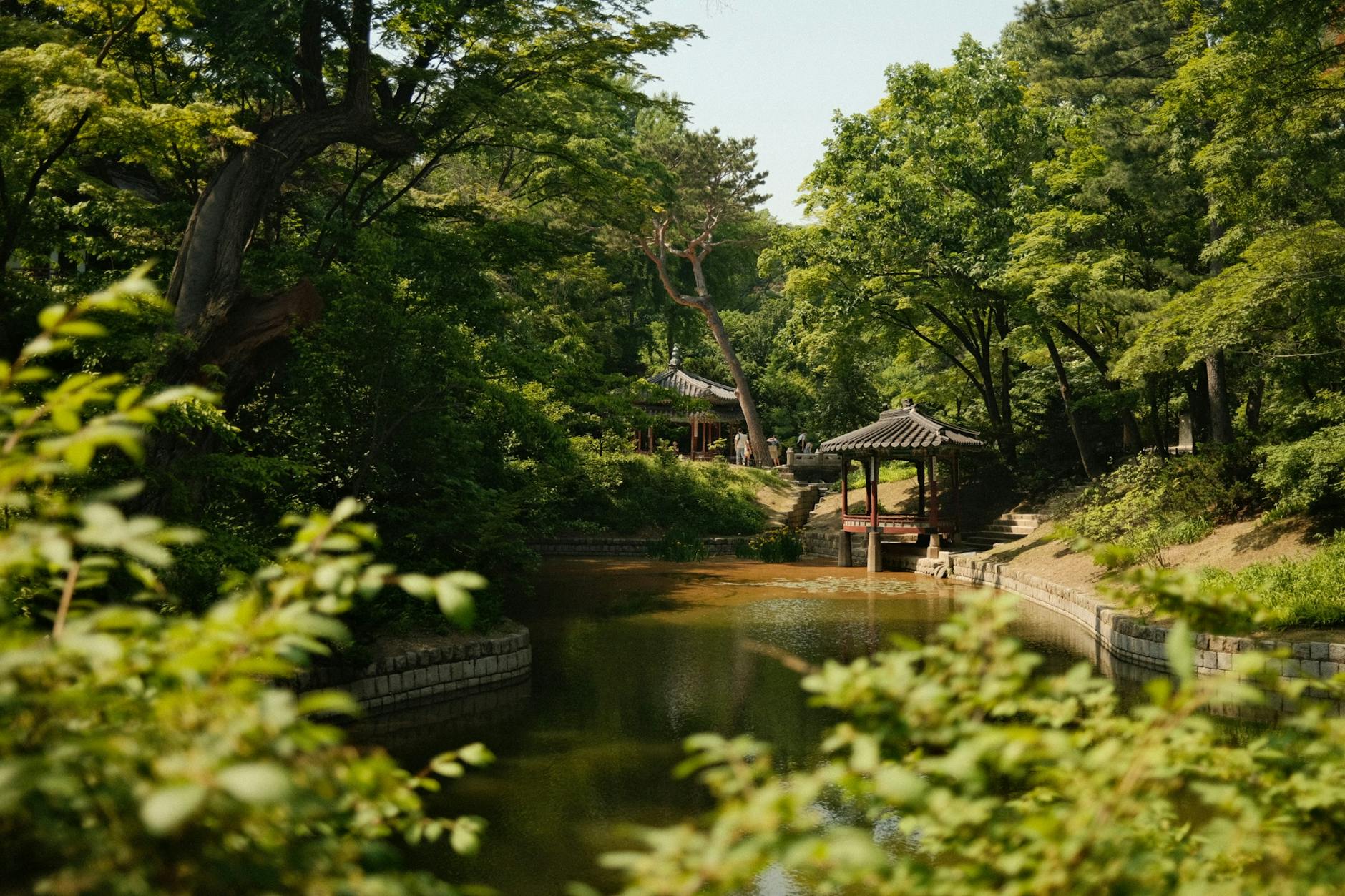
The first great view comes a few minutes in. Buyongji is a square pond with a small round island in the middle, a shape that expresses the old idea that heaven is round and the earth is square. On its southern edge, Buyongjeong is a cross-shaped pavilion with two of its pillars standing in the water. Up the slope opposite rises Juhamnu, a two-storey pavilion whose ground floor housed the Gyujanggak, the royal library and research institute founded by King Jeongjo in 1776. The small gate at the foot of its steps, Eosumun, is named for fish and water: the king was the water, his officials the fish, and neither could do without the other. If you take one photograph in the garden, it will probably be this one.
Aeryeonji and Bullomun
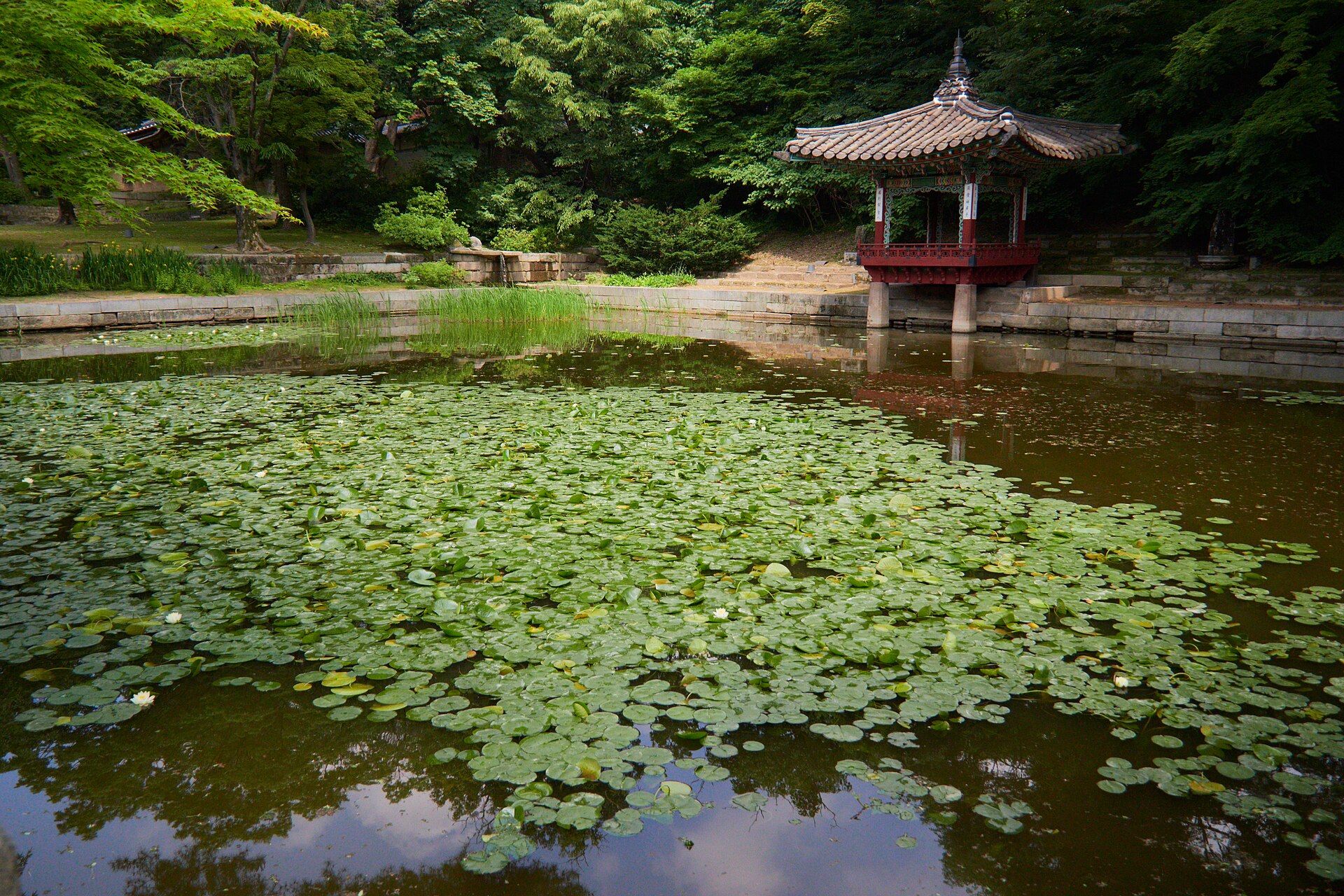
Further on, the lotus pond of Aeryeonji has a tiny pavilion, Aeryeonjeong, built in 1692, whose name means something like “loving the lotus”. Nearby stands Bullomun, a gate carved from a single block of stone. Its name means “gate of eternal youth”, and legend has it that walking through it keeps you young, so expect the whole group to shuffle through it one by one.
Yeongyeongdang
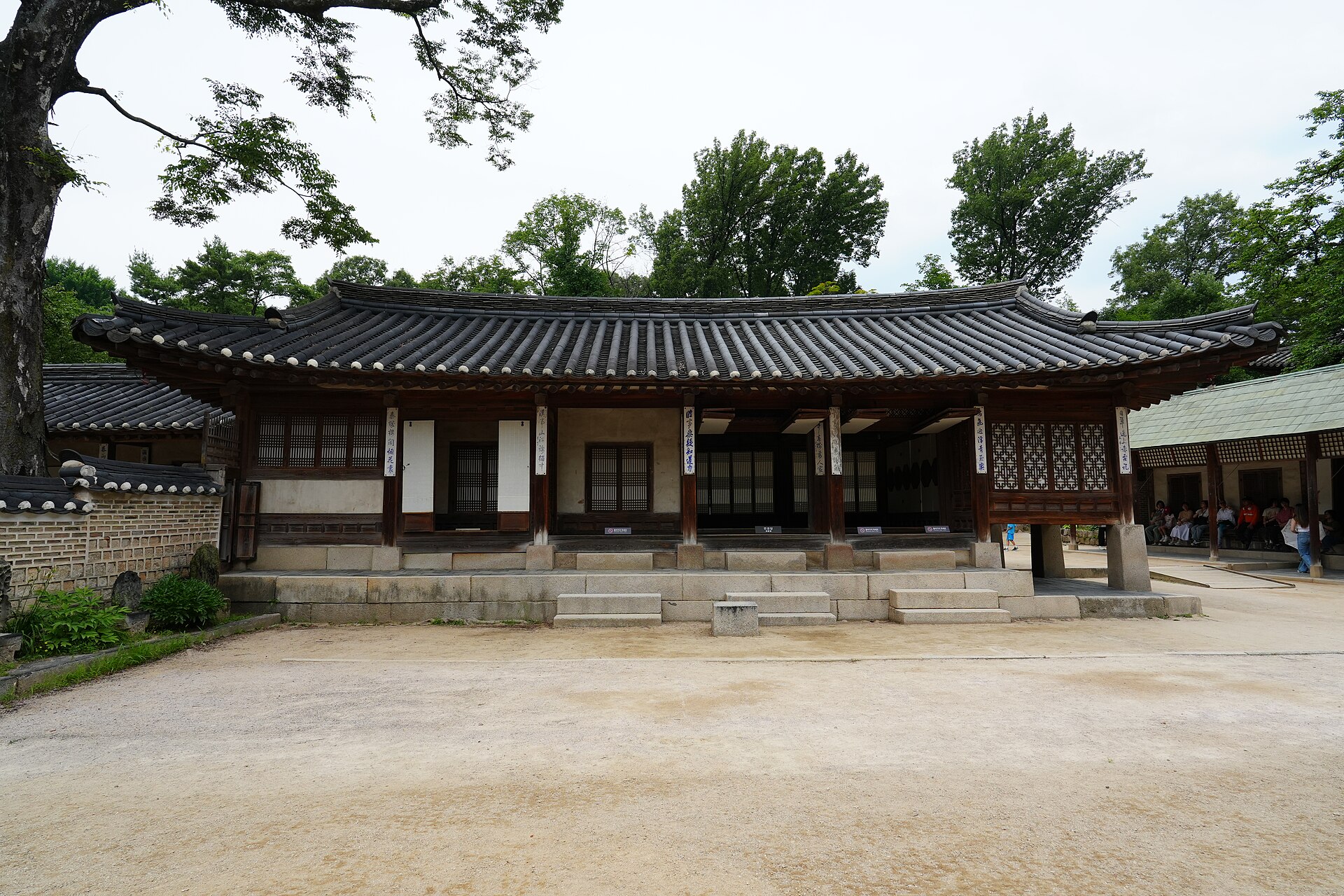
Tucked into the woods, Yeongyeongdang is a full-sized compound built in the 1820s, deliberately modelled on the house of a Joseon scholar-aristocrat rather than a royal building. It is unpainted, with separate men’s and women’s quarters, a study and a small library. The guide will point out the stepping stones, the door sizes and the other small signs of rank that were built into ordinary domestic life. For many people it is the most memorable stop, precisely because it is so understated.
Gwallamji, Jondeokjeong and Ongnyucheon
Deeper into the valley, Gwallamji is a pond often described as shaped like the Korean peninsula, with a fan-shaped pavilion, Gwallamjeong, on its bank, and Jondeokjeong, a hexagonal pavilion with a double roof, nearby. The furthest part of the garden, Ongnyucheon, is a rocky stream where kings once floated cups of wine along a carved channel and composed poems, with a seventeenth-century inscription cut into the rock. Access to it depends on conservation work, so ask at the ticket office whether your tour will reach it.
When to visit
Season by season
- Autumn (mid-October to mid-November) is the peak, and for good reason: the maples, ginkgoes and zelkovas turn the whole valley red and gold, reflected in the ponds. It is also when booking is hardest. Late October and early November are the usual best weeks; our autumn foliage guide tracks the timing across the city.
- Spring (April and May) brings fresh green leaves, azaleas and royal azaleas, and apricot and cherry blossom in early April. Busy, but slightly easier to book than autumn.
- Summer is green and shady. The woodland canopy makes the garden the most bearable place in the palace district on a hot day, but bring mosquito repellent and water, and be ready for monsoon downpours in July.
- Winter is bare and cold, with fewer sessions, but it is by far the easiest time to get a ticket, and after snow the pavilions are extraordinary. Check Seoul weather by month before committing to a January visit on those exposed paths.
Day and time
Weekdays are markedly easier than weekends, for both the palace and the garden. The first English session, at 10:30, has the freshest light and the quietest paths; the last one, at 15:30, brings the soft late-afternoon glow in autumn, but you will be walking out close to closing time. Remember the palace is closed on Mondays. If a public holiday falls on a Monday, it usually opens that day and closes on the Tuesday instead.
The Moonlight Tour
For a few weeks in spring, and in some years in autumn, the palace runs an evening Moonlight Tour: a small-group, lantern-lit walk through the palace and part of the garden, with traditional music along the way. In 2026 the spring run was from 16 April to 31 May, Thursday to Sunday, at ₩30,000, and tickets were allocated by lottery through the Ticketlink platform, with remaining seats sold first come, first served from 6 April. It is one of the most sought-after cultural tickets in Seoul. Watch for the announcement a few weeks before each season if you want to enter the draw.
Changdeokgung vs Gyeongbokgung
This is the question most people with limited time are really asking. Both are excellent, and they are genuinely different experiences.
| Changdeokgung | Gyeongbokgung | |
|---|---|---|
| Ticket | ₩3,000, plus ₩5,000 for the garden | ₩3,000 |
| Closed | Monday | Tuesday |
| Setting | Buildings fitted into wooded hills | Formal, symmetrical, wide granite courtyards |
| Scale | Smaller, more intimate | The largest and grandest palace |
| Crowds | Busy, but the garden is capped at 100 per session | Very busy from late morning |
| Highlights | The Secret Garden, Nakseonjae, UNESCO status | Gyeonghoeru, the guard ceremony, free museums |
| Shade | Plenty, especially in the garden | Very little on the main axis |
| Planning needed | Book the garden ahead | Just turn up |
| Best for | Atmosphere, gardens, photographers, return visitors | First-timers, history, ceremony, hanbok photos |
Our honest take: if you have time for only one and you like gardens, walking and atmosphere more than pageantry, choose Changdeokgung, and book the garden. If you want the classic first-visit experience, with the guard ceremony, the grand courtyards and the museum, choose Gyeongbokgung. If you have two half-days, do both on the integrated ticket, starting with Gyeongbokgung so that you understand the formal palace layout before seeing how Changdeokgung breaks it. The Gyeongbokgung guide covers the other half of that plan.
Is the Secret Garden worth it?
For most people, yes. It is one of the most beautiful places in central Seoul, the capped numbers keep it calm, and ₩5,000 for a guided walk through a UNESCO garden is extraordinary value. But it is not for everyone, and it is worth being honest about who should skip it:
- If you have very small children. The tour is a guided walk with hills, steps and uneven earth paths. Toddlers tend to last about twenty minutes.
- If walking is difficult. The route climbs and descends through woodland and there is no shortcut once the tour is under way.
- If you are rushed. Between the fixed session time and the walk to the entrance, the garden needs a solid two hours of your day. On a packed two-day trip, the palace buildings on their own, with no garden ticket, are a perfectly good forty-five minutes.
- If you dislike guided groups. There is no self-guided option; you move with the guide. The upside is that the group is capped and spreads out along the paths.
For everyone else, especially in autumn, this is the palace experience to make room for.
Getting there and combining it with the area
The nearest station is Anguk (Line 3). From Exit 3 it is a short walk to Donhwamun. Jongno 3-ga Station (Lines 1, 3 and 5) lies to the south, and the walk up from there passes the edge of Ikseon-dong. The basic subway fare is ₩1,550 with a T-money card, rising for longer journeys; our subway guide explains the rest.
The palace sits in the middle of the most walkable part of the old city, so it combines easily with its neighbours:
- Bukchon Hanok Village climbs the hill just west of the palace wall, and the walk between Bukchon and Changdeokgung is one of the best short walks in Seoul. See our Bukchon guide, and be quiet in the residential lanes.
- Changgyeonggung adjoins Changdeokgung to the east, connected by an internal gate, Hamyangmun, and covered by the integrated ticket. It is open until 21:00, so it makes an easy evening follow-on.
- Ikseon-dong, the hanok cafe quarter, is ten minutes south, and the obvious place for lunch or coffee afterwards. Our Ikseon-dong guide lists the places worth queuing for.
- Insadong is fifteen minutes south-west for tea houses and craft shops; see the Insadong guide.
- Jongmyo Shrine, the royal ancestral shrine and a UNESCO site in its own right, is a short walk south-east. It is closed on Tuesdays and is guided-only on most weekdays; our guide to Seoul’s temples and shrines covers it.
A classic half-day: Bukchon at nine while the lanes are quiet, Changdeokgung’s palace buildings at ten, the 11:30 English garden tour, and a late lunch in Ikseon-dong. If you would like to stay in the neighbourhood, our guide to hanok stays in Seoul covers guesthouses within walking distance of the palace.
Practical tips
- Wear proper shoes. The garden paths are uneven, gravelly and in places steep.
- Bring water. There is nowhere to buy anything once the tour has started.
- Use the toilets before you head up to the garden. Once the tour sets off you are committed to the group for well over an hour.
- Keep your garden ticket handy. Staff check it at the Huwon gate, and the palace ticket at Donhwamun.
- Hanbok is fine, but think about the hills. The palace is a lovely setting for hanbok photographs, but long skirts and rental shoes on a 90-minute woodland walk are hard work.
- Photography is allowed throughout, but the group keeps moving, so take your shots at the stops rather than lagging behind.
- Look for the old trees. Near Bongmodang in the palace grounds stands a Chinese juniper estimated at around 750 years old, and the garden has zelkovas and pines that are centuries old.
Frequently asked questions
How do I book the Secret Garden at Changdeokgung?
Book online through the official royal palaces reservation site, which opens at 10:00 Korea time six days before your visit. Half of each session’s 100 places are sold online and half on site from 09:00 on the day. If the English sessions are full, join a Korean-language session: the route is the same.
How much are Changdeokgung tickets?
The palace costs ₩3,000 and the Secret Garden tour a further ₩5,000 for adults, ₩2,500 for ages 7 to 18, and nothing for under-7s. A full visit for an adult is ₩8,000.
Can I visit the Secret Garden without a guide?
No. Huwon is visited in timed sessions with a capped number of places. You can explore the palace buildings on your own, but the garden gate only opens for your session.
Is the Secret Garden included in the combined palace ticket?
No. The current ₩6,000 integrated palace ticket covers Changdeokgung’s palace buildings but not the garden, and neither hanbok nor the weekly Wednesday Culture Day makes the garden free. Guides quoting a ₩10,000 pass that includes the garden are out of date.
What day is Changdeokgung closed?
Monday. If a public holiday falls on a Monday, the palace usually opens that day and closes the following day instead.
How long does the Secret Garden tour take?
About 90 minutes. Leave time to walk from the main gate to the garden entrance, and plan on roughly an hour more if you want to see the palace buildings too.
Is Changdeokgung better than Gyeongbokgung?
It depends what you want. Changdeokgung is more atmospheric and has the Secret Garden; Gyeongbokgung is grander, with the guard ceremony and two free museums. Many people who see both prefer Changdeokgung, but Gyeongbokgung is the better introduction to Korean palaces.
When is the best time to see the Secret Garden?
Late October to early November for autumn colour, and April and May for spring green and blossom. Weekday mornings are the calmest. Winter has the easiest booking and, after snow, some of the loveliest views.
Final thoughts
Changdeokgung rewards the small amount of planning it asks for. Put a reminder in your phone for 10:00 Korea time six days ahead, book an English garden session, arrive an hour early to see the palace buildings, and linger in Nakseonjae on the way up. Then give yourself over to the garden for an hour and a half. It is the closest thing Seoul has to stepping out of the city altogether, and for many visitors it is the most memorable morning of the trip. If you still have energy afterwards, Changgyeonggung is next door, and the rest of the palace circuit is laid out in our guide to Seoul’s palaces.
Photo Credits
Buyongji pond and Juhamnu in the Secret Garden: Changdeokgung, Seoul – Changdeokgung3135 by lumoplank, CC0, via Wikimedia Commons.
Donhwamun gate: Donhwamun-01 by Bryan, CC BY 2.0, via Wikimedia Commons.
Injeongjeon throne hall: Changdeokgung Injeongjeon in 2026 (1) by Sadopaul, CC BY-SA 4.0, via Wikimedia Commons.
Nakseonjae: Changdeokgung Nakseonjae in 2026 by Sadopaul, CC BY-SA 4.0, via Wikimedia Commons.
Lily pond in the Secret Garden: Changdeokgung, Seoul – Changdeokgung3148 by lumoplank, CC0, via Wikimedia Commons.
Yeongyeongdang: Changdeokgung Yeongyeongdang in 2026 by Sadopaul, CC BY-SA 4.0, via Wikimedia Commons.