This guide covers what hanbok rental actually costs and what is and is not included, the rule for free palace entry and which outfits qualify, the three shop clusters around Gyeongbokgung, Bukchon and Insadong, how to choose a shop and whether to book ahead, men’s and children’s hanbok, how to stay warm in winter and cool in summer, and the options for a hanbok photoshoot. Prices were checked in October 2026 against shop listings and recent guides; treat them as the right order of magnitude, because rental shops change their price lists and even their names often. For the palaces themselves, start with our Seoul palaces guide.
Hanbok rental costs at a glance
| What | Typical price (September 2026) | Notes |
|---|---|---|
| Standard hanbok, 4 hours | ₩15,000–25,000 | The value sweet spot; some shops do 2- and 3-hour options slightly cheaper |
| Themed or premium | ₩25,000–45,000 | Better fabrics, headpieces, bags; royal and historical-drama styles |
| Designer hanbok | ₩45,000–80,000 | Higher-end shops, often in Bukchon, with dressing help included |
| Couple sets | ₩30,000–50,000 | Two coordinated outfits |
| Children’s hanbok | ₩10,000–18,000 | Toddler sizes upward at most shops |
| Hair styling | Free–₩10,000 | A basic braid or bun is free at some shops; ₩5,000–10,000 elsewhere |
| Bag, shoes, extra accessories | Small extra charges | Included in premium packages; add-ons in basic ones |
| Locker for your own clothes | Usually free | Check before you choose the shop |
| Palace entry in hanbok | Free | Saves ₩1,000–3,000 per palace |
| Professional photoshoot | Roughly ₩150,000–250,000 an hour | With a handful of retouched images |
The short version: rent for four hours from a shop near the palace you plan to visit, book online if it is a weekend in spring or autumn, pay the few thousand won for hair styling, and go to the palace first thing, before the courtyards fill up.
What you are actually renting
Hanbok is the traditional dress of Korea, still worn by many Koreans at weddings, at Seollal and Chuseok, and on a child’s first birthday. The rental versions are simplified and brightened for photographs, but the basic pieces are the same:
- Jeogori: the short jacket, tied at the front with a long ribbon called the goreum. On women’s hanbok it is cropped high; on men’s it is longer.
- Chima: the women’s skirt, a full wrap that ties high on the chest, which is why a single size fits a wide range of body shapes. Rental skirts are often printed with gold patterns.
- Baji: men’s loose trousers, tied at the ankle, worn with the jeogori and often a vest, the jokki.
- Durumagi: a long overcoat for men and women, useful in cold weather and the thing that makes a men’s outfit look finished.
- Accessories: a daenggi ribbon for braided hair, a binyeo hairpin for a bun, a norigae tassel hanging from the jacket tie, a small pouch bag, and for men the tall black horsehair gat hat of the Joseon scholar.
Most rental hanbok are made from polyester satin rather than silk, in cuts designed for photographs: brighter colours, fuller skirts and more sparkle than anything a Korean grandmother would wear to a wedding. That is not a scam, just what the market wants. If you would like something closer to the real thing, the premium and designer shops use better fabrics and more traditional cuts.
Hanbok rental prices: what you actually pay
The basic tiers
A standard outfit for four hours costs ₩15,000 to ₩25,000 at the shops around Gyeongbokgung and Anguk. That is the price most visitors pay, and it is enough for a palace visit, a walk through Bukchon and a coffee. Shorter options, from about ninety minutes to three hours, exist at some shops for a few thousand won less, but they are false economy. By the time you have chosen an outfit, been dressed and had your hair done, walked to the palace and queued for photographs, two hours has gone.
Themed or premium hanbok, ₩25,000 to ₩45,000, get you better fabric, a headpiece or crown, a matching bag and more choice. This tier also includes the “royal” and historical-drama styles: queens’ robes, court ladies, Joseon scholars and swordsmen. Designer hanbok, ₩45,000 to ₩80,000, is a different product: modern Korean designer pieces in real fabrics, at the smaller boutiques.
What is and is not included
This varies more than the headline price, so ask before you pay:
- Hair styling. Some shops include a basic braid or bun with a hairpin; others charge ₩5,000 to ₩10,000. Elaborate styles and hair accessories cost extra almost everywhere.
- Accessories. A basic hair ornament is usually included. Bags, norigae, crowns and flower pieces are often add-ons at the basic tier and included in premium packages.
- Shoes. Some shops rent traditional shoes; many visitors simply wear their own trainers, which are hidden by a long skirt anyway and far more comfortable on palace gravel.
- Locker. Most shops give you a free locker for your clothes and bag. Take only your phone, cards and ticket out with you.
- When the clock starts. At some shops the rental period starts when you walk out of the door, and time spent choosing and being styled is not counted. At others it starts when you check in. Ask, because it can be worth half an hour.
- Late returns. Overtime is charged by the hour and is not cheap. Note your return time and set an alarm.
Free palace entry in hanbok: the rule
Anyone wearing hanbok gets free entry to Gyeongbokgung, Changdeokgung, Changgyeonggung, Deoksugung and Jongmyo Shrine, though not to the Secret Garden tour at Changdeokgung. It applies to foreign visitors exactly as it does to Koreans, and it covers the Gyeongbokgung night openings too.
What counts as hanbok? The guidance is that you should be wearing a proper jeogori with a chima or baji, worn as an outfit: not a hanbok jacket thrown over jeans. Modernised hanbok, with simpler cuts and contemporary fabrics, is accepted. The staff at the gate are not looking for historical accuracy; they are checking that you are genuinely dressed in hanbok. Any rental shop near a palace will dress you in something that qualifies, and if you are tempted by a very short or heavily “fused” design, ask the shop whether it passes.
Two exceptions catch people out. The Secret Garden at Changdeokgung is a separate ₩5,000 guided tour, and hanbok does not make it free; see our Changdeokgung and Secret Garden guide for the booking. And any paid special programme at a palace, such as an evening tour with a meal, is charged in the normal way.
Is the free entry worth it on its own?
No. Palace tickets cost ₩1,000 to ₩3,000, and a hanbok costs at least five times that. Rent hanbok because you want the experience and the pictures; treat the free entry as a pleasant bonus. If you are visiting two palaces in the same four-hour window, the saving reaches ₩4,000 or so, still well short of the rental price.
Is it disrespectful for tourists to wear hanbok?
No. This is the question many visitors quietly worry about, and the answer from Korea is clear: the government actively encourages it, through the free-entry rule, and Koreans are generally delighted to see foreign visitors in hanbok. Korean teenagers and couples rent it for exactly the same palace photographs. It is not a costume in the sense of dressing up as someone else’s culture for a joke. It is closer to borrowing a kimono for a walk in Kyoto, which Japan also welcomes. The things that would be disrespectful are the same as in any outfit: behaving badly in a sacred or historic place, climbing on the palace terraces for a photograph, or treating it as fancy dress for a drunken night out.
Where to rent: the three clusters
Hanbok shops are concentrated in three areas, all within walking distance of each other. Choose the one closest to where you plan to spend your four hours.
| Area | Nearest station | Best for | What it is like |
|---|---|---|---|
| Gyeongbokgung / Seochon | Gyeongbokgung (Line 3) | A Gyeongbokgung visit | Rental shops around the station exits |
| Anguk / Bukchon | Anguk (Line 3) | Bukchon, Changdeokgung, premium and designer shops | A mix of mainstream shops by the station and boutiques in the hills |
| Insadong / Ikseon-dong | Anguk or Jongno 3-ga | Changdeokgung, Insadong and Ikseon-dong photo walks | Fewer shops, handy if you are based there |
Around Gyeongbokgung
The lanes just west and south-west of the palace, near Gyeongbokgung Station, are full of rental shops. This is the obvious place to rent if Gyeongbokgung is the main event. Hanboknam has a branch about 60 m from Exit 4, with basic four-hour rentals from around ₩18,000; ask what hair styling, bags and shoes cost extra. Smaller independent shops around it compete hard on price, and on a weekday you can walk along the street and compare racks. Our Gyeongbokgung Palace guide has a route through the palace and the best photo spots.
Anguk and Bukchon
Around Anguk Station, between Gyeongbokgung and Changdeokgung, is another area for rentals. Rent here if you want to combine Bukchon’s lanes with Changdeokgung. Two shops sit near Gyeongbokgung Station instead: Oneday Hanbok, at 137 Sajik-ro (basement level), about 50 m from Exit 4, charges ₩24,000 for four hours, and Seohwa Hanbok, on the second floor of the same address, charges ₩24,000 for four hours across its premium designs, which suits you if you would like something more distinctive than the standard sparkle.
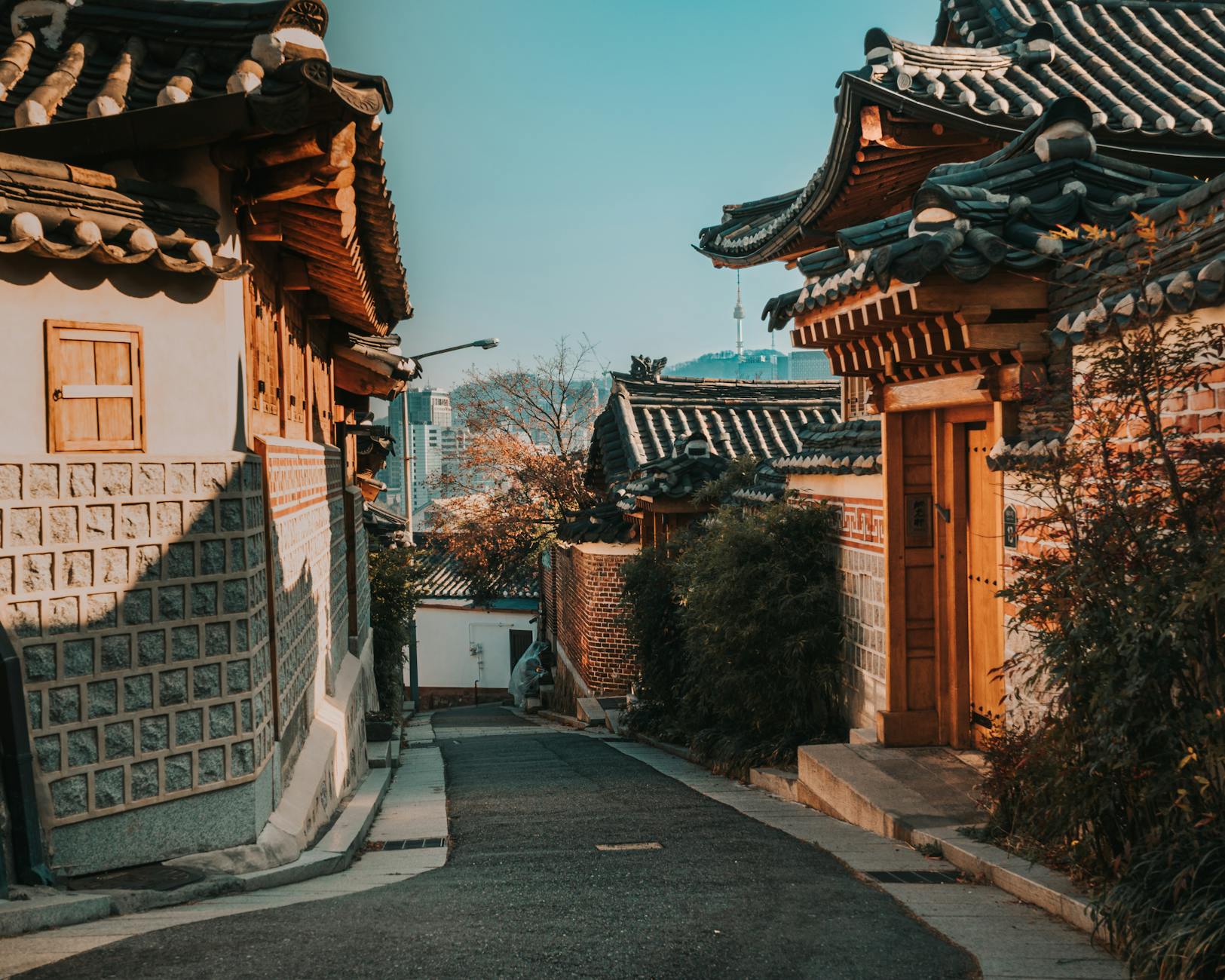
A note on Bukchon: it is a residential neighbourhood, and after years of complaints about noise, parts of the village now limit tourist visits to the daytime, roughly 10:00 to 17:00 in the most crowded lanes, with fines for visiting outside those hours. Keep your voice down, do not photograph through windows or open doors, and see our Bukchon Hanok Village guide before you go.
Insadong and Ikseon-dong
There are fewer shops around Insadong, but it is a convenient base if you are staying nearby or want to combine Changdeokgung with the craft shops of Insadong and the hanok cafes of Ikseon-dong, which make a very photogenic backdrop.
How to choose a shop
Shops open and close, change hands and change names quickly in this business, so rather than trust any list, including ours, use this checklist on the day:
- Look at the actual rack. Photos online show the best outfits. Walk in and look at what is available in your size on the day.
- Check the fabric and the fastenings. Stained skirts, frayed ties and broken ribbons are signs of a shop that does not replace stock.
- Ask what is included. Hair, accessories, bag, shoes and locker, and when the clock starts.
- Check the return time and the overtime charge.
- Read recent reviews, from the last few months, on the booking platforms or map apps.
- Go early on weekends. The best outfits in popular sizes go by late morning on spring and autumn Saturdays.
Booking ahead or walking in
For a weekday outside the peak seasons, just walk in. You will have plenty of choice, and you can compare two or three shops in fifteen minutes. For weekends in April, May, September and October, and for any specific shop or designer outfit, book ahead. Online booking, either through the shop’s own website or through platforms such as Klook and KKday, lets you reserve a slot; compare the final price and the reservation terms with the walk-in price. The trade-off is that you commit to a shop before you have seen its stock. A sensible compromise is to book a well-reviewed mainstream shop for a 09:00 or 10:00 slot, and choose your outfit when you get there.
Men’s hanbok
Men rent hanbok too, and the good news is that men’s outfits are simpler, cheaper to style and usually available at the same price as women’s. A standard men’s hanbok is a jeogori, baji and vest, with a durumagi overcoat in cooler weather. The accessory that transforms it is the gat, the wide-brimmed black hat of the Joseon scholar, which most shops can add. Themed options include scholars’ robes, the red and blue outfits of royal guards and officials, and king’s robes, which are popular for couple photos.
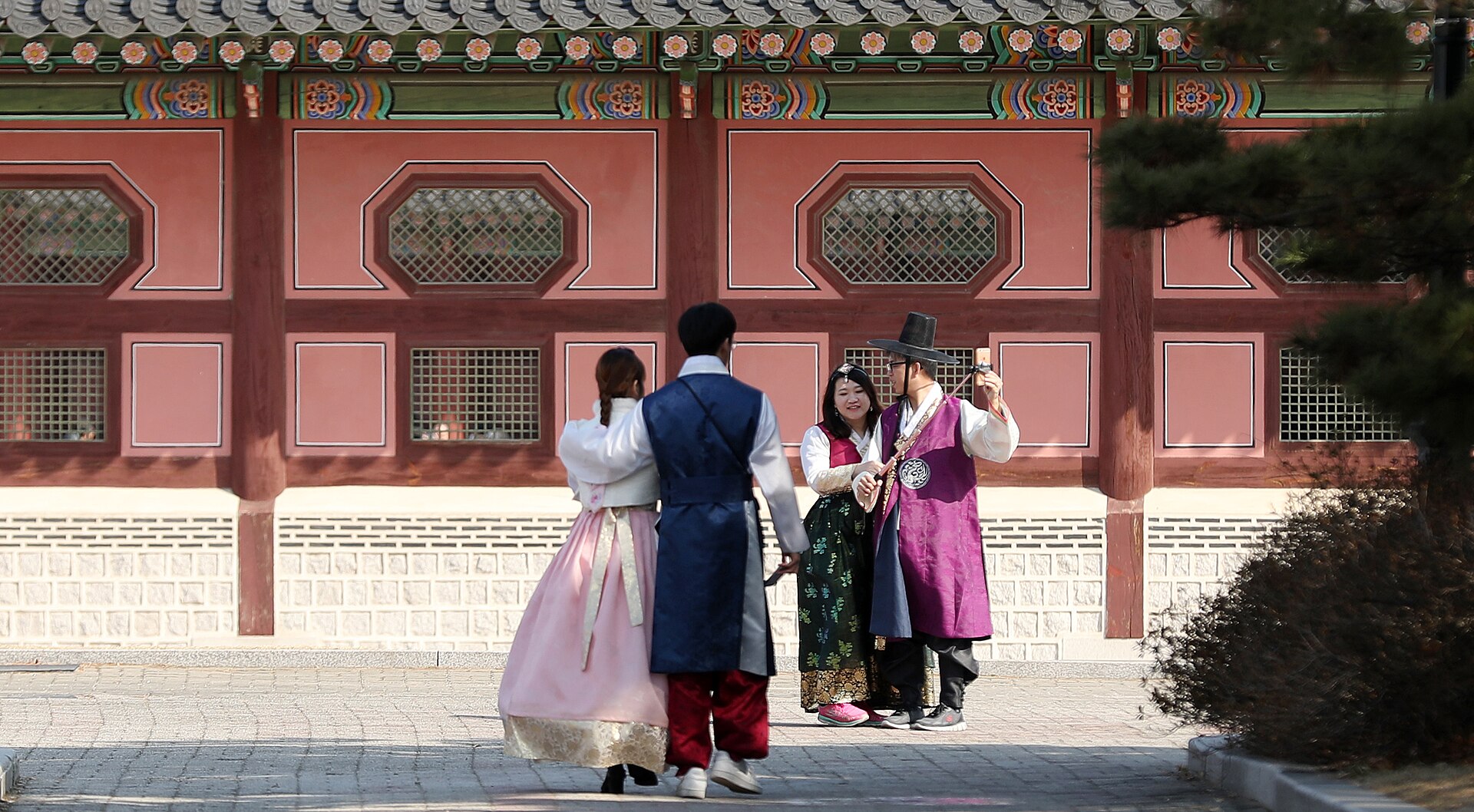
Anyone can wear any style: men in women’s hanbok and women in men’s are a common and cheerful sight on the palace grounds. If you are tall or broad, go to a larger shop, where the range of sizes is better, and try the durumagi, which looks good on almost anyone.
Children’s hanbok
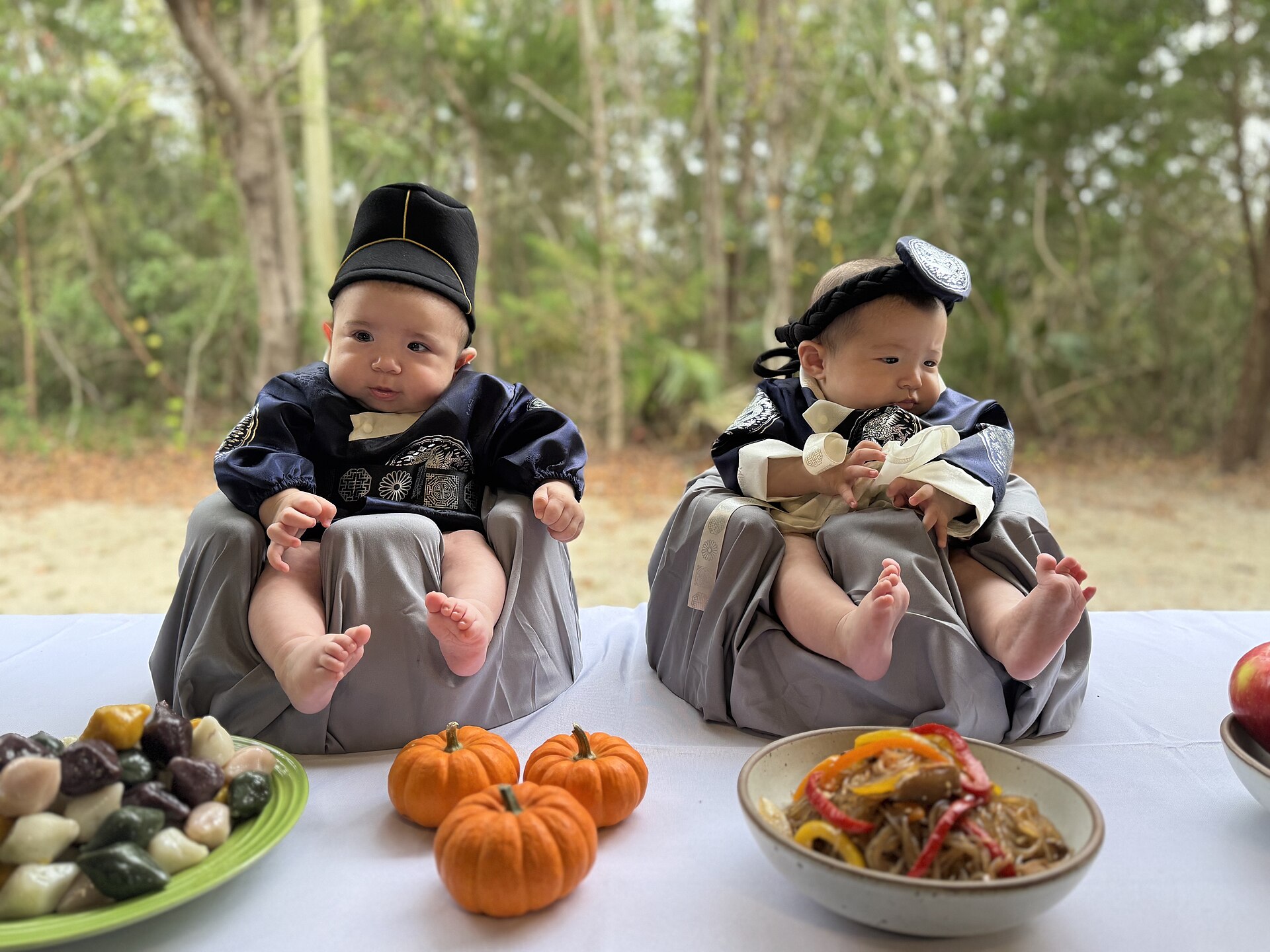
Children’s hanbok costs ₩10,000 to ₩18,000 at most shops and is available from toddler sizes up. Children’s jackets often have saekdong sleeves, bands of rainbow colours that are traditional for children. For younger kids, choose a shorter rental period, ask for a skirt length that clears the ground, and plan the toilet stop before they are dressed, because hanbok and small children in a hurry are not a good combination. Children six and under get into the palaces free whatever they wear, so for them hanbok is purely for the photographs.
Travelling with a buggy? Ask the shop whether it can store it, and see our guides to Seoul with kids and Seoul with toddlers and babies for the practicalities around the palaces.
Hanbok through the seasons
Spring and autumn
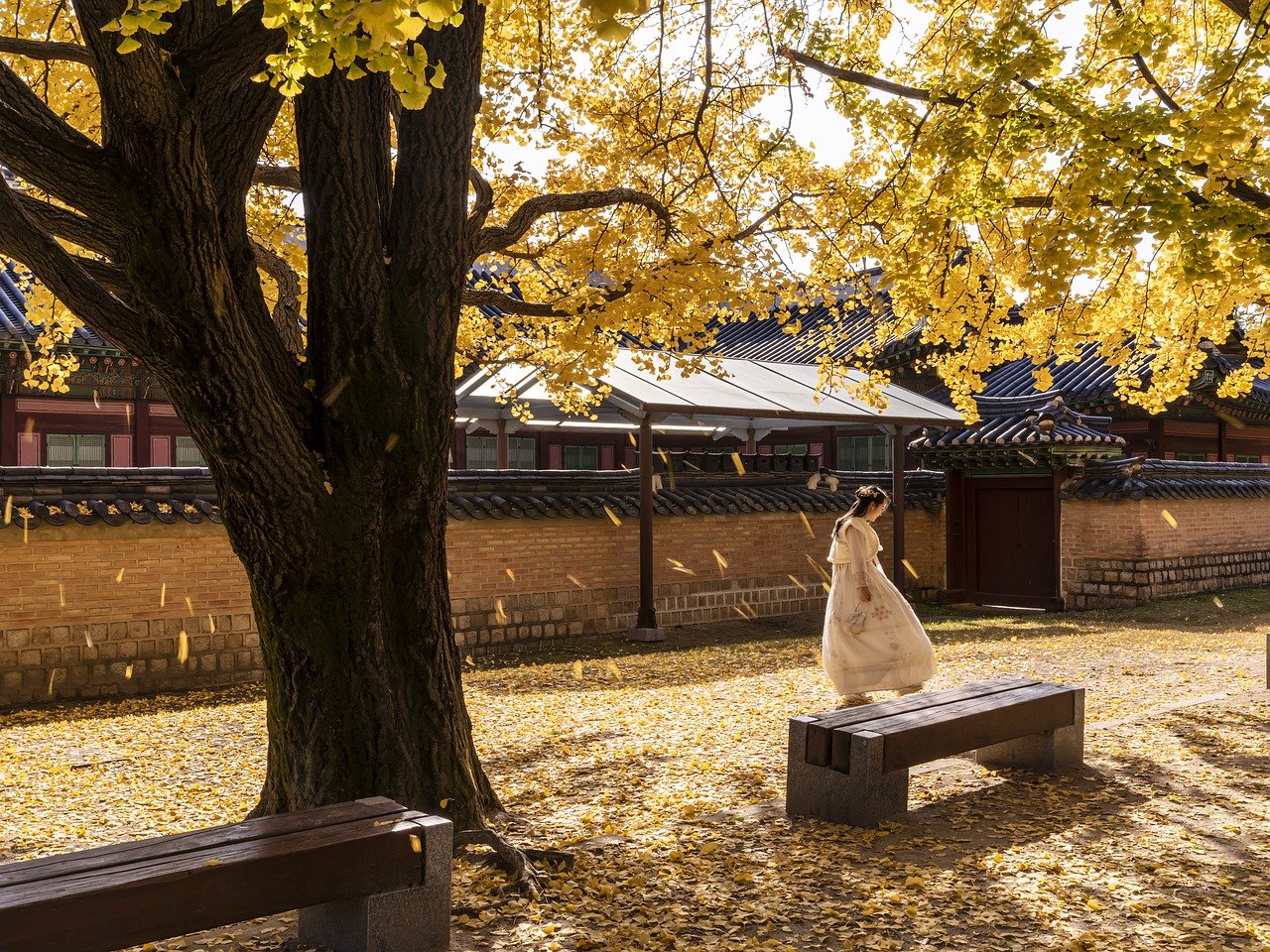
These are the best and busiest seasons. The weather is comfortable for layers, and the palaces are at their most beautiful: blossom in early April, and red maples and gold ginkgoes from late October into November. Our cherry blossom and autumn foliage guides have the timing. Book ahead for weekends.
Summer
Hanbok is warm, with multiple layers and synthetic fabric, and Seoul in July and August is hot and humid. If you are renting in summer, go first thing in the morning or in the last two hours before the palace closes, ask whether the shop has lighter summer fabrics, carry water and a handheld fan, and do not plan a four-hour midday walk. The July monsoon brings sudden downpours, so check the forecast; our Seoul summer guide has more on coping with the heat.
Winter
Winter hanbok works better than you might think, and the palaces are quiet. The wrap skirt leaves plenty of room for thermal leggings and a warm layer underneath, and most shops stock fur-trimmed vests, capes or durumagi overcoats in winter. Wear thermals and warm socks, stick heat packs from any convenience store inside your jacket, bring gloves, and keep the rental short: two or three hours outdoors at minus five is plenty. Photographs of hanbok in snow at Gyeongbokgung are among the most beautiful you can take in Seoul. See our Seoul in winter guide for more.
Hair, make-up and accessories
Hair styling makes more difference to the photographs than the hanbok itself. A braid with a daenggi ribbon or a low bun with a binyeo hairpin costs between nothing and ₩10,000, depending on the shop. Some shops also offer make-up for around ₩10,000 more, and a few do full historical looks for the royal outfits. If the make-up has you curious about Korean beauty products, our K-beauty shopping guide covers where to buy them.
For accessories, a norigae tassel and a small pouch bag are the finishing touches in most photographs. Crowns, veils and floral headpieces come with the premium packages. Keep valuables in the shop’s locker: the pouch bags hold a phone and a card, not much else.
Hanbok photoshoot in Seoul
There are three ways to come home with good pictures.
- Do it yourself. Go early, when the courtyards are quiet, and use a friend with a phone. The best spots at Gyeongbokgung are the pond at Gyeonghoeru, the island pavilion at Hyangwonjeong, the red-columned corridors around the throne-hall courtyard and the gates of the royal residences. Outside the palaces, Bukchon’s lanes and the hanok alleys of Ikseon-dong work well.
- A shop studio shoot. Many rental shops have a small studio and offer a short session with a few edited images as an add-on. It is quick and cheap, but the backdrops are studio sets, not palaces.
- A professional photographer. Freelance photographers work around Gyeongbokgung and can be booked through the major platforms or directly. Expect roughly ₩150,000 to ₩250,000 for about an hour, including a handful of fully retouched images; one well-reviewed operator charges around US$170 a person. Edited photos typically arrive a few days to a couple of weeks later. Book at least a few days ahead in peak seasons, and check whether the price includes the hanbok rental.
For something quicker and sillier, Seoul’s self-photo booths are the other photo ritual of a Seoul trip. Our guide to self-photo studios explains how they work.
Practical tips for the day
- Go to the palace first. Get dressed at opening time, walk straight to the palace, and take your photographs before 11:00, when the crowds build.
- Check the palace’s closing day. Gyeongbokgung closes on Tuesdays; Changdeokgung and Deoksugung close on Mondays. Renting hanbok for a palace that is shut is a classic mistake.
- Mind the skirt on stairs. Lift it at the front with one hand, especially on the steep palace steps.
- Eat carefully, or eat before you change. Tteokbokki sauce and hanbok are not friends, and shops may charge for stains.
- Use the toilet before you are dressed. Then use it again before you head out.
- Carry the rental receipt or return time, and set a phone alarm for thirty minutes before it.
- Rain: shops may lend umbrellas, and a rainy palace can be very atmospheric, but wet skirts drag. Consider rescheduling if it is pouring.
Is hanbok rental worth it? The honest verdict
For most visitors, yes, once. It is cheap, it is fun, it produces the best photographs of the trip, and wearing hanbok changes how you experience the palace: you slow down, you notice the setting, and Korean visitors will often smile, compliment you or ask for a photo. The mistake is to treat it as a money-saver, to rent for too short a time, or to rent on a hot August afternoon or on the palace’s closing day.
It is less worth it if you only have an hour at the palace, if you are visiting in the peak of summer, or if you have small children who will not tolerate being dressed up. In those cases, pay the gate fee (₩3,000 at Gyeongbokgung) and enjoy the palace in your own clothes. For everyone else, give it a morning: hanbok, Gyeongbokgung at opening time, a walk through Bukchon, and lunch in Samcheong-dong. Our Deoksugung guide covers a quieter palace for an evening hanbok walk, since Deoksugung is open until 21:00, although you will need a shop that stays open late enough to take the outfit back.
Frequently asked questions
How much does hanbok rental cost in Seoul?
A standard hanbok costs about ₩15,000 to ₩25,000 for four hours, themed or premium outfits ₩25,000 to ₩45,000, and designer hanbok ₩45,000 to ₩80,000. Children’s hanbok is around ₩10,000 to ₩18,000. Hair styling is free at some shops and ₩5,000 to ₩10,000 at others. If you book online, compare the final price with the walk-in rate.
Do you get free entry to Seoul’s palaces in hanbok?
Yes. Anyone wearing hanbok, foreign visitors included, gets free entry to Gyeongbokgung, Changdeokgung, Changgyeonggung, Deoksugung and Jongmyo Shrine. You need to be wearing a proper hanbok jacket with a skirt or trousers. It does not cover the Secret Garden tour at Changdeokgung.
Where is the best place to rent hanbok in Seoul?
Near the palace you plan to visit. Rental shops gather around Gyeongbokgung Station and around Anguk Station, and there are a few near Insadong. For Gyeongbokgung, rent near Gyeongbokgung Station; for Changdeokgung and Bukchon, rent near Anguk.
Do I need to book hanbok rental in advance?
Only for spring and autumn weekends, holidays, or a specific shop or designer. On weekdays you can walk in and compare shops. Online booking is usually cheaper, but you commit before seeing the stock.
How long should I rent hanbok for?
Four hours is the sweet spot. Shorter rentals disappear quickly once you count dressing, hair, the walk to the palace and queues. Longer rentals are rarely worth it unless you are also doing a professional photoshoot.
What should I wear under hanbok?
A thin T-shirt or vest and leggings or shorts in summer, and thermals in winter. The wrap skirt is forgiving. Wear comfortable shoes: many people keep their own trainers on, since the skirt hides them.
Can men and foreigners wear hanbok?
Yes, and they do. Men’s hanbok is widely available, anyone can wear any style, and Koreans generally see foreign visitors in hanbok as a compliment rather than an intrusion.
Final thoughts
Hanbok rental is one of those Seoul experiences that sounds touristy until you do it, and then turns out to be one of the best mornings of the trip. Keep it simple: a well-reviewed shop near the palace, four hours, hair styling included, and the palace gates at opening time. The free entry is a nice bonus rather than the point. For the palace itself, our Gyeongbokgung guide has the route and the photo spots, and the Seoul palaces guide compares all five.
Photo Credits
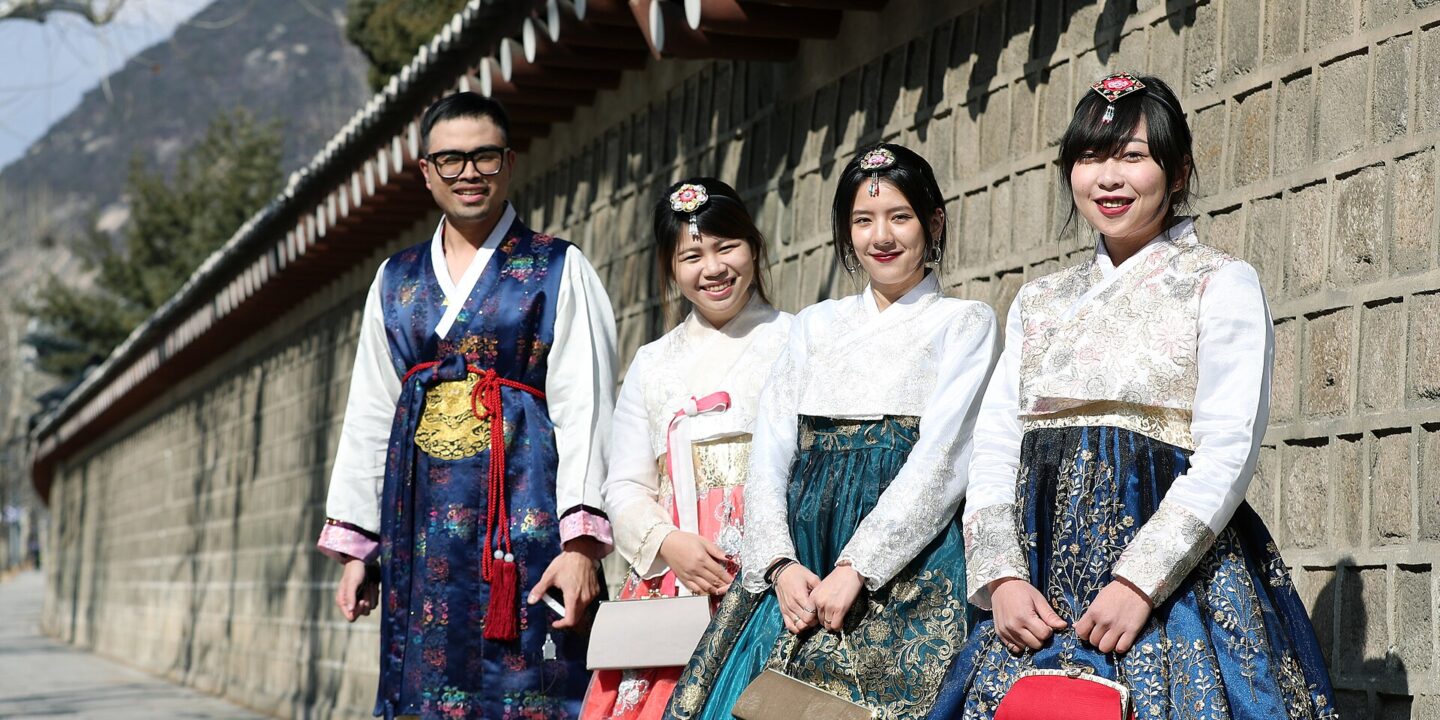
Friends in hanbok along the palace wall: Gyeongbokgung Hanbok 01 by Republic of Korea, CC BY-SA 2.0, via Wikimedia Commons.
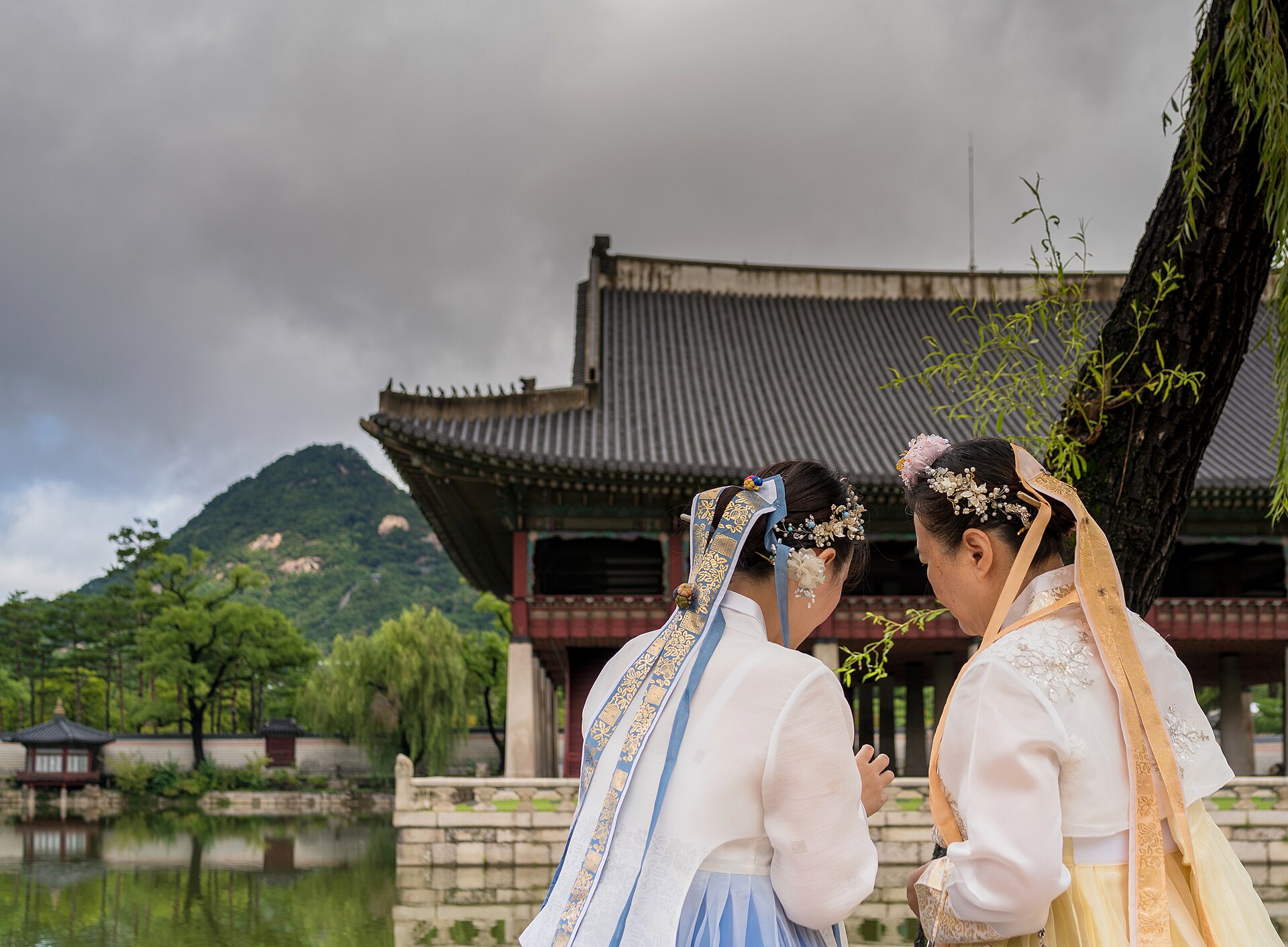
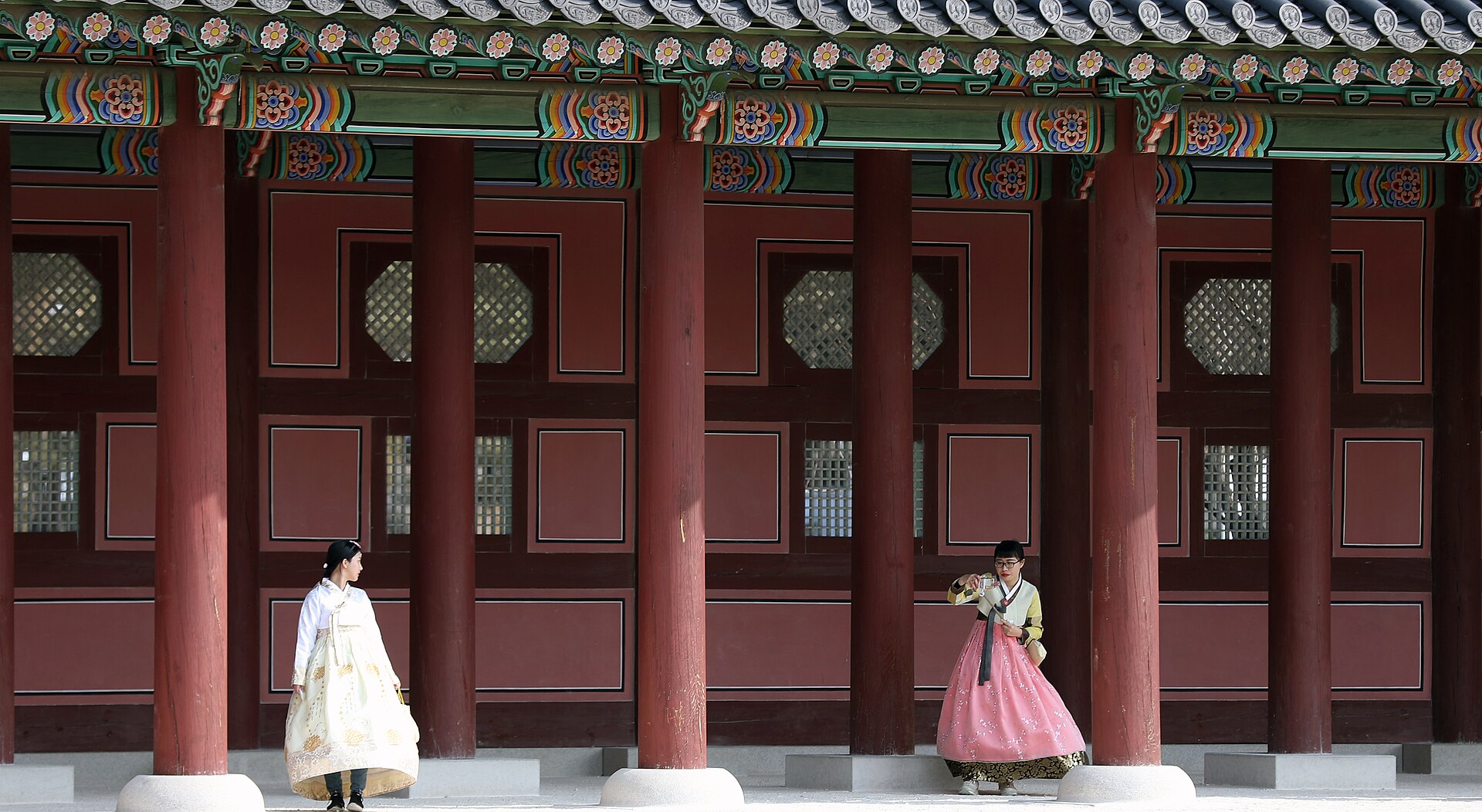
Two women in hanbok between palace columns: Gyeongbokgung Hanbok 04 by Republic of Korea, CC BY-SA 2.0, via Wikimedia Commons.
Couples in hanbok at the palace: Gyeongbokgung Hanbok 03 by Republic of Korea, CC BY-SA 2.0, via Wikimedia Commons.
Women in veiled hanbok at Gyeongbokgung: Female Hanbok From South Korea by IssamBarhoumi, CC BY-SA 4.0, via Wikimedia Commons.
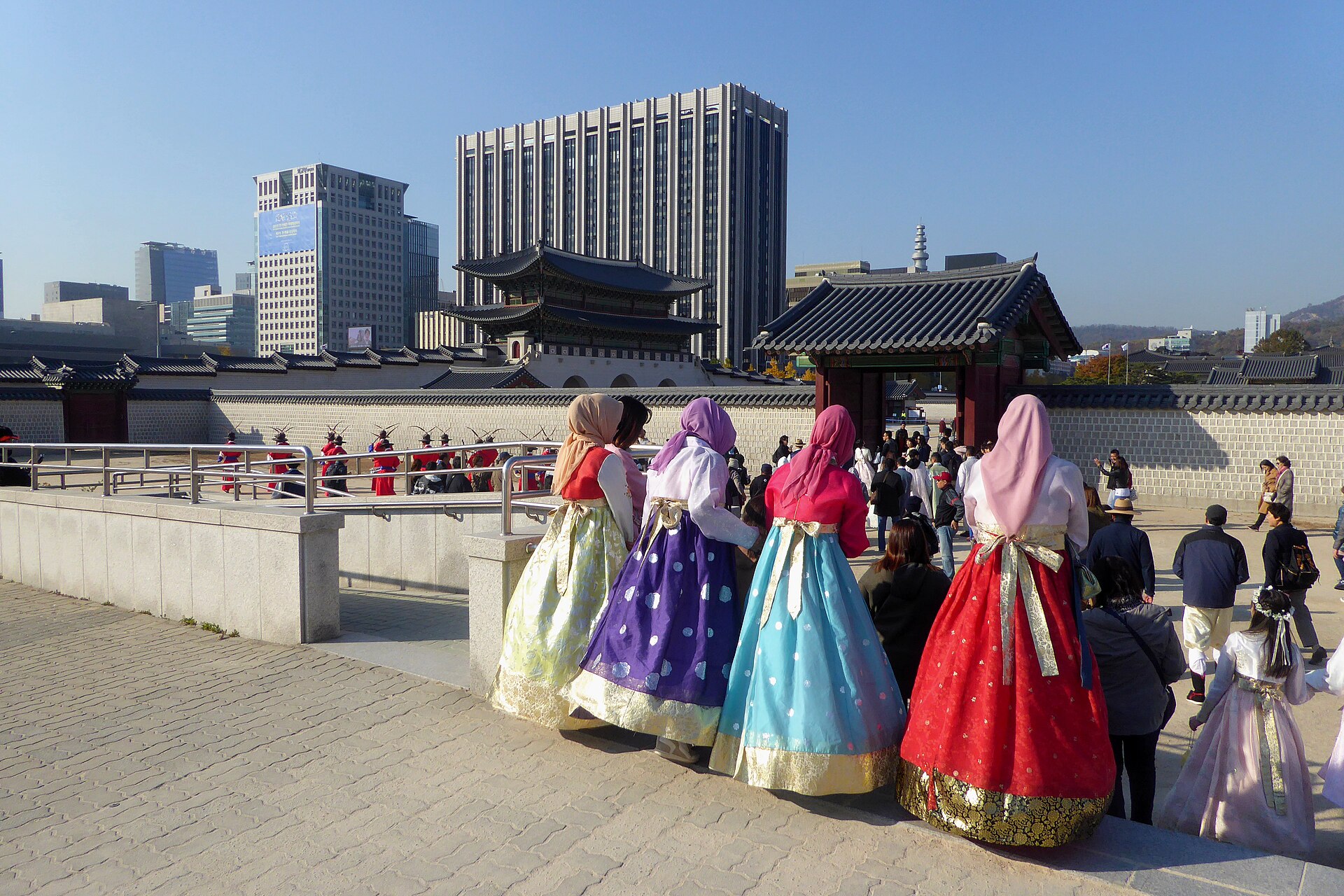
Visitors in hanbok and hijabs: Muslim Women in Hanbok visiting the Gyeongbokgung Palace by Ethan Doyle White, CC BY-SA 4.0, via Wikimedia Commons.
White hanbok under an autumn ginkgo: Woman wearing white, Gyeongbok Palace, Korea, author not listed, CC0, via Wikimedia Commons.
Babies in hanbok at a 100th-day celebration: Baek Il by KellyDoyle, CC BY-SA 4.0, via Wikimedia Commons.