This guide covers tickets and the Monday closure, the late opening hours, the Royal Guard Changing Ceremony at Daehanmun and where to stand for it, a route through the palace, the Western-style Seokjojeon and its separate reservation, what the palace is like after dark, the Deoksugung Stone Wall Road walk through Jeongdong, and the free Jeongdong Observatory view over the whole compound. Prices and times were checked in October 2026; treat them as the right order of magnitude and confirm on the official royal palaces site before a special trip. For how Deoksugung fits alongside the other four palaces, see our Seoul palaces guide.
Deoksugung at a glance
| What | Detail (September 2026) |
|---|---|
| Adult ticket | ₩1,000 |
| Free entry | Foreign visitors aged 18 and under or 65 and over, anyone in hanbok, and everyone on Wednesdays (Culture Day) |
| Integrated palace ticket | ₩6,000, also covers Gyeongbokgung, Changdeokgung, Changgyeonggung and Jongmyo |
| Hours | 09:00–21:00 every day except Monday; last entry 20:00 |
| Closed | Mondays |
| Royal Guard Changing Ceremony | 11:00 and 14:00 at Daehanmun, about 25 minutes, free, not on Mondays |
| Seokjojeon interior | Timed visits by advance reservation only |
| Art museum inside | MMCA Deoksugung, ticketed per exhibition |
| Jeongdong Observatory | Free, 13th floor of the Seosomun building next door; hours vary, so check before going |
| Time needed | About an hour for the palace; two to three hours with the stone wall road and Jeongdong |
| Nearest station | City Hall (Lines 1 and 2): Line 1 Exit 2 for Daehanmun, Line 2 Exit 12 for the Seosomun building |
The short version: time your arrival for one of the three guard ceremonies, give the palace an unhurried hour, walk the stone wall road into Jeongdong, and if you can, come back after dark, when the palace is at its best and the day-trippers have gone.
Why Deoksugung is different
Deoksugung was never meant to be a palace. It began as the house of a prince, and it became a royal residence by accident, when the Japanese invasions of 1592 burned every palace in Seoul. King Seonjo returned to a ruined capital in 1593, made the former residence of Grand Prince Wolsan his temporary palace, and lived there until his death in 1608. His successor named it Gyeongungung, and it spent the next three centuries as a secondary palace, occasionally a place of confinement, while the kings lived at Changdeokgung.
Its moment came at the very end of the dynasty. In 1896, after the murder of his queen at Gyeongbokgung, King Gojong fled to the Russian legation, a few hundred metres up the road. When he emerged a year later, he chose not to go back to the big palaces but to move into Gyeongungung, surrounded by the foreign legations of Jeongdong, where he felt safer. That same year he declared the Korean Empire, styling himself emperor, and set about turning the palace into the seat of a modern state: Western-style buildings went up next to traditional halls, electric light and a telephone arrived, and diplomats came to dinner.
It did not last. A fire destroyed most of the palace in 1904, and in 1907 Japan forced Gojong to abdicate in favour of his son. The palace was renamed Deoksugung, “the palace of virtuous longevity”, and the retired emperor lived here until he died in Hamnyeongjeon hall in January 1919. Rumours that he had been poisoned helped draw mourners to Seoul, and the crowds filled the streets for the March 1st independence protests, which broke out just before his funeral on 3 March. Over the following decades the palace was cut down to a fraction of its former size as land was sold and roads widened, and it opened as a public park in 1933.
That history is what makes the place so interesting to walk around. It is not a reconstruction of a single ideal moment, like much of Gyeongbokgung, but a record of a kingdom trying to modernise in a hurry, and of the moment it ran out of time.
Deoksugung tickets and opening hours
An adult ticket costs ₩1,000, less than a subway fare. There is no advance booking for general entry and no need for one. The usual free categories apply: foreign visitors aged 18 and under or 65 and over, anyone wearing hanbok, and everyone on Culture Day, held every Wednesday (Gyeongbokgung and the Changdeokgung Secret Garden are left out of it, but Deoksugung is included). The ₩6,000 integrated palace ticket also covers Deoksugung, although at ₩1,000 it hardly moves the maths; the pass earns its keep on the two big palaces, as our Gyeongbokgung Palace guide explains.
The palace is open from 09:00 to 21:00, with last entry at 20:00, every day except Monday. Those late hours are the headline. Deoksugung and Changgyeonggung both stay open until nine on every opening day, and Deoksugung sits beside City Hall in central Seoul, which makes it an easy palace to fit into a busy day: before dinner, after a museum, or on the way back from Myeongdong. If a public holiday falls on a Monday, the palace usually opens that day and closes the following day instead.
The Royal Guard Changing Ceremony at Deoksugung
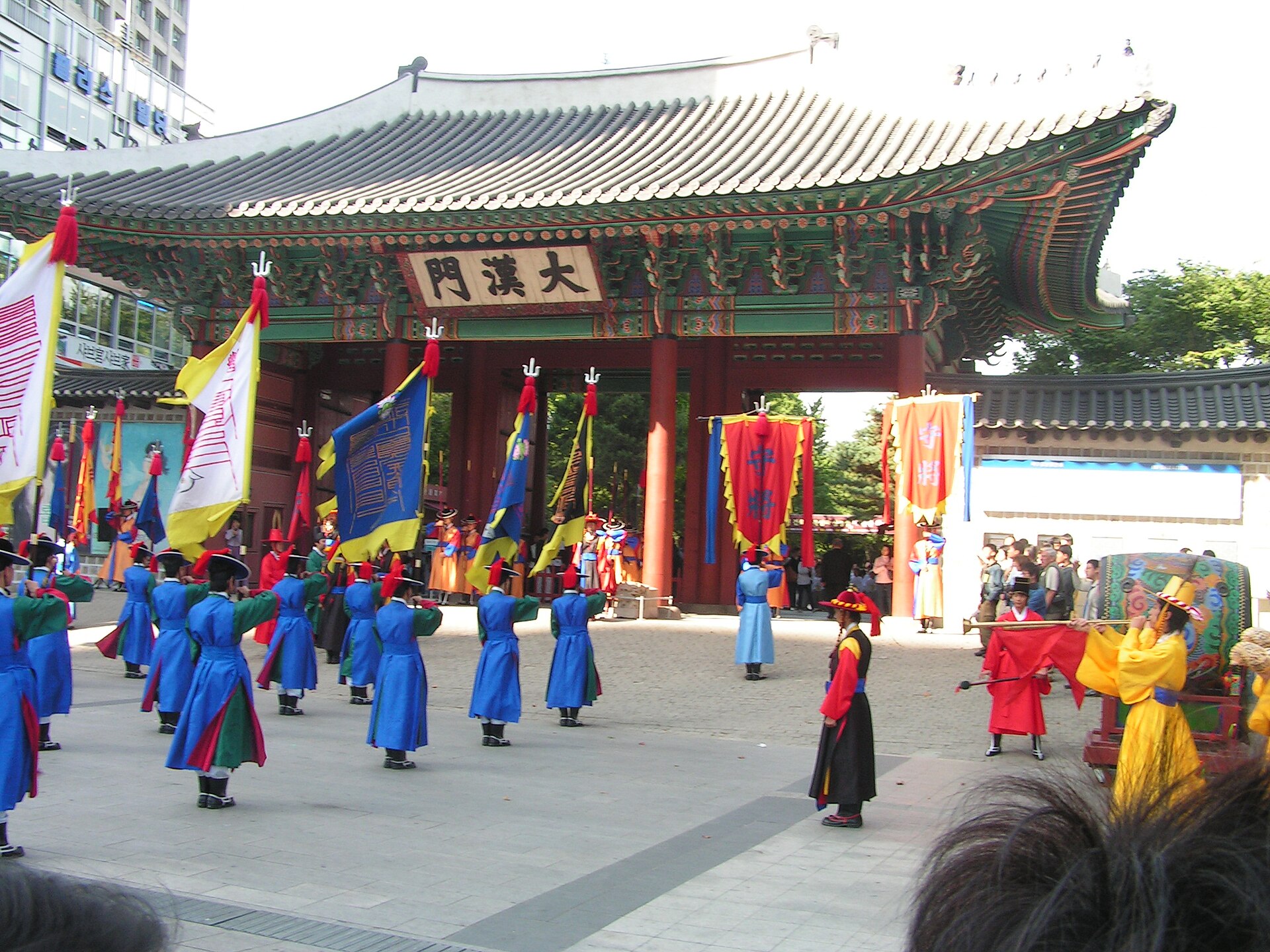
The Royal Guard Changing Ceremony takes place in front of Daehanmun at 11:00 and 14:00, every day except Monday. Each performance lasts about twenty-five minutes, including the procession, and it is free: it happens on the pavement outside the gate, so you do not need a ticket to watch. It is cancelled in bad weather and sometimes on the hottest summer days.
The ceremony re-creates the handover between units of the royal gate guard in the Joseon period. A drum signals the start, the relieving unit arrives with banners, weapons and musicians in bright yellow, the commanders carry out the formal checks and take over the gate, and the outgoing guard marches away. The colours are extraordinary against the glass of the surrounding office towers, and the whole thing is well drilled and easy to follow even if you do not understand a word of the commentary.
Where to stand and when to arrive
The ceremony uses the forecourt in front of Daehanmun, on the edge of Seoul Plaza. The best view is from directly in front of the gate, looking in, so arrive ten minutes early and claim a spot at the rope line. With performances at 11:00 and 14:00, pick whichever suits your day. After each performance the guards often pose for photographs in front of the gate, which is the moment for a picture if you have children with you.
Deoksugung’s ceremony or Gyeongbokgung’s?
Seoul’s two regular changing of the guard ceremonies are similar in spirit but different in feel. Gyeongbokgung’s, in front of Gwanghwamun at 10:00 and 14:00, is larger and set against the grand backdrop of the main palace gate and Bugaksan. Deoksugung’s is more intimate and runs at 11:00 and 14:00, and because it takes place on a downtown pavement by City Hall Station, it is the easiest one in the city to catch by chance. If you are only going to see one, choose by your schedule. Gyeongbokgung normally closes on Tuesdays and Deoksugung on Mondays, so on most Mondays and Tuesdays only one of them is running; when a public or substitute holiday falls on the closing day, that palace opens and closes on the next non-holiday day instead.
A route through the palace
Deoksugung is compact, and an hour is enough to see it properly. This route loops from the main gate through the traditional halls and ends at the Western buildings, which is the order the palace’s history happened in.
1. Daehanmun and Geumcheongyo
The main gate, Daehanmun, faces Seoul Plaza. It began as the palace’s eastern gate, Daeanmun, and became the official main gate in 1900; after the 1904 fire it was rebuilt and renamed Daehanmun in 1906, and it was moved back in 1914 and again in 1970 as the road in front was widened. Once through it, you cross a small stone bridge, Geumcheongyo, over a channel that marked the boundary of the royal domain, as at every Joseon palace.
2. Junghwajeon, the throne hall
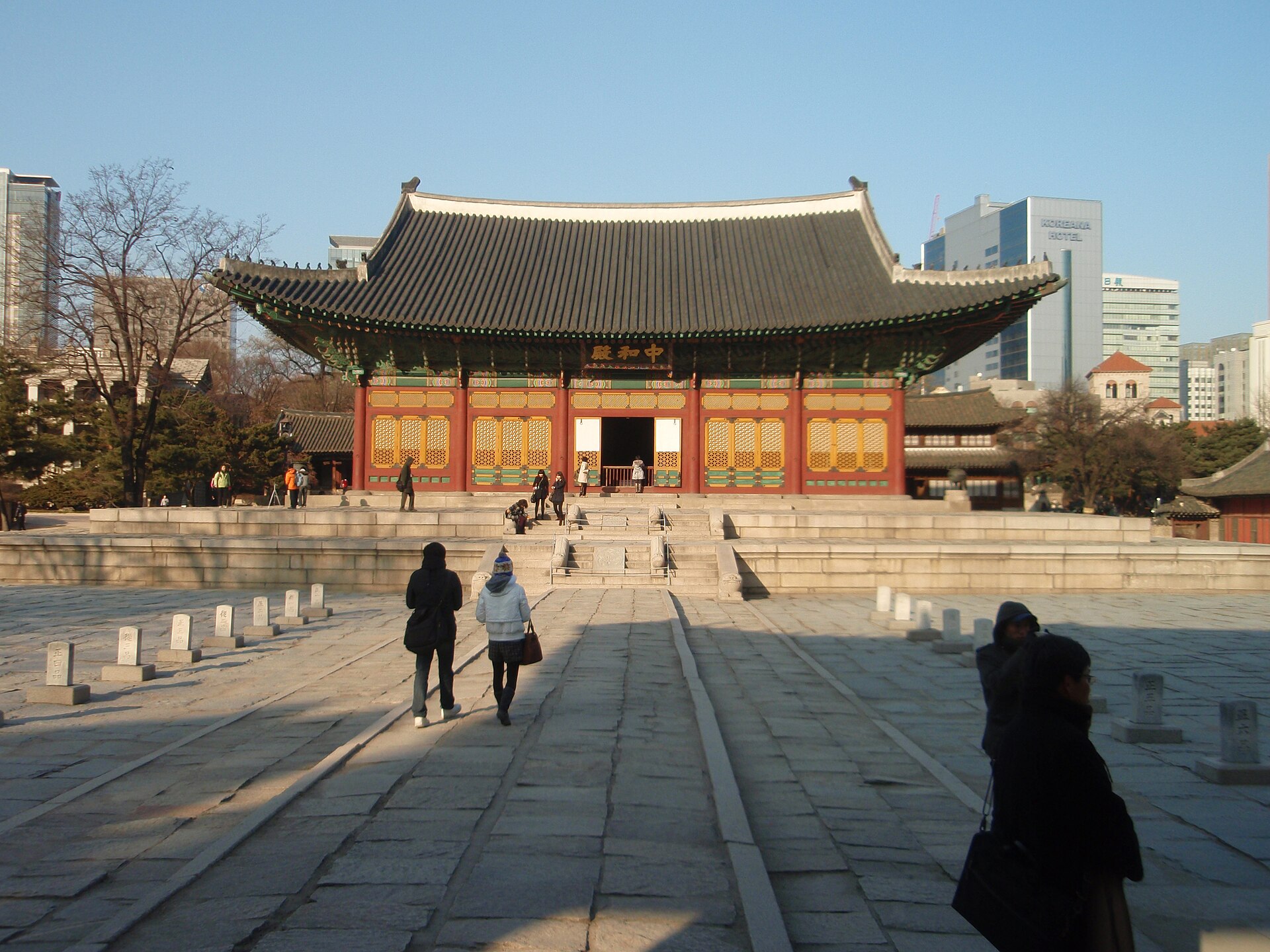
Through Junghwamun, the inner gate, is the throne hall, Junghwajeon, where the emperor held state ceremonies. It was originally a two-storey hall, but it was rebuilt as a single storey after the fire of 1904. The courtyard is where you get the palace’s signature view: tiled roofs and painted eaves in the foreground, high-rise offices directly behind.
3. Seogeodang, Jeukjodang and Junmyeongdang
North of the throne hall, the older residential buildings cluster together. Seogeodang, a two-storey wooden building left unpainted, is named for the fact that a king once lived there: it marks the place where Seonjo stayed after the war. Beside it, Jeukjodang is where two kings, Gwanghaegun and Injo, came to the throne. Junmyeongdang, linked to it by a corridor, is said to have housed a kindergarten for Gojong’s youngest daughter, Princess Deokhye, in the 1910s. These are quiet, human-scale buildings, and most visitors walk straight past them.
4. Deokhongjeon and Hamnyeongjeon
Further on, Deokhongjeon stands on the west side of Hamnyeongjeon, where an earlier hall, Gyeongsojeon, once stood. Next to it, Hamnyeongjeon was Gojong’s bedchamber, and the room where he died in 1919. For all its modest size, it is one of the most poignant buildings in Seoul.
5. Jeonggwanheon
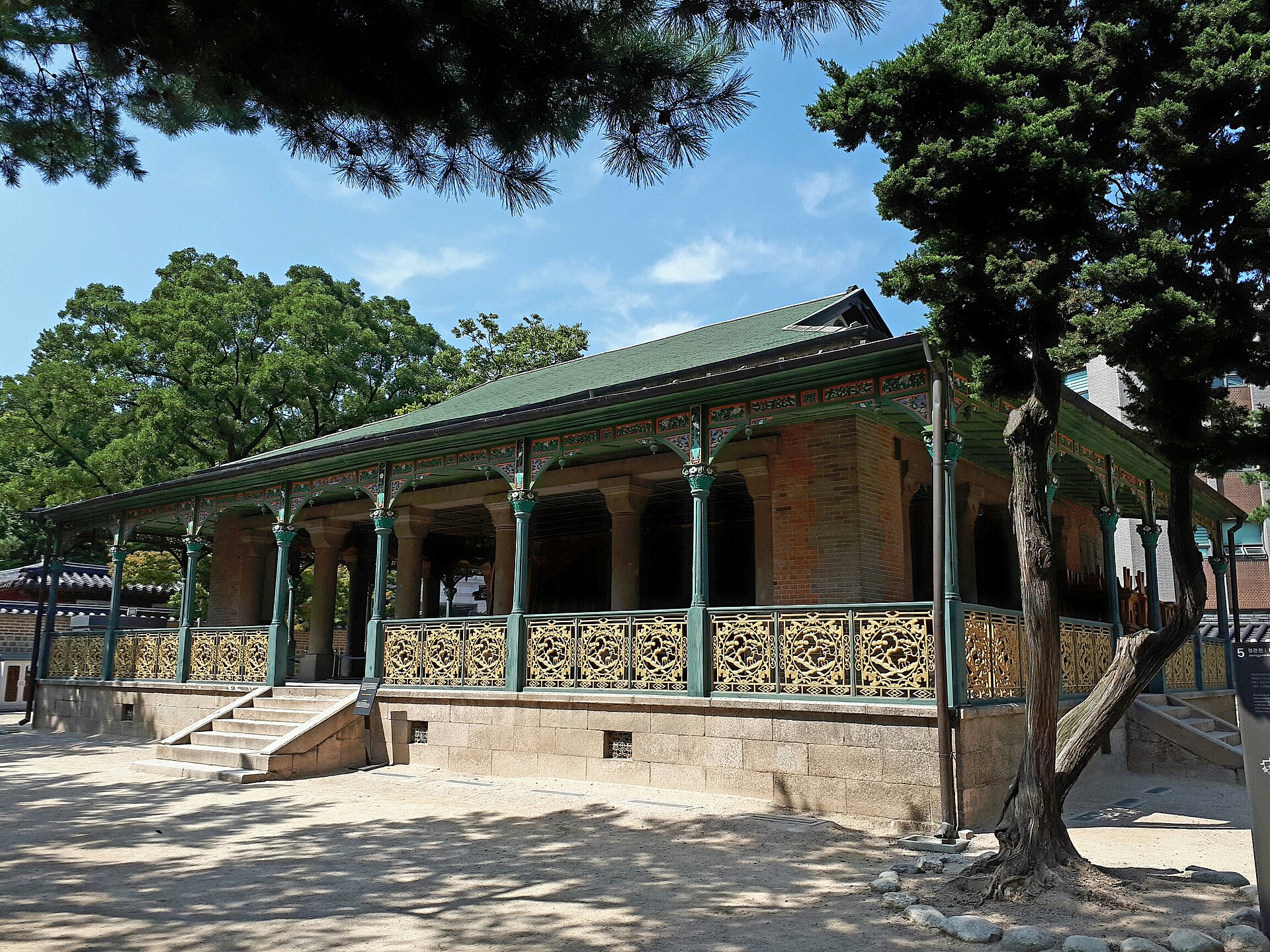
On the slope behind Hamnyeongjeon sits Jeonggwanheon, a pavilion built in 1900 to a design usually attributed to the Russian architect Afanasy Seredin-Sabatin. It is a hybrid of East and West: a veranda of slender columns and cast-iron railings, decorated with Korean motifs such as bats, deer and pine trees. Gojong used it for receptions and to relax, and legend has it that he drank coffee here, which is why Korean coffee culture likes to claim the building as its birthplace. It is a lovely spot to sit, and one of the best places in the palace at night, when it is lit from below.
6. Seokjojeon and the fountain garden
Finally, on the western side of the grounds, the palace turns European. Seokjojeon, the “stone hall”, is a neoclassical building of granite with Ionic columns, designed by a British architect and completed in 1910, just in time for the end of the empire it was built to house. In front of it, a formal garden with a fountain was laid out in the 1930s. The west wing, added in 1938, now holds the Deoksugung branch of the National Museum of Modern and Contemporary Art. The contrast between these buildings and the Joseon halls a few steps away is the whole point of Deoksugung.
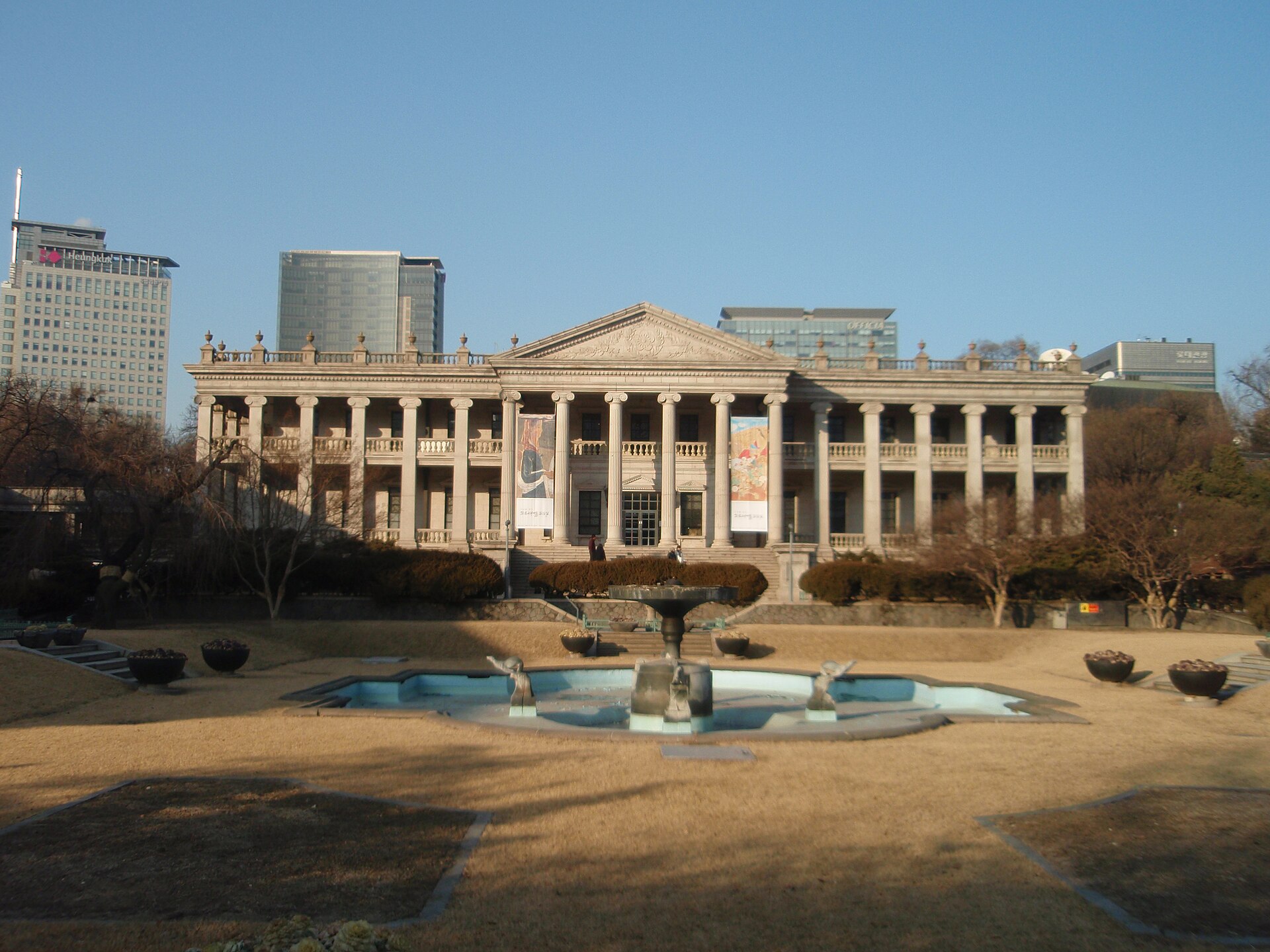
Seokjojeon and the Daehan Empire History Museum
The interior of Seokjojeon has been restored to show how the Korean Empire’s court lived and received its guests: reception rooms, a dining room and private apartments, furnished in the European style of the 1900s. It operates as the Daehan Empire History Museum, and it is the one part of Deoksugung that needs planning. Visits are by advance reservation only, on timed entries with limited places, through the official royal palaces booking site. Weekend slots go early, so book a few days ahead if you have a particular day in mind. You still need a palace ticket to reach the building, and the exterior and the fountain garden are open to everyone without a booking.
Is it worth the effort? If the story of Korea’s last emperor has caught your interest, yes. It is a small, well-presented museum, and the rooms explain the palace better than any signboard. If you are simply passing through, the facade and the garden are the main event, and you will not miss much by skipping the interior.
The MMCA Deoksugung, in the west wing, runs changing exhibitions of modern Korean art, usually from the early twentieth century onward. Tickets are priced per exhibition, so check what is showing on the MMCA website. It is the one art museum in Seoul you can combine with a palace visit in a single ticket queue, and a very pleasant hour if the current show appeals. Our guide to Seoul’s museums and galleries covers the MMCA’s other branches.
Deoksugung at night
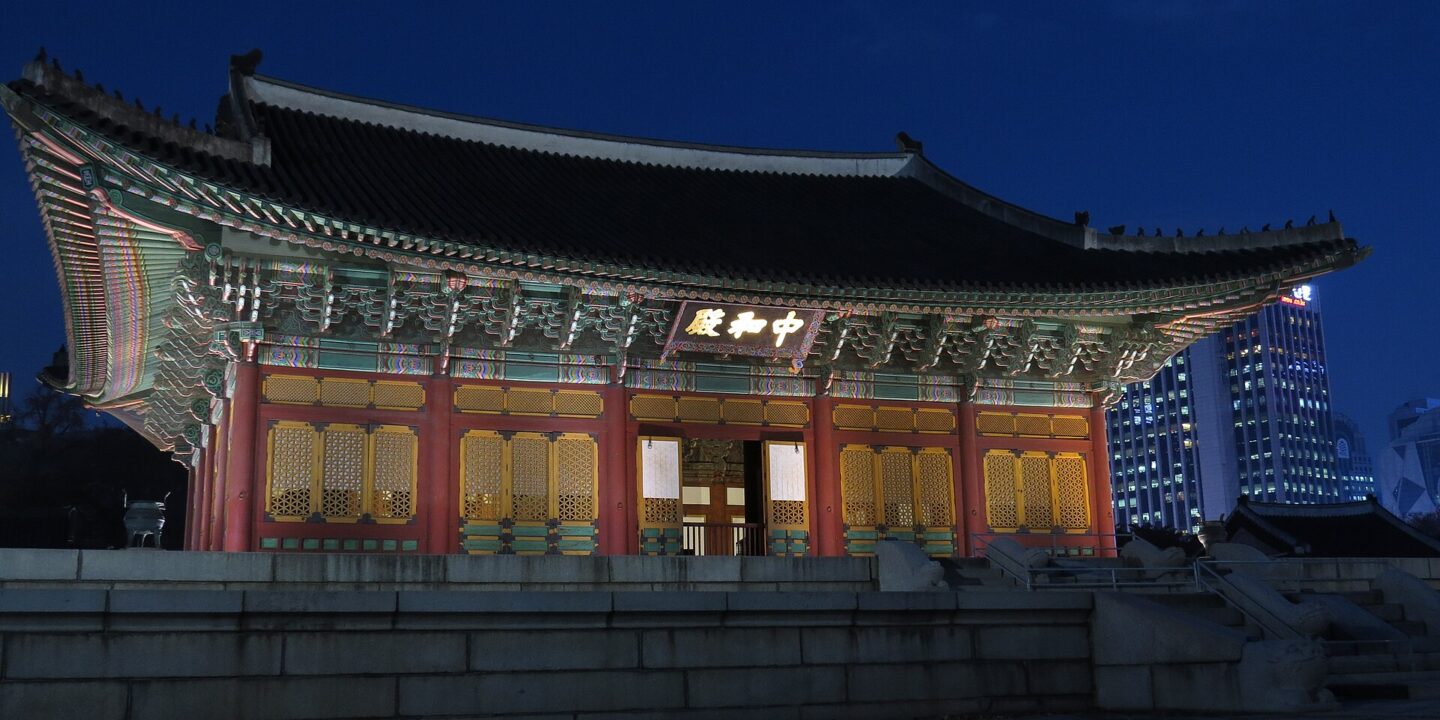
This is where Deoksugung beats every other palace. Last entry is at 20:00 and the gates close at 21:00, so you can walk the grounds after dark, with the office towers around the walls lit up behind the roofs, which gives the palace a kind of stage-set quality that is very different from its daytime self. You do not need a special ticket, a lottery or a reservation: the same ₩1,000 ticket buys an evening visit every night of the week except Monday.
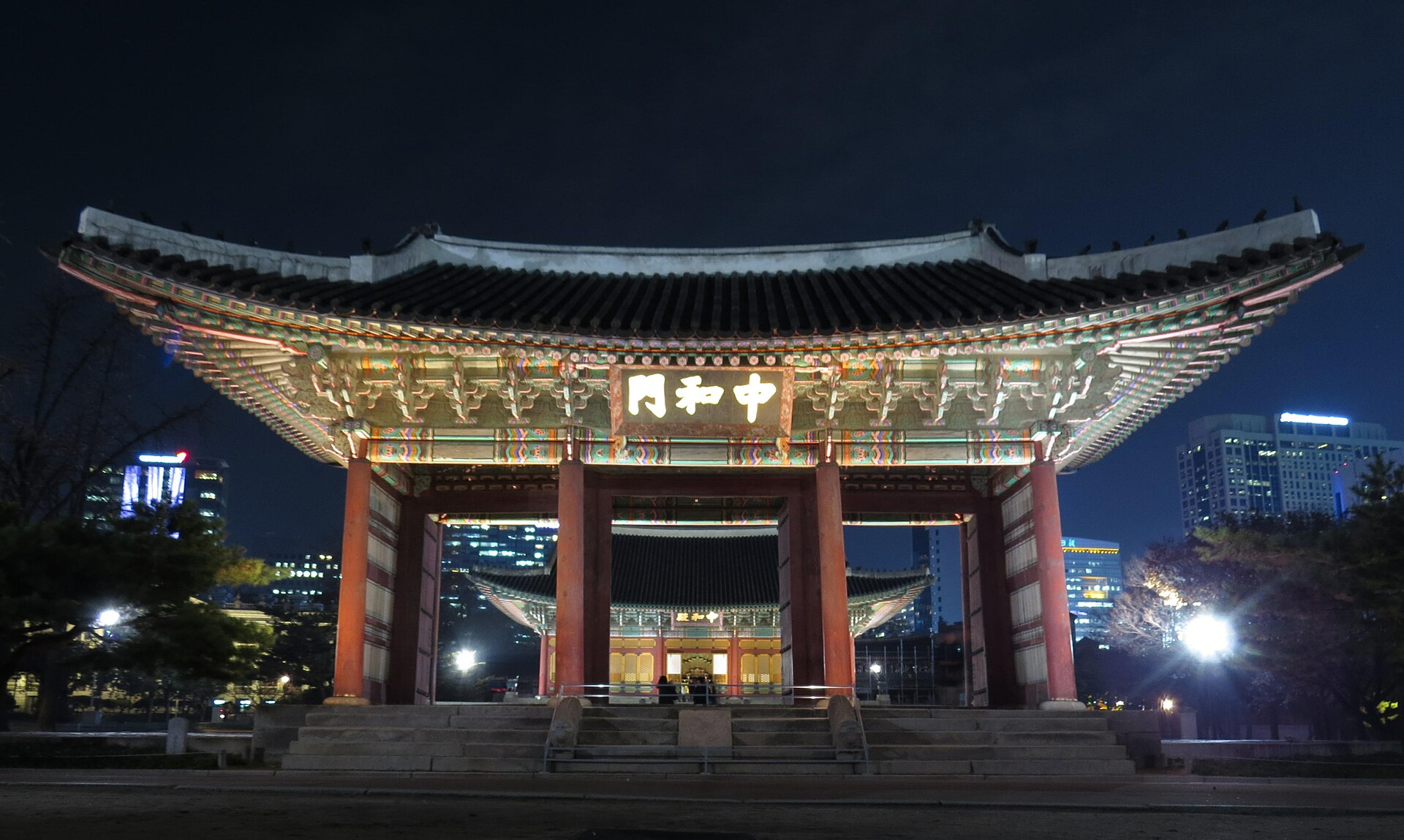
A good evening plan: arrive around sunset, walk the palace as the lights come on, sit for a while at Jeonggwanheon, then leave by Daehanmun and walk the stone wall road into Jeongdong for dinner. It works especially well as a date, and our Seoul itinerary for couples builds an evening around it. For the other palace night openings, which need tickets or lotteries, see the Gyeongbokgung guide and our Changdeokgung and Secret Garden guide.
The Deoksugung Stone Wall Road walk
Deoksugung-gil, the Deoksugung Stone Wall Road, runs from Daehanmun along the palace’s southern wall, beneath an avenue of ginkgo and plane trees, and into the neighbourhood of Jeongdong. It is one of the most loved walks in Seoul, especially in late October and November, when the ginkgoes turn a brilliant yellow and the pavement disappears under their leaves. Our autumn foliage guide puts it among the best city-centre walks for colour.
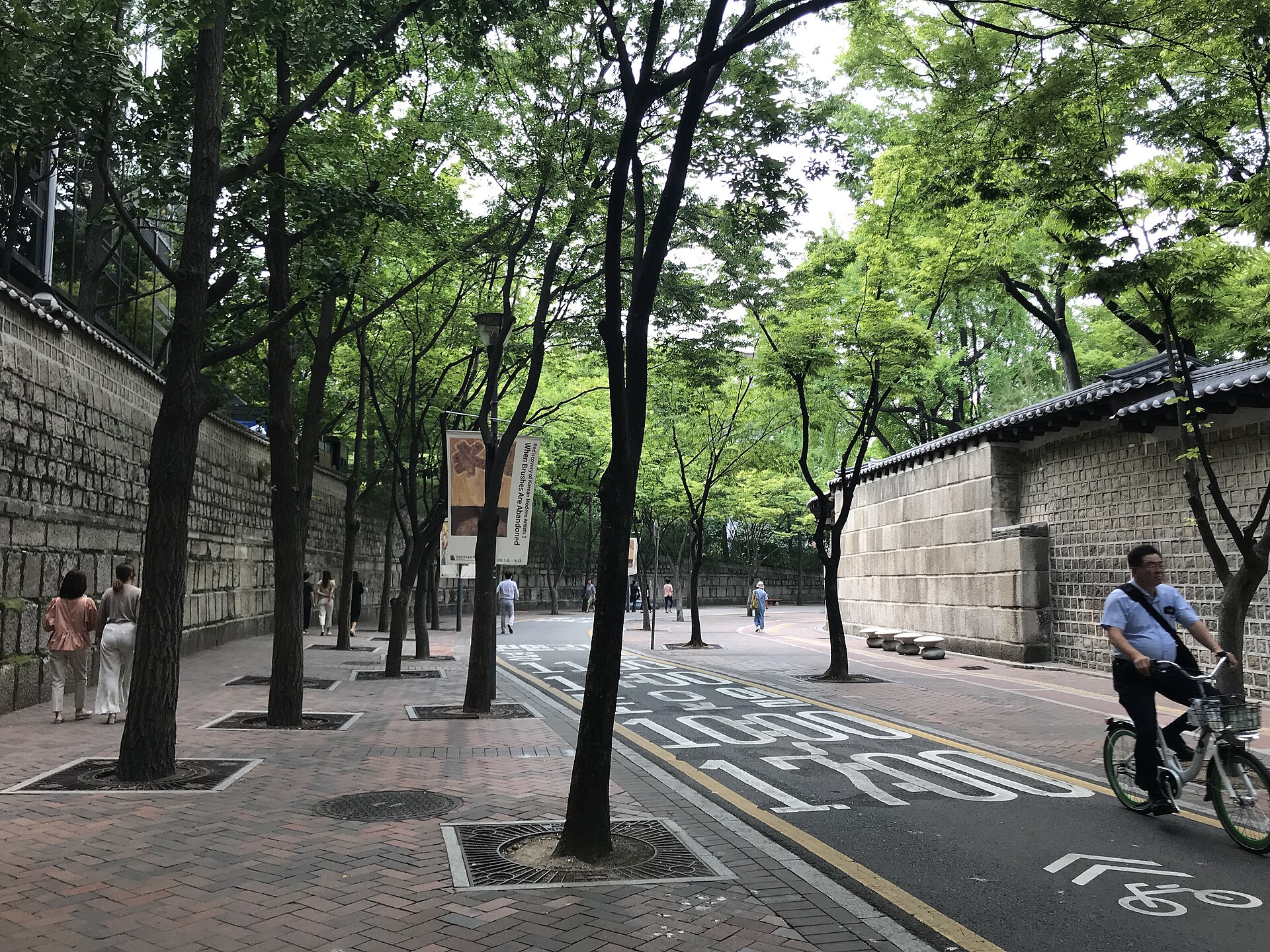
Seoul has a long-standing superstition that couples who walk this road together will break up. The usual explanation is that the Supreme Court, which also housed the Family Court where divorces were settled, stood on this road until 1995. Plenty of couples walk it anyway.
For decades, the road stopped short. A stretch running behind the British Embassy was closed to the public from the 1950s, and part of it was only reopened in 2017, which means you can now walk much further around the palace walls than earlier visitors could.
What to see in Jeongdong
At the end of the wall, the road bends into Jeongdong-gil, the old diplomatic quarter. In the 1880s and 1890s this was where the Western legations, missionaries and the first modern schools settled, and it still keeps red-brick buildings from Korea’s modern era and the sites of the former foreign legations. A slow circuit of twenty to forty minutes takes in:
- Jeongdong First Methodist Church, a red-brick Gothic chapel completed in 1897, which the Seoul city tourist guide describes as Korea’s first Protestant chapel.
- Pai Chai Hakdang, founded in 1885 as the country’s first modern school, whose old school hall now houses a small museum.
- Ewha Girls’ High School, on the site of the first modern school for women.
- Jungmyeongjeon, the imperial library, a small brick building just outside the palace walls where the 1905 treaty that made Korea a Japanese protectorate was forced through. It is now a free exhibition hall.
- The old Russian Legation, of which only the white tower survives, on the hill where Gojong took refuge in 1896.
- The Seoul Museum of Art, behind the preserved facade of the old Supreme Court, with exhibitions that are usually free.
- Jeongdong Theater, a venue for traditional Korean performance, if you want an evening show.
In recent years, the neighbourhood has also held a Jeongdong Culture Night weekend in spring and autumn, when the historic buildings open late and the street fills with stalls and performances. If your dates line up, it is worth going. Check the Jung-gu district’s announcements for the current year.
Jeongdong Observatory: the free view over the palace
The best view of Deoksugung is from above, and it costs nothing. The Jeongdong Observatory is on the 13th floor of the Seosomun Office of Seoul City Hall, a plain government building at 15 Deoksugung-gil, just along the stone wall road from Daehanmun. Take the dedicated lift from the lobby, and you come out in a small room, with a cafe, whose windows look straight down on the palace: Junghwajeon’s roof, the courtyards, Seokjojeon and its fountain garden, and beyond them the towers of downtown and the ridge of Bugaksan.
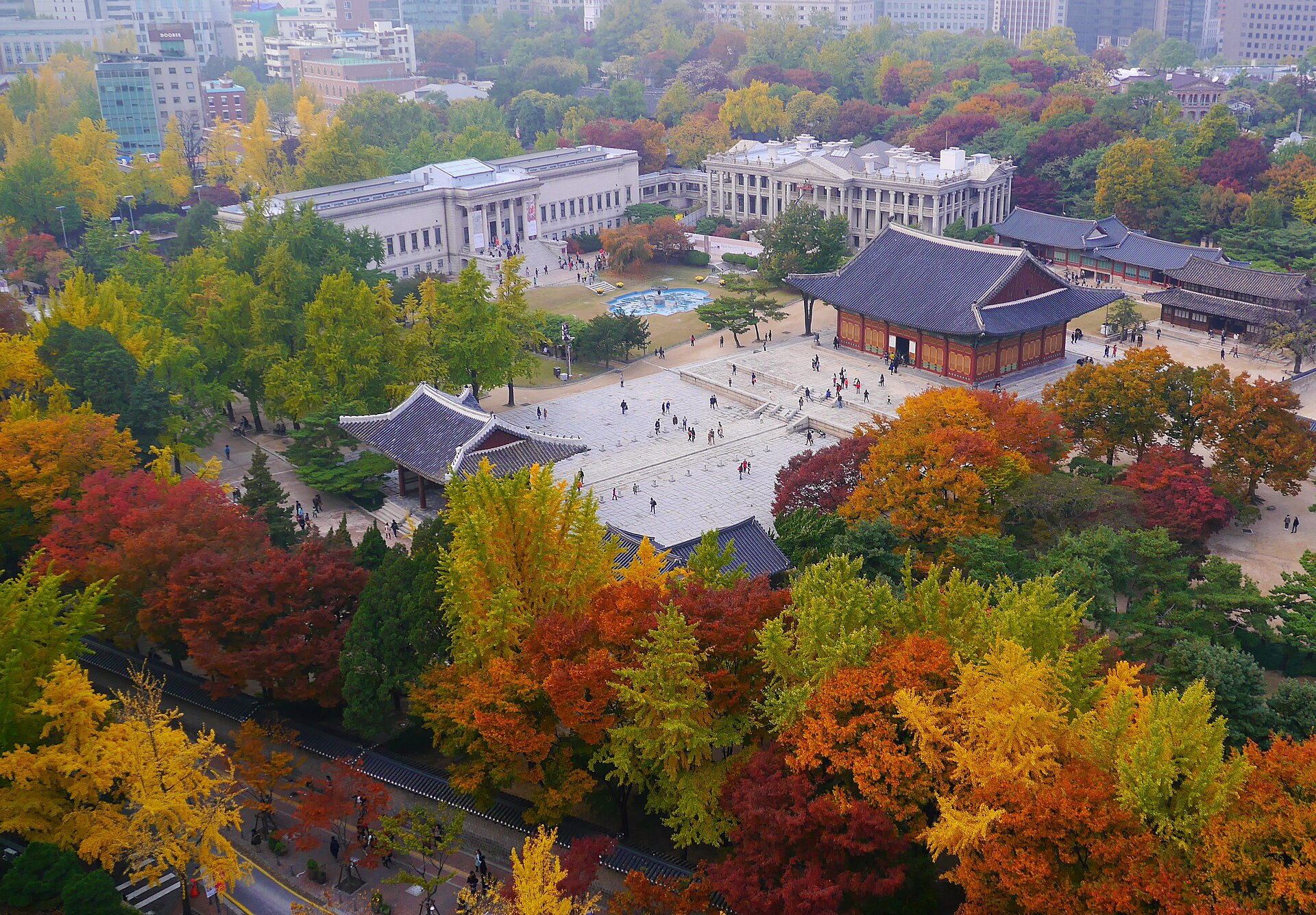
Opening hours are the catch. The observatory opens 13:30–17:30 on weekdays and 09:00–17:30 at weekends, with evening opening until 22:00 on Fridays and Saturdays (21:00 in winter). It closes on public and substitute holidays, and last entry is ten minutes before closing. Check the Seoul city website before you make a special trip, and if it is closed, the palace itself is a fine consolation. From City Hall Station, Line 2 Exits 11 and 12 serve the building.
How long to spend, and three ways to do it
- The lunchtime hour. Catch the 11:00 ceremony, walk the palace loop, and eat in the office district around City Hall. About ninety minutes in all.
- The afternoon circuit. The 14:00 ceremony, the palace, Seokjojeon on a booked slot, the stone wall road and a loop of Jeongdong, finishing at the observatory if it is open. Allow three hours.
- The evening visit. Arrive at dusk, see the palace lit up, and walk the stone wall road to dinner in Jeongdong or Gwanghwamun. Allow two hours, and remember last entry is 20:00.
Getting there and what is nearby
City Hall Station, on Lines 1 and 2, is right outside. Line 1 Exit 2 comes up beside Daehanmun, and Line 2 Exit 12 is best for the Seosomun building and the observatory. Subway fares start at ₩1,550 with a T-money card and rise on longer journeys; see our Seoul subway guide for the rest.
Deoksugung sits at a crossroads of the old city, so it combines naturally with its neighbours:
- Seoul Plaza, across the road, hosts events and festivals through the year and, in most winters, an outdoor ice rink. Our Seoul in winter guide has the seasonal details.
- Gwanghwamun and Gyeongbokgung are twenty minutes’ walk north along Sejong-daero, past the statues of King Sejong and Admiral Yi. The whole area is covered in our Jongno district guide.
- Myeongdong is about fifteen minutes east, for street food and shopping; see the Myeongdong guide.
- Namdaemun Market is ten to fifteen minutes south, past the great gate itself. Our Namdaemun Market guide explains where to eat there, and remember most of it closes on Sundays.
- Gyeonghuigung, the free and very quiet fifth palace, is fifteen minutes west along Saemunan-ro, next to the Seoul Museum of History.
Is Deoksugung worth it? The honest verdict
Yes, and it is the easiest yes on the palace circuit. At ₩1,000, open until nine every night except Monday, a few steps from a subway station and with a guard ceremony at 11:00 and 14:00, it asks almost nothing of you. It also tells a fascinating story about the collision between the old Korea and the modern world, and you can see that collision in the buildings themselves: Korean halls and Western stone buildings that the Korean Empire raised as symbols of modernisation.
What it is not is grand. It is small, you can see it in under an hour, and the office towers around it mean it never feels like an escape from the city the way Changdeokgung’s Secret Garden does. If you have one morning for palaces and have never seen one, go to Gyeongbokgung first. But on almost any trip to Seoul there is an evening when Deoksugung fits, and it is the palace most visitors are gladdest they did not skip. The free Jeongdong Observatory is a bonus, as long as you check its hours.
Frequently asked questions
How much is Deoksugung Palace?
An adult ticket costs ₩1,000. Entry is free for foreign visitors aged 18 and under or 65 and over, for anyone wearing hanbok, and for everyone on Wednesdays, which are Culture Day. The Seokjojeon interior needs a separate advance reservation, and the MMCA art museum inside charges per exhibition.
What time is the changing of the guard at Deoksugung?
11:00 and 14:00, in front of Daehanmun, every day except Monday. Each performance lasts about 25 minutes and is free to watch from the pavement. It is cancelled in bad weather.
Is Deoksugung open at night?
Yes. The palace is open until 21:00 every day except Monday, with last entry at 20:00. No special ticket or reservation is needed, which makes it the easiest palace in Seoul to see at night.
What day is Deoksugung closed?
Monday. The guard ceremony does not run on Mondays either. If a public holiday falls on a Monday, the palace usually opens and closes the next day instead.
Do I need to book Seokjojeon?
Yes, to go inside. The Daehan Empire History Museum in Seokjojeon can only be visited on a timed entry reserved in advance through the royal palaces booking site. You can see the building’s exterior and the fountain garden without a booking.
Is the Jeongdong Observatory free?
Yes. It is on the 13th floor of the Seosomun Office of Seoul City Hall, beside the stone wall road, and has a small cafe. It opens weekday afternoons from 13:30 and weekends from 09:00, closing at 17:30 except on Friday and Saturday evenings, when it stays open until 22:00 (21:00 in winter); it is shut on public holidays.
How long do you need at Deoksugung?
An hour covers the palace itself. Add half an hour for the guard ceremony, an hour for Seokjojeon or the MMCA, and an hour for the stone wall road and Jeongdong if you want the full circuit.
Final thoughts
Deoksugung is the palace that fits around your trip rather than demanding a morning of its own. Catch a guard ceremony if you can, walk the loop from Junghwajeon to Seokjojeon, and then give the stone wall road the slow walk it deserves, ideally in autumn and ideally at dusk. If you only have time for one more palace after Gyeongbokgung, this is the easiest one to say yes to. The rest of the circuit is in our guide to Seoul’s palaces.
Photo Credits
Junghwajeon at night: Deoksu Palace at night, Seoul by Rtflakfizer, CC BY-SA 4.0, via Wikimedia Commons.
Changing ceremony at Daehanmun: Deoksugungchangingofguard1 by Arthur Chapman from Australia, CC BY 2.0, via Wikimedia Commons.
Junghwajeon throne hall: Chunghwajeon Deoksugung ROK by 元諜報員, CC BY-SA 3.0, via Wikimedia Commons.
Jeonggwanheon pavilion: Deoksugung-jeonggwanheon by Kimhs5400 (블루시티), CC BY-SA 4.0, via Wikimedia Commons.
Seokjojeon at Deoksugung Palace: Seokjojeon Deoksugung ROK by 元諜報員, CC BY-SA 3.0, via Wikimedia Commons.
Junghwamun and Junghwajeon at night: Deoksu Palace at night, Seoul.2 by Rtflakfizer, CC BY-SA 4.0, via Wikimedia Commons.
Jeongdong-gil along the palace wall: Jeongdong-gil, one of the most popular pedestrian alleys in Seoul by Joongwon Lee – SKKU DOA, CC BY-SA 4.0, via Wikimedia Commons.
Deoksugung from above in autumn: Deoksugung-02 by travel oriented, CC BY-SA 2.0, via Wikimedia Commons.