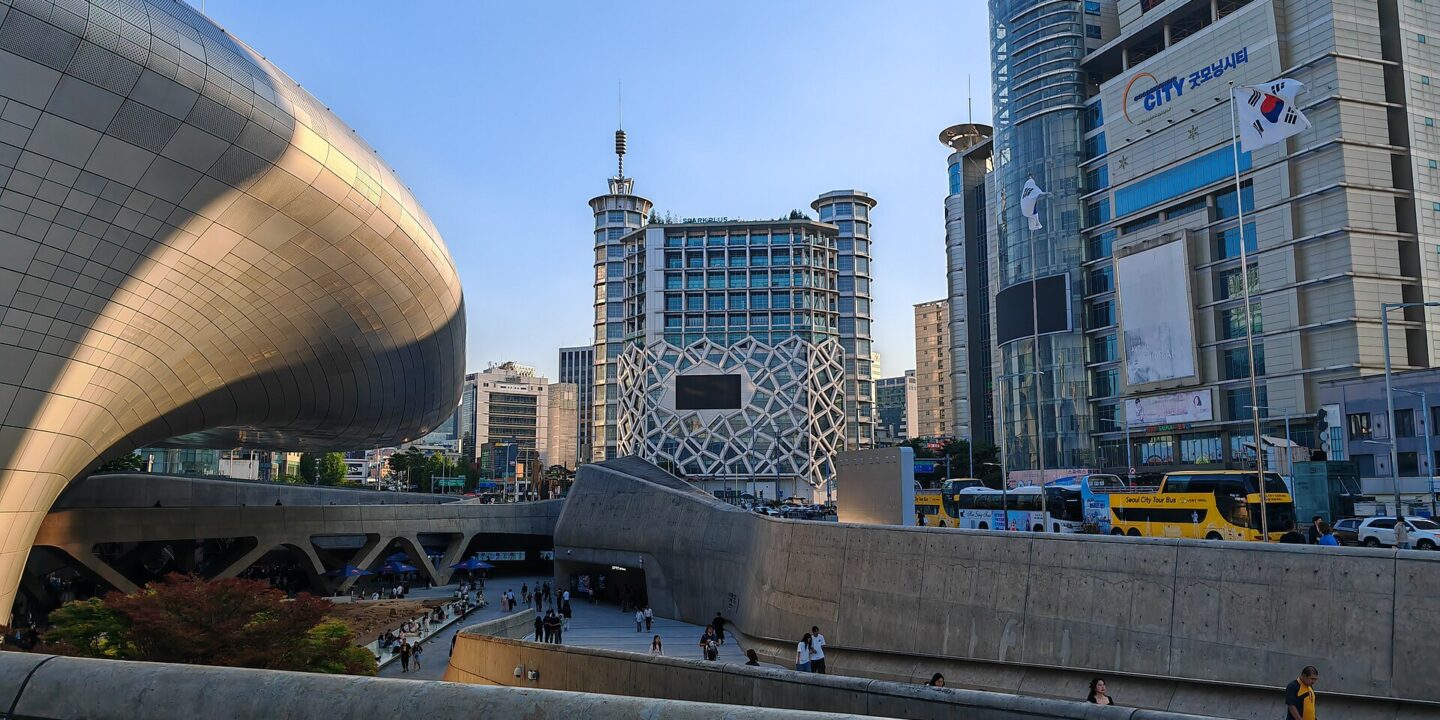
This guide explains the timetable first, because it is the single thing that determines whether a visit works. Then Zaha Hadid’s DDP and what is actually worth seeing inside it, the difference between the wholesale and retail buildings, the night food stalls, Heunginjimun gate, and how to walk out of the district along the Cheonggyecheon. Hours and prices were checked in September 2026; mall hours in particular have moved around since 2020, so confirm the specific building before you commit an evening to it.
At a glance
| Detail | |
|---|---|
| Getting there | Dongdaemun History & Culture Park (Lines 2, 4, 5) for DDP; Dongdaemun (Lines 1, 4) for the gate and markets |
| Retail mall hours | Roughly 10:30–05:00 — Doota Mall, Migliore, Hello apM |
| Wholesale hours | Roughly 20:00–06:00 — Pyounghwa and the surrounding buildings |
| DDP | Free to walk around; exhibitions ticketed. Zaha Hadid, opened 2014, 45,000 aluminium panels |
| LED Rose Garden | Outdoor, free, best after dark |
| Night food stalls | From around 17:00–18:00 |
| Best time to visit | Arrive 18:00, stay until midnight or later |
| Worst time to visit | Weekday afternoon |
| Closed | Most wholesale buildings shut Saturday night into Sunday |
The timetable, which is the whole point
Dongdaemun is two overlapping businesses in the same few blocks, and they keep opposite hours.
The retail malls
Doota Mall, Migliore and Hello apM sell to the public — individual items, fixed prices, changing rooms, tax-refund desks. Their traditional hours run from about 10:30 in the morning to around five the following morning, which is what gave Dongdaemun its reputation as a 24-hour shopping district. Post-pandemic, several buildings trimmed their closing times and the pattern is no longer uniform, so check the specific mall’s current hours if you are planning a late night around it.
The wholesale buildings
Pyounghwa Market and the towers around it sell to trade — shop owners, market stallholders, online sellers — in bulk, from roughly eight in the evening to six in the morning. This is the real Dongdaemun, and it is the reason for the vans, the trolleys and the bin bags. Buyers come from across Korea and from overseas, place orders overnight, and the goods are on shelves elsewhere by lunchtime.
You can walk through most wholesale buildings, and it is a genuinely interesting hour. What you generally cannot do is buy one of something. Minimum orders are common, prices assume volume, and haggling for a single T-shirt marks you as a tourist wasting a busy person’s time at three in the morning. Look, do not shop.
Which means
Arrive at six in the evening. The night stalls are setting up, the retail malls are in full swing, DDP is about to light up, and by nine or ten the wholesale side is opening around you. A weekday afternoon visit gets you a quiet mall and an empty plaza, and this is the single most common Dongdaemun mistake.
DDP: Dongdaemun Design Plaza
Zaha Hadid’s building opened in 2014 and is clad in around 45,000 aluminium panels, no two of which are identical — a fact that gets repeated because it is genuinely the interesting thing about the structure. It is a huge, curved, silver mass with no obvious front, sunk into and rising out of a park, and it is the most striking piece of contemporary architecture in Seoul.
What to actually do there
- Walk around the outside. Free, takes twenty minutes, and it is the best of it. The ramps and the sunken plaza reward wandering, and the building looks entirely different from each side.
- The LED Rose Garden — thousands of small illuminated roses laid out on the grass beside the building. Free, outdoors, and only worth seeing after dark. It is aggressively photogenic and there will be a queue of people photographing it.
- Exhibitions. DDP hosts rotating design, art and fashion exhibitions, most of them ticketed, quality genuinely variable. Check what is on before you commit — some are excellent, some are branded marketing.
- Dongdaemun History Museum and the excavated ruins. During construction, remains of the Seoul city wall and a Joseon-era military camp were uncovered, and they are preserved on site alongside a small free museum. Quiet, uncrowded and more interesting than most people expect.
- Seoul Fashion Week. Twice a year, DDP’s plazas fill with street-style photographers and extremely well-dressed people. If your dates coincide, it is worth an hour of watching.
- The design shop in the basement is a good source of Korean-designed objects and stationery — see our what to buy in Korea guide.
The honest verdict on DDP
It is a great building and a mediocre visit. There is not much programme inside for a structure of that size, the interior circulation is confusing, and a lot of the floor area is either an empty concourse or a shop. Come at dusk, walk the outside, see the rose garden, look at whichever exhibition appeals, and do not plan a half day around it.
Shopping properly
Where to buy things you can actually buy
Doota Mall is the most visitor-friendly building: fixed prices, a decent range of Korean brands, English-speaking staff, and a tax-refund desk. It is more expensive than the rest of Dongdaemun and cheaper than Myeongdong for comparable items.
Migliore and Hello apM are more chaotic, more variable, cheaper and more fun. Stalls rather than shops, prices sometimes negotiable, quality genuinely mixed. This is where the district’s reputation for bargains comes from and it rewards patience.
The underground shopping centre connecting the stations is a long, strip-lit run of small shops selling clothes, bags, phone accessories and shoes at low prices. Utterly unglamorous and often the best value in the district.
What Dongdaemun is good for
- Fast fashion and trend pieces at genuinely low prices.
- Fabric, buttons, zips, trimmings — the market complex around here supplies Korea’s garment trade and the haberdashery floors are extraordinary if that is your thing.
- Bags, shoes and accessories in volume.
- Sports goods and outdoor gear, in a cluster of dedicated buildings.
- Anything you need at two in the morning.
What it is not good for
Quality basics that will last, anything designer, and cosmetics — Myeongdong does the last of those far better, as our Myeongdong guide covers. Sizing runs small and Korean fashion sizing is not generous; try things on. For the wider picture of shopping in the city, see our Korean fashion shopping guide.

The other markets in the complex
“Dongdaemun Market” is not one building. It is a designation covering something like two dozen commercial buildings and several older market halls spread across a few blocks either side of the Cheonggyecheon, and knowing which is which saves a lot of aimless walking.
- Pyounghwa Market — the oldest and best known of the wholesale halls, dating to the 1960s, and historically significant beyond shopping: it was here that the labour activist Jeon Tae-il set himself alight in 1970 in protest at garment-factory conditions, an event that shaped the Korean labour movement. There is a small memorial and a bridge named after him nearby.
- Dongdaemun Shopping Complex — fabric, trimmings, buttons, beads and haberdashery over several floors. If you sew, budget two hours and take cash.
- Gwangjang Market — technically in Jongno rather than Dongdaemun, fifteen minutes west, and the best food market in Seoul.
- Bangsan Market — baking supplies, packaging and confectionery ingredients, just to the west. Genuinely fascinating if you cook.
- The sporting goods and outdoor blocks north of the main junction, which are the cheapest place in the city for hiking gear.
None of these needs to be a destination, but knowing they exist changes an evening from “three malls” into a proper wander. The rule everywhere is the same: cash is welcome, cards mostly work, and the older the building the more likely the seller wants notes.
Practical notes
- Take cash for the markets and the food stalls, even though cards work in the malls.
- Tax refunds are available at Doota and a handful of other buildings, not at the market stalls. Bring your passport if you intend to claim.
- Sizing is small. Korean fashion sizing runs roughly one size below European. Try things on where you can; a lot of stalls will not let you.
- Most wholesale buildings close Saturday night and reopen Sunday evening, so a Saturday-night visit sees the retail half only.
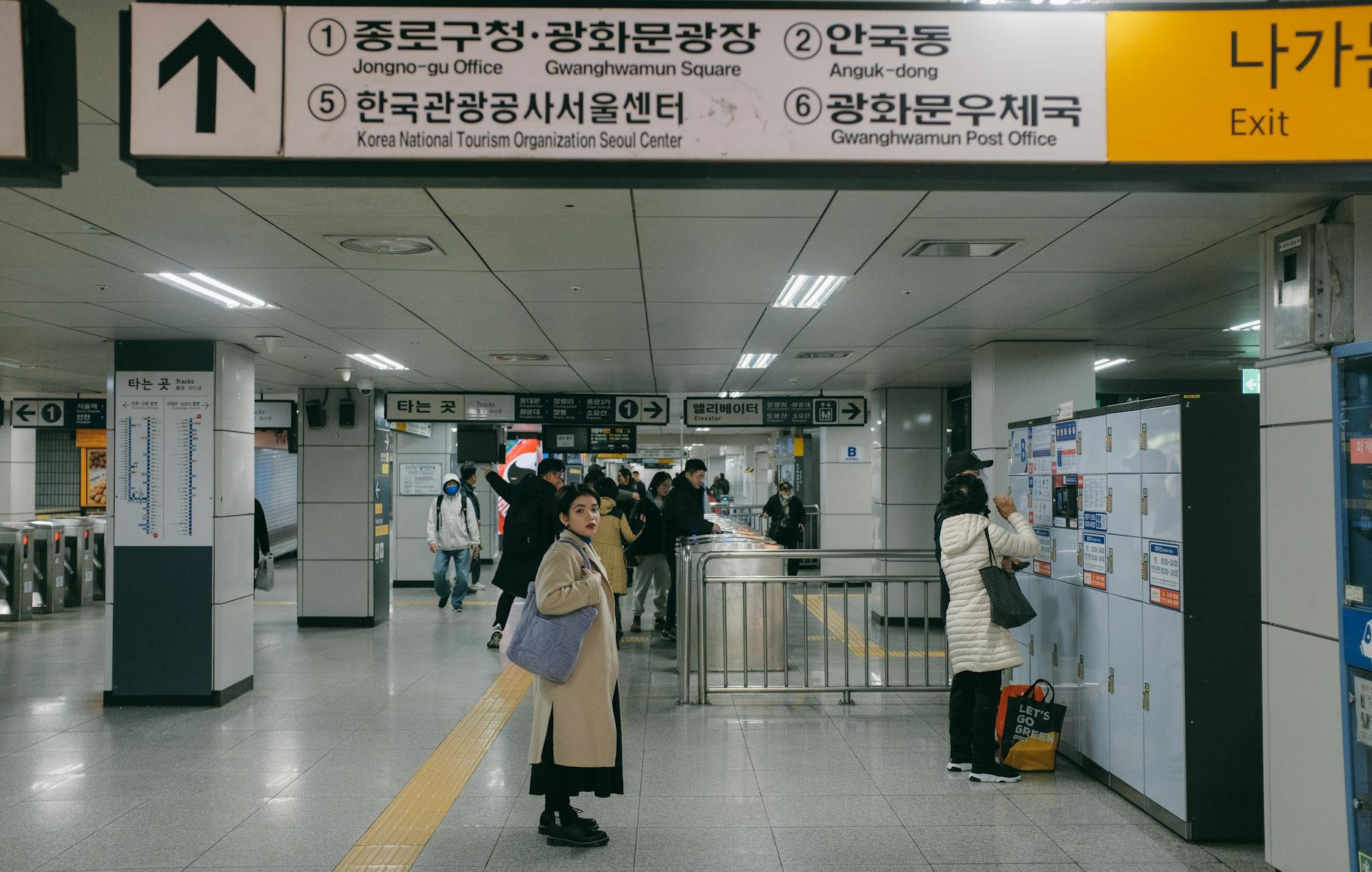
- Luggage. There are lockers at the stations, which matters if you are shopping seriously.
- It is very hot in summer and the streets between the buildings offer no shade at all. Evening is the answer in July and August, not just the best option.
Eating in Dongdaemun
The night stalls
From around five or six in the evening, food stalls set up along the streets between the malls — tteokbokki, sundae, twigim (fried things), grilled skewers, hotteok in winter. Prices are low, the seating is plastic stools under a tarpaulin, and this is one of the better street-food environments in Seoul precisely because it exists to feed market workers rather than tourists.
Dakhanmari alley
A short walk towards Jongno, in the alleys near Dongdaemun Station, is a run of restaurants specialising in dak hanmari — literally “one whole chicken” — a whole bird simmered in a clear broth with potato, rice cake and leeks, eaten from a communal pot with a mustard and vinegar dipping sauce, and finished by cooking noodles in the remaining broth. It is one of the great Seoul meals, costs somewhere in the region of ₩25,000–30,000 for two, and is the single best reason to eat in this part of the city.
Gwangjang Market
Not in Dongdaemun, but a fifteen-minute walk west and completely worth building into the same evening. Bindaetteok, mayak gimbap, yukhoe, and the most famous market food hall in the country. See our Seoul traditional markets guide.
Late
Because the district works overnight, restaurants here keep hours that almost nowhere else does. At three in the morning you will find hot food without difficulty, which is unusual even in Seoul — more options in our late-night food guide.
Heunginjimun and the city wall
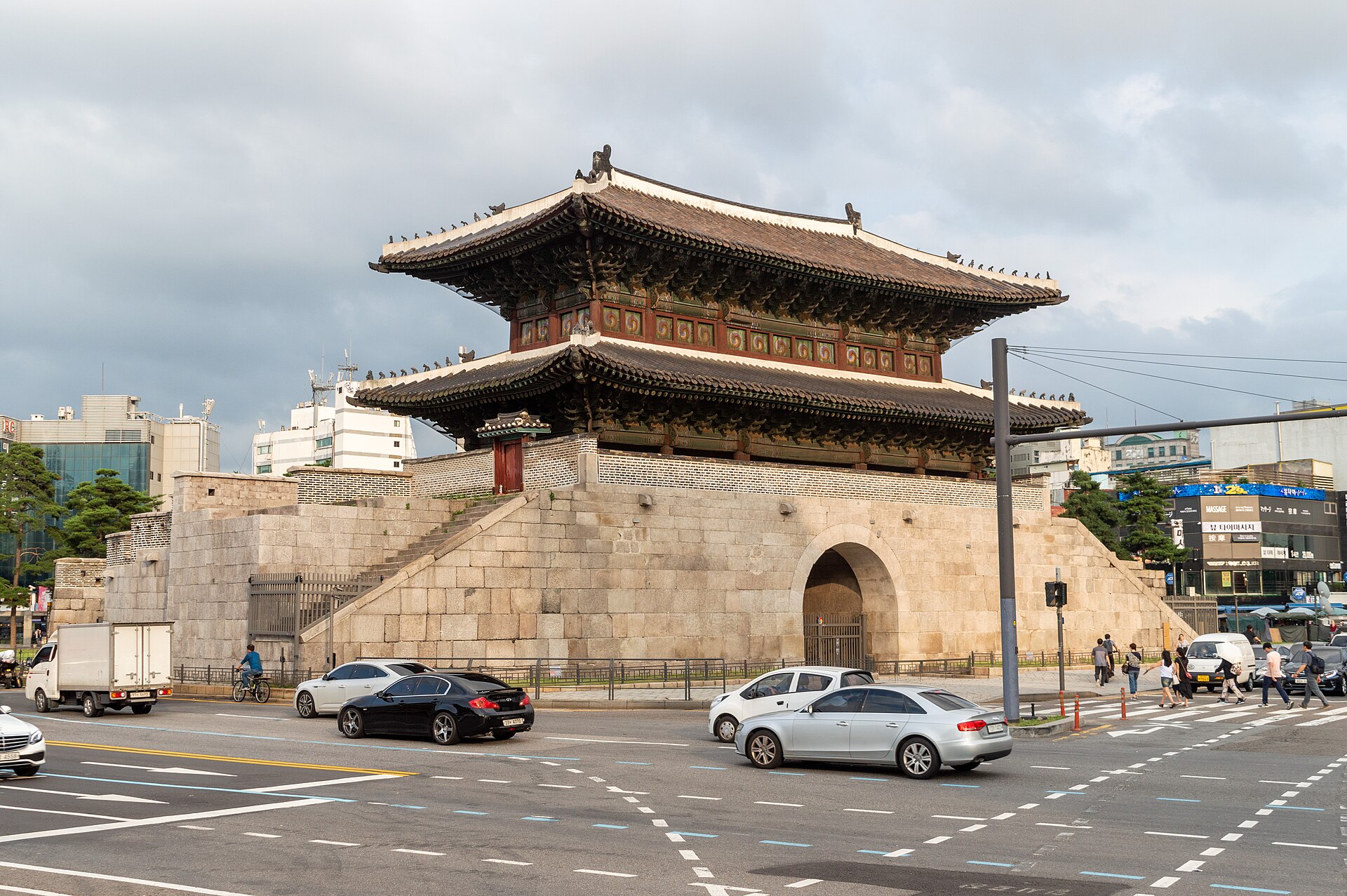
The gate that gives the district its name — Dongdaemun means “Great East Gate” — is Heunginjimun, originally built in 1398 and rebuilt in 1869. It is a handsome two-storey wooden gatehouse on a stone base, with a distinctive semicircular defensive wall around the outer face, and it now sits marooned on a traffic island in the middle of eight lanes of road.
That siting does it no favours. You cannot go inside, the traffic is loud, and the photographs are difficult. It is worth two minutes on your way past rather than a dedicated visit.
Better is the Seoul city wall itself, which runs north from beside the gate up Naksan. The Naksan section is one of the easiest and best stretches of the wall walk: a gentle climb, a good view back over the city, and a park at the top. Allow an hour, go at sunset, and it turns a shopping trip into a proper evening.
Walking the Cheonggyecheon
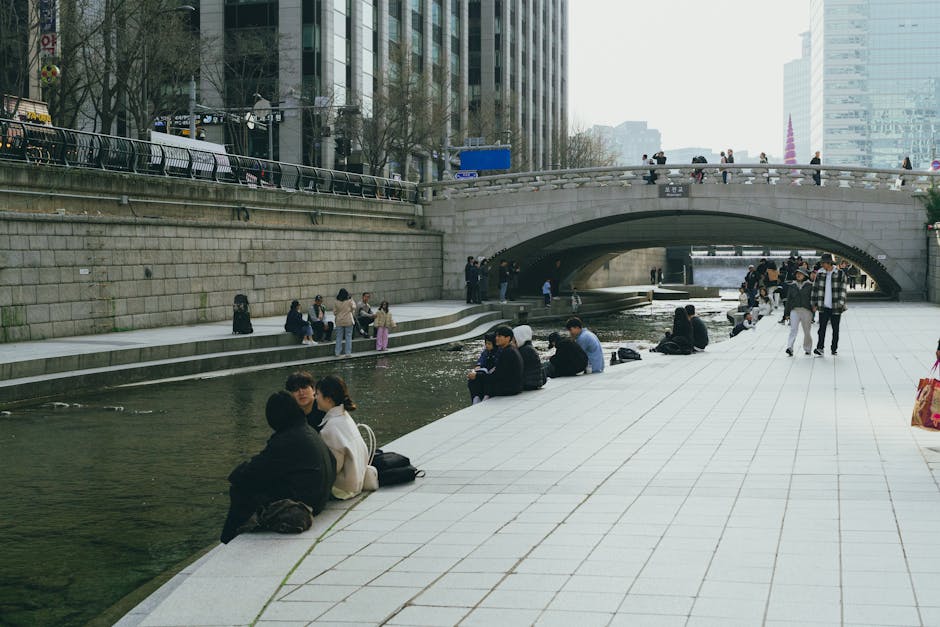
The restored stream runs east–west through central Seoul and passes just beside Dongdaemun. From here you can walk west along the water all the way to Cheonggye Plaza near Gwanghwamun in about an hour, dropping below street level into a green, quiet corridor with stepping stones, small waterfalls and considerably less traffic noise than the roads above.
It is the best way to leave Dongdaemun on foot, it costs nothing, and it delivers you into the palace district. Doing it in the evening, lit, is better than in daylight. Our Jongno guide picks up at the far end.
A Dongdaemun evening, in order
- 17:30 — Arrive at Dongdaemun History & Culture Park station. Walk up into the DDP plaza while there is still light.
- 18:00 — Circle the building, go down into the sunken plaza, look at the excavated wall ruins.
- 18:45 — Eat at the night stalls, or walk fifteen minutes to Gwangjang Market and eat properly.
- 20:00 — Back for the LED Rose Garden after dark.
- 20:30 — Doota Mall and Migliore, or the underground shopping centre if you want the cheap version.
- 22:00 — Walk through a wholesale building to see the trade in operation. Look, do not buy.
- 23:00 — Dak hanmari in the alleys towards Jongno, then either the Cheonggyecheon walk west or the last subway home.
The last useful trains leave around midnight; after that it is a taxi, and Dongdaemun is central enough that this is not expensive. Timings are in our Seoul subway guide.
Should you stay here?
There are hotels in Dongdaemun and they are cheaper than the equivalent in Myeongdong, with excellent subway connections — three lines at one station. The trade-off is that the district is a workplace rather than a neighbourhood: noisy at night, lifeless at breakfast time, and short of the ordinary cafes and restaurants that make somewhere pleasant to wake up in.
For a short trip it is a reasonable value choice; for a first visit, Myeongdong or Jongno will make better use of your mornings. Our neighbourhood comparison sets out that trade-off in detail.
Frequently Asked Questions
What time does Dongdaemun open?
Retail malls such as Doota, Migliore and Hello apM traditionally run from about 10:30 to around 05:00; wholesale buildings run roughly 20:00 to 06:00. Several buildings shortened their hours after 2020, so check the specific mall before planning a late night around it.
What is the difference between the retail and wholesale buildings?
Retail malls sell individual items at fixed prices to the public. Wholesale buildings sell in bulk to shop owners and online sellers overnight, usually with minimum order quantities. You can walk through the wholesale towers to look, but you generally cannot buy one of something.
Is DDP worth visiting?
The exterior is, and it is free — come at dusk, walk around it, and see the LED Rose Garden after dark. The interior is a large building with relatively little in it, and the ticketed exhibitions vary considerably in quality. Budget an hour, not an afternoon.
Which subway station should I use?
Dongdaemun History & Culture Park (Lines 2, 4 and 5) for DDP and the malls. Dongdaemun (Lines 1 and 4) for Heunginjimun gate, the dak hanmari alley and the walk towards Gwangjang Market.
Is Dongdaemun good for shopping?
For fast fashion, accessories, fabric and anything you need at an unusual hour, yes, at low prices. For quality basics, designer goods or cosmetics, no — Myeongdong and the department stores are better. Sizing runs small.
Can I haggle?
In the stall-based malls like Migliore, sometimes, politely, and mainly if you are buying more than one item. In Doota, no — prices are fixed. In the wholesale buildings, do not: you are not the customer.
What is dak hanmari?
A whole chicken simmered in clear broth with potato, rice cake and leek, eaten from a shared pot with a mustard-vinegar sauce and finished by cooking noodles in the broth. The alleys near Dongdaemun Station are its home, and it costs about ₩25,000–30,000 for two.
Is Dongdaemun safe at night?
Yes. The area is busy all night with workers, buyers and shoppers, and it is one of the better-lit and better-populated parts of central Seoul at three in the morning.
How long do I need?
An evening — arrive around six, leave around midnight. That covers DDP, the food stalls, the malls, a look at the wholesale trade and a proper meal. Anything shorter and you will only see the retail half.
Final Thoughts
Dongdaemun is the district in Seoul most often visited badly. Come in the afternoon and it is a set of unremarkable malls beside an admittedly interesting building. Come at six in the evening and stay until midnight and it is one of the strangest and most alive parts of the city — an entire garment industry operating overnight, a Zaha Hadid building lit up beside a six-hundred-year-old gate, food stalls feeding people who will be working until dawn.
Get the timing right and it is unmissable. Get it wrong and you will wonder why anyone recommended it. For the rest of the city’s districts, start with our Seoul neighbourhoods guide.
Photo Credits
Dongdaemun Design Plaza: 20240601 144028 Dongdaemun Design Plaza, Seoul 08 by Dwxn, CC BY-SA 4.0, via Wikimedia Commons.
Heunginjimun gate: Heunginjimun, Seoul by Tristan Surtel, CC BY-SA 4.0, via Wikimedia Commons.