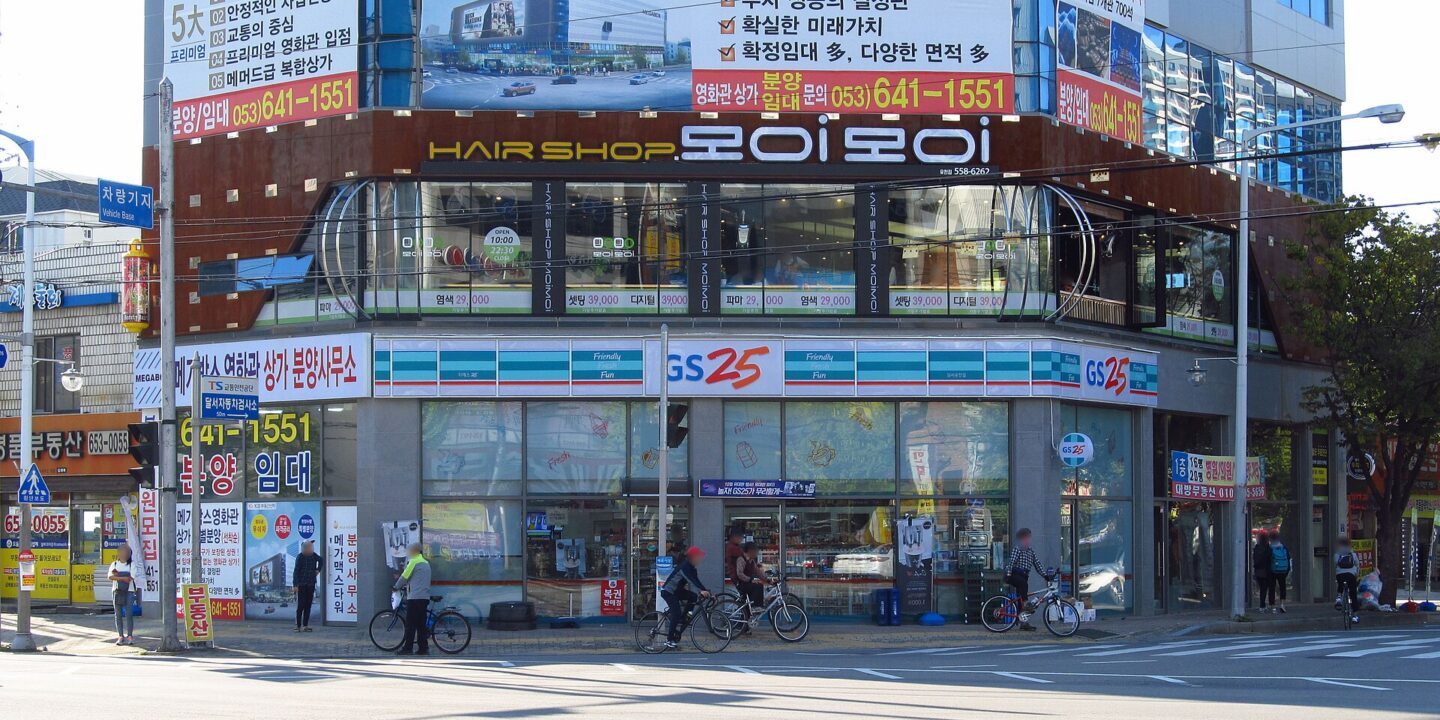
This guide covers the four chains and what each is actually good at, how to open a triangle gimbap without destroying it, how to use a ramyeon machine, the discount system that catches people out, the specific products worth your money, and the ones that are famous rather than good. Prices were checked in September 2026 and sit in a tight band nationally, so treat them as reliable within a few hundred won.
At a glance
| Detail | |
|---|---|
| Typical price range | ₩1,000–5,000 for almost everything |
| The four chains | CU · GS25 · 7-Eleven · Emart24 |
| Best-selling single item | Triangle gimbap (samgak gimbap) |
| New product drops | Every Tuesday and Thursday |
| Discount system | 1+1 (buy one get one) and 2+1 (buy two get one), marked on the shelf tag |
| Facilities | Microwave, hot water, ramyeon machine, chopsticks, scissors, bins, seating |
| Opening hours | Most are 24 hours |
| A full meal | ₩4,000–7,000 including a drink |
Why these shops are different
Korea has somewhere north of 50,000 convenience stores, which works out at roughly one for every thousand people, and in central Seoul you will frequently see two competing chains facing each other across a street. That density produces the two things that make them worth writing about.
The first is turnover. New products land every Tuesday and Thursday, every week, all year. Collaborations with celebrities, drama tie-ins, limited-edition flavours, seasonal items — the shelves are genuinely different month to month, and Korean shoppers treat the new arrivals as an event. This is why a convenience store here feels alive in a way its equivalent elsewhere does not.
The second is infrastructure. Korean stores are built to be eaten in. There is a microwave, a hot-water dispenser, usually a ramyeon machine, free chopsticks and scissors, a bin, and a counter or a table with stools — frequently outside as well, which in warm weather turns the shop into a small informal bar. That is the difference between buying a sandwich and having a meal.
The four chains, and what each does best
CU
The largest network. CU’s distinguishing feature is the hot snack bar — the heated cabinet by the counter with corn dogs, fried chicken pieces, sausages and croquettes, which is consistently the best of the four chains. CU also tends towards bolder, spicier triangle gimbap fillings and has a strong own-brand line in tteokbokki and instant meals. If you want hot food handed over a counter at two in the morning, CU.
GS25
The one to go to for anything new. GS25 leads on collaborations and private label — celebrity tie-ins, drama products, its own-brand desserts and coffee. Its coffee line is the best of the four by a reasonable margin, and its dosirak (packed lunch boxes) tend to be better composed. If you are browsing for the sake of browsing, GS25 is the most interesting shop.
7-Eleven
Familiar branding, Korean product range. Good on onigiri-style items and reliable on the basics. Nothing it does is the best in class, but nothing it does is bad, and there are a great many branches.
Emart24
The smallest of the four, and the one most likely to have a proper seating area, a wine and craft-beer selection, and a slightly more grocery-shaped range. Worth walking into if you pass one, particularly for alcohol — our Korean alcohol guide covers what is on those shelves.
In practice the differences are marginal and you should use whichever is nearest. The exception is if you want the hot snack bar, in which case find a CU.
Triangle gimbap, and how to open it
Samgak gimbap — the triangular rice parcel wrapped in seaweed — is the single best-selling item in Korean convenience stores, costs around ₩1,200–1,800, and is the thing most visitors get wrong.
The engineering is clever. The nori is separated from the rice by a layer of plastic film, so it stays crisp until the moment you open it. The wrapper is numbered.
The three-step opening
- Pull tab 1 — a strip running down the back of the triangle from the point. This splits the outer film in half.
- Pull corner 2 — marked on one side. This slides half the film out, leaving the nori pressed against the rice.
- Pull corner 3 — the other side. The remaining film comes away and the seaweed wraps the rice.
Do it in that order and you get a neat parcel with crisp nori. Do it wrong and you get rice in your hand and seaweed in the bin. It takes one attempt to learn.
Reading the fillings
Each chain colour-codes its own range and the schemes are not consistent between them, so the colour is a hint rather than a rule — but the Korean name on the front is reliable. The ones worth knowing:
- 참치마요 (chamchi mayo) — tuna mayonnaise. The default, the bestseller, and genuinely good. If you buy one, buy this.
- 전주비빔 (Jeonju bibim) — bibimbap-style, vegetables and gochujang. Usually vegetarian, though check.
- 김치볶음밥 (kimchi bokkeumbap) — kimchi fried rice. Reliably good and reliably spicy.
- 불고기 (bulgogi) — sweet marinated beef. The safest option for anyone avoiding spice.
- 스팸마요 (Spam mayo) — Spam and mayonnaise, and considerably better than that description suggests. Spam occupies a serious place in Korean food culture.
- 매운 (maeun) anything — the word means spicy, and Korean packaging is not being polite about it.
The ramyeon machine
Most stores have one, usually near the hot-water dispenser, and using it is the moment a convenience store stops being a shop.
The flow: buy your cup or bowl ramyeon, open it, add the sachets, fill with water to the marked line, then put the bowl in the machine and press the button. It cooks for around two to three minutes and beeps. Some older machines are simply a hot-water tap with a timer above it; newer ones actually boil the bowl, which produces noticeably better noodles.
Chopsticks and lids are free and stacked beside the machine. There is a bin for the broth, which you should use rather than pouring it down the sink. And if you want to upgrade it — this is the standard move — add a slice of processed cheese, a boiled egg from the counter, or a triangle gimbap dropped into the broth at the end.
Which ramyeon to buy
- Shin Ramyun — the national default. Beefy, properly spicy, never disappointing.
- Jin Ramen — milder, comes in mild and spicy versions, arguably the better noodle.
- Chapagetti — black bean sauce, sweet and savoury, not spicy. Mix it with Neoguri to make jjapaguri, the dish from the film Parasite.
- Buldak (Samyang Hot Chicken) — the internet-famous one. Handle with respect; see below.
Buldak, decoded
Samyang’s Buldak line is the fire noodle everyone has seen on video, and it comes in a spread of heat levels that the packaging makes clear if you know what you are looking at. The original sits around 4,400 Scoville units. The 2x Spicy version is roughly double that. There is a 3x above it, which is a stunt rather than a meal. Going the other way, the Carbonara version is much milder — somewhere around 2,700 — and is the one most people actually enjoy, along with the cheese and jjajang variants.
The honest advice: start with Carbonara or Cheese. The original is hot in a way that is difficult to eat rather than pleasurable to eat, and the 2x is a dare. Drink milk, not water — banana milk is right there.
The things actually worth buying
Drinks
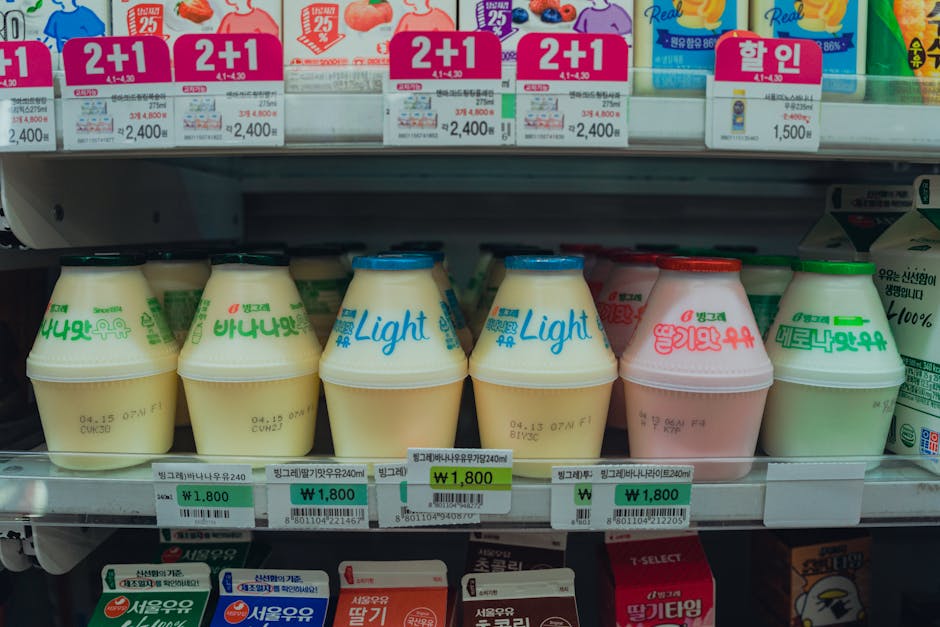
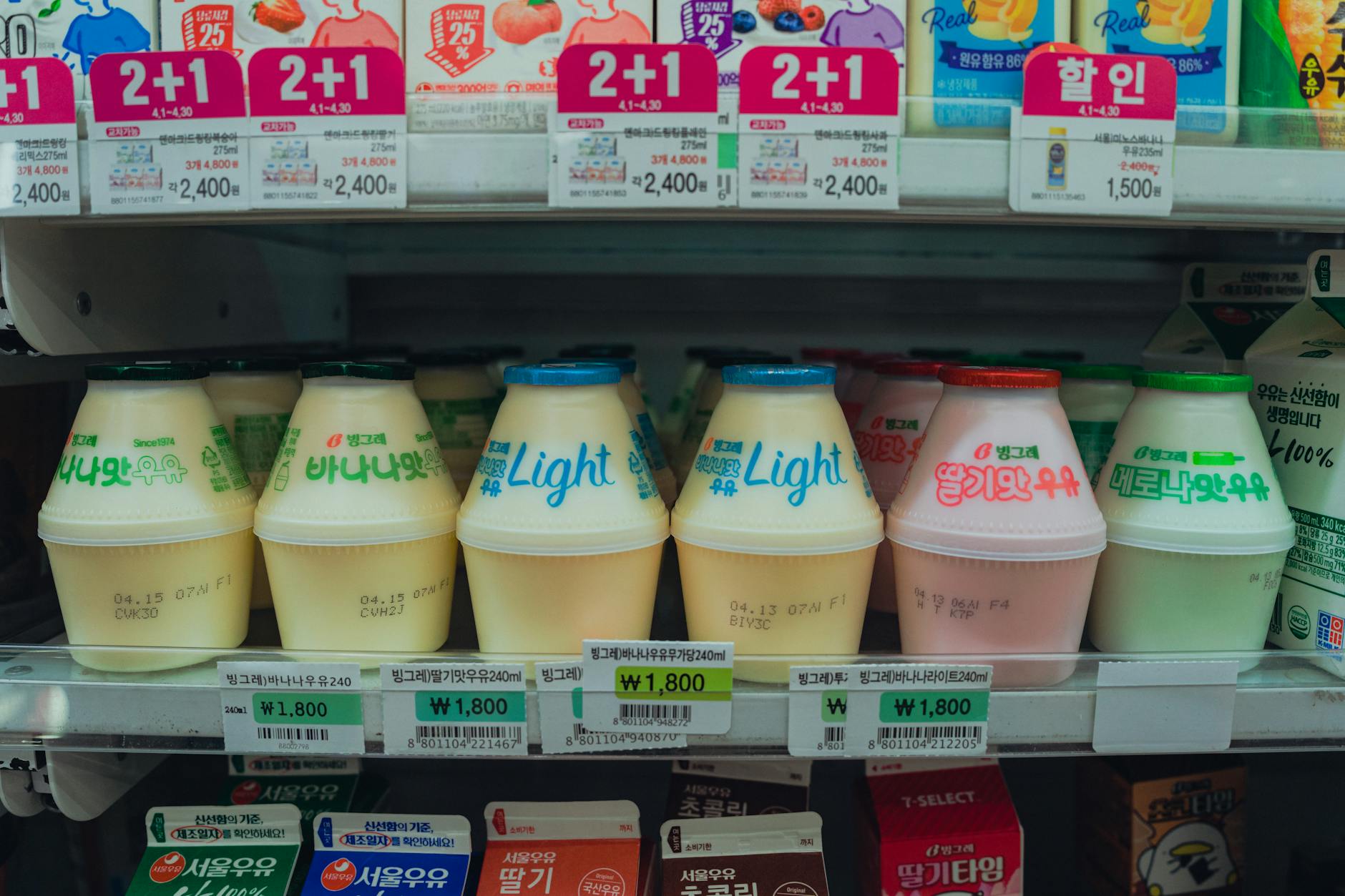
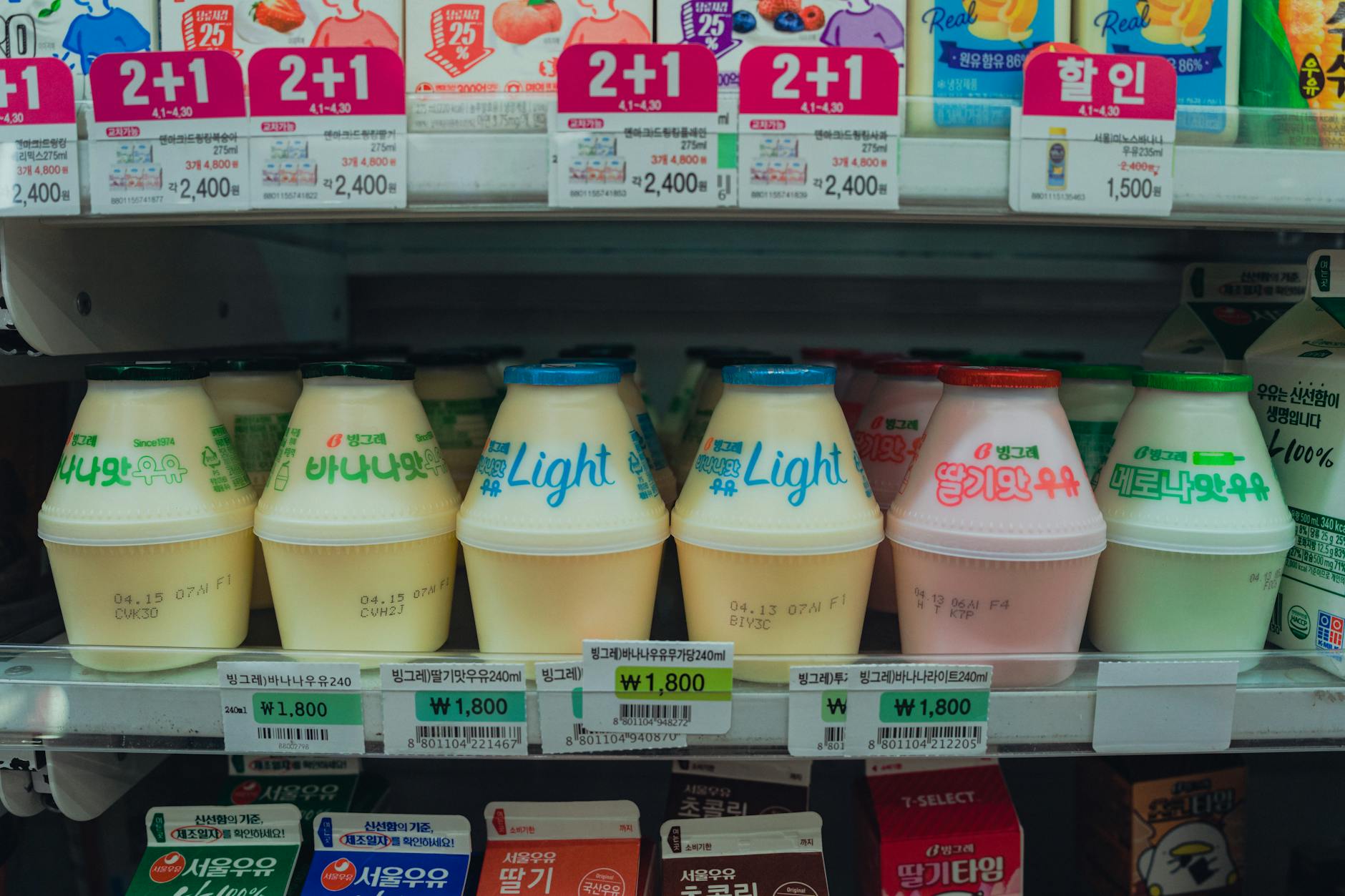
- Banana milk (바나나맛 우유) — in the fat-bellied plastic pot. A genuine national institution, sold since 1974, and the single most Korean thing in the fridge. Around ₩1,700.
- Vita500 and Bacchus — small vitamin drinks, sold everywhere, drunk by everyone.
- Milkis — carbonated milk soda. Stranger than it sounds and better than it sounds.
- Corn silk tea (옥수수수염차) — sold cold, faintly sweet, oddly excellent. Sold as a health drink.
- Convenience-store coffee. GS25’s own-brand cold brew is the pick, and at ₩2,000–3,000 it undercuts the cafes considerably.
Snacks
- Yakgwa (약과) — a deep-fried honey and sesame-oil pastry, chewy, sticky, traditional, and currently having a major revival with modern versions in every store. Buy one.
- Honey Butter Chip — the crisp that caused a national shortage when it launched. Still good.
- Choco Pie and Custard — the Korean lunchbox classics.
- Turtle chips (꼬북칩) — four-layer corn snack, corn-soup flavour, better than any of that sounds.
- Dried squid and jerky — the standard beer accompaniment, sold in every store.
Meals
- Dosirak (도시락) — the packed lunch box, ₩4,000–5,500, microwaved at the counter. Rice, a protein, several banchan. This is a proper meal for the price of a coffee and it is the single best-value thing in the shop.
- Hot snack bar items — corn dogs, fried chicken, sausage. CU does these best. ₩1,500–3,500.
- Tteokbokki cups — microwave rice cakes in gochujang sauce. Reliably good.
- Sandwiches — the egg sandwich in particular, which is an oddly excellent thing at seven in the morning.
The 1+1 and 2+1 system
Shelf tags marked 1+1 mean buy one, get one free; 2+1 means buy two, get one free. This is not a loyalty scheme and does not require a card — you simply take the extra items to the counter and pay for one or two.
Three things people get wrong:
- The free item must usually be the same product, not just the same brand. Some promotions allow a swap within a defined group; the tag will say, in Korean.
- You have to physically take the extra. The till does not add it for you, and staff will often point at the shelf if you have missed it.
- Promotions rotate weekly and differ between chains, which is genuinely worth thirty seconds of looking if you are buying drinks for a group.
Between this and the base prices, feeding two people from a convenience store costs about ₩10,000. It is the backbone of eating cheaply here, and it sits alongside the markets in our cheap eats in Seoul guide and the wider Seoul on a budget page.
How to actually use one
- Payment. Cards work everywhere, including foreign ones. T-money and WOWPASS also work, which is useful for small amounts.
- The microwave is self-service and usually has preset buttons; staff will heat a dosirak for you if you hand it over.
- Scissors are attached near the hot water for opening sachets and cutting noodles. Use them and put them back.
- Seating is free and there is no time limit. Nobody will move you on.
- Alcohol is sold at all hours and can be drunk at the store’s outside tables, which is completely normal and a very pleasant way to spend a summer evening.
- Bins are separated — general waste, food waste, and recycling. Follow what is written on them.
- Bags cost extra and are not automatic. Say yes if you want one.
What is famous but not actually good
A short list, in the interest of honesty.
The 3x Spicy Buldak is not food. It is a challenge product and eating a whole packet is unpleasant rather than impressive.
Most of the collaboration snacks are ordinary snacks in a different bag. The novelty is the packaging, not the contents, and there is no reason to buy one unless you like the packaging — which is a perfectly good reason.
Convenience-store sushi exists and is fine, but you are in a country with extraordinary cheap seafood a short walk away in any direction. Spend the ₩5,000 elsewhere; our Seoul food guide has better ideas.
The instant coffee cans are sweet enough to be a dessert. This is a feature for some people and a shock for others.
Late night, which is when this really matters
Seoul’s subway stops around midnight and its restaurants thin out after two, but the convenience stores never close. That makes them the default answer to the two most common late-night problems: you are hungry at three in the morning, and everything else has shut. A dosirak, a ramyeon at the machine, a beer at the outside table — this is a completely normal Korean way to end a night, and it costs less than a taxi fare. For the sit-down alternatives at that hour, see our late-night food in Seoul guide.

Taking it home
Convenience stores are also, quietly, the best souvenir shop in Korea. Ramyeon packets, honey butter chips, yakgwa, banana milk powder, Vita500 and the collaboration snacks all travel well, cost almost nothing, and are more interesting than anything in a gift shop. Buy a bag of it at the airport branch on the way out — the airport stores charge the same prices as the city ones. More on this in what to buy in Korea.
Frequently Asked Questions
How much does convenience store food cost in Korea?
Almost everything sits between ₩1,000 and ₩5,000. A triangle gimbap is ₩1,200–1,800, a full dosirak lunch box ₩4,000–5,500, and a meal with a drink comes to roughly ₩4,000–7,000.
CU or GS25 — which is better?
CU for the hot snack bar and bolder triangle gimbap fillings; GS25 for private label, coffee and new collaboration products. The gap is small and you should use whichever is closer, unless you specifically want hot food from the counter.
How do you open a triangle gimbap?
Pull tab 1 down the back to split the film, then pull corners 2 and 3 out sideways. Done in that order, the seaweed wraps the rice and stays crisp. Done in any other order, it falls apart.
How do the ramyeon machines work?
Open your bowl, add the sachets, fill with water to the line, put it in the machine and press the button. It cooks for two to three minutes. Chopsticks and lids are free beside the machine, and there is a separate bin for leftover broth.
What does 1+1 mean in Korean convenience stores?
Buy one, get one free — take two identical items to the counter and pay for one. 2+1 means buy two, get one. No card or app is needed, but you do have to take the extra item yourself.
When do new products come out?
Tuesdays and Thursdays, every week. Korean shoppers genuinely track this, and it is why the shelves look different from one visit to the next.
Can I eat inside the store?
Yes. Most have a counter or tables, often outside as well, plus a microwave, hot water and free chopsticks. There is no time limit and nobody will hurry you.
Is Buldak really that spicy?
The original is around 4,400 Scoville units and the 2x version roughly double. The Carbonara version is much milder at about 2,700 and is the one most people actually enjoy. Start there.
Can I use a foreign card?
Yes, cards work everywhere, and T-money and WOWPASS are also accepted. Carrying cash is optional.
Final Thoughts
The convenience store is the most underrated thing about eating in Seoul, and the reason is that visitors judge it against the shops at home rather than against the restaurants here. Judged properly — as a place with hot food, a microwave, a table, a rotating product range and nothing over ₩5,000 — it is one of the best value propositions in any city in the world.
Buy a tuna mayo triangle gimbap, learn the three-tab trick, cook a Shin Ramyun in the machine and eat it at the window with a banana milk. Then read our Seoul food guide and the dishes worth trying for everything that is better still.
Photo Credits
GS25 storefront: GS25 Dalseo-yucheon branch by LERK, CC BY-SA 4.0, via Wikimedia Commons.
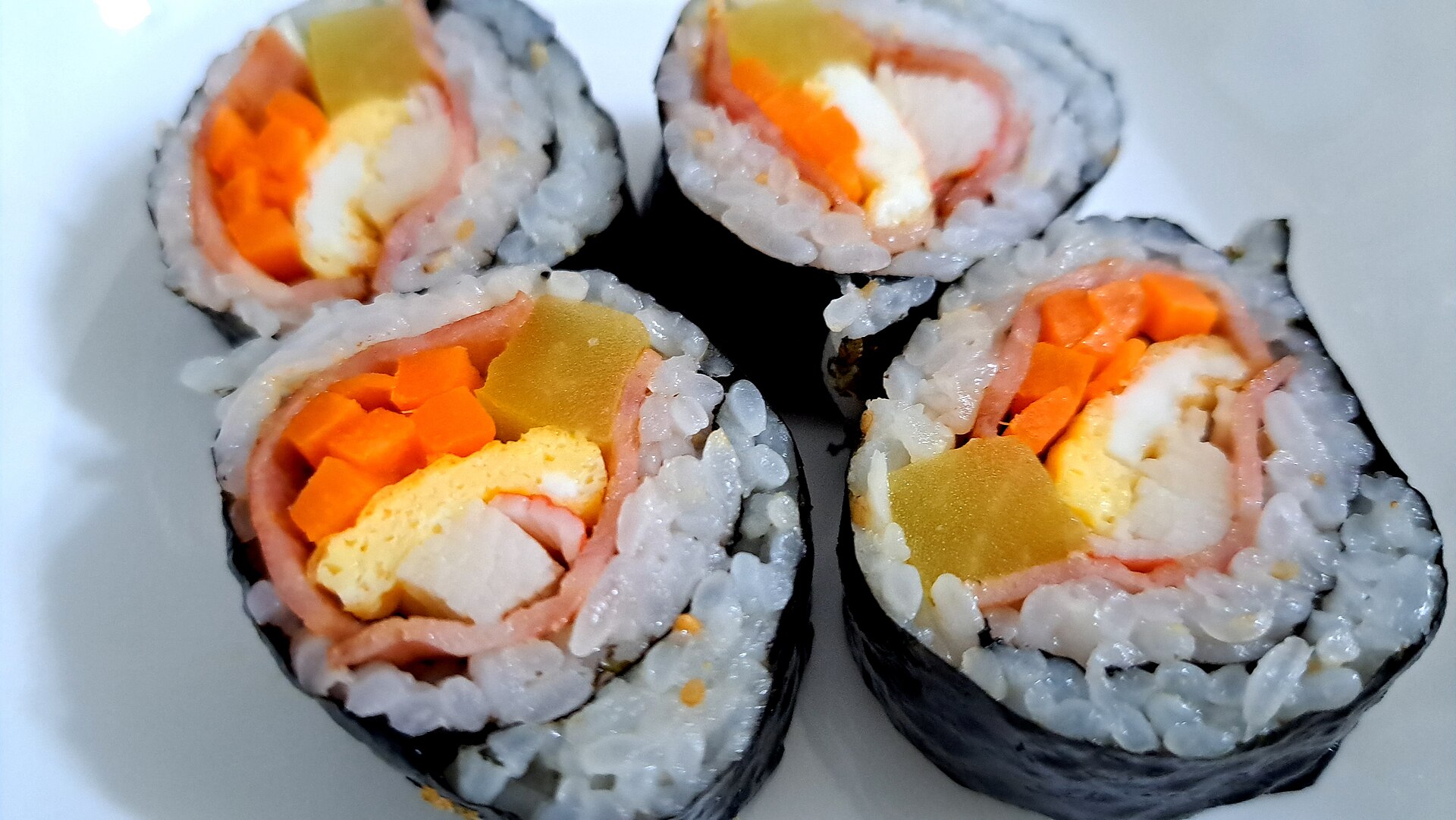
Gimbap close-up: Gimbap Kimbap Korean food 02 by 한국의 멋, CC0, via Wikimedia Commons.