This guide fixes that. It covers what the different formats are, what the brands mean, exactly what happens from the moment you walk in to the moment the strip drops out of the slot, what all the Korean buttons say, and where the densest clusters are. Prices were checked in September 2026 and sit in a narrow band across the city, so treat them as reliable within a thousand won or so.
At a glance
| Detail | |
|---|---|
| Cost per session | ₩4,000–8,000, typically ₩5,000 for four cuts |
| What you get | Two identical printed strips, plus digital copies via QR code |
| Time needed | 10–15 minutes including choosing and retouching |
| Payment | Card, mobile pay, sometimes cash — most machines take foreign cards |
| Opening hours | Typically 24 hours, unstaffed |
| Main brands | Life4Cuts, Photoism, Photo Signature, Harupict, PIXX |
| Best areas | Hongdae (densest), Seongsu, Myeongdong, Gangnam, Konkuk University |
| Group size | Two to four is ideal; six will fit if you are enthusiastic |
What these places actually are
The Korean term you will see everywhere is 인생네컷 — “life four cuts” — which started as one brand name and became the generic word for the whole category, the way “hoover” did in Britain. The concept is a photo booth with the technology and the aesthetics updated by about thirty years: a proper studio light rig, a DSLR-quality camera, a big touchscreen, dozens of frame designs, real-time retouching, and a printer that produces two strips in under a minute.
They are almost always unstaffed and almost always open 24 hours. You walk in off the street, and there is no booking, no attendant and no minimum. This matters more than it sounds, because it makes the whole thing a spontaneous activity rather than a planned one — the standard Korean use is at the end of a night out, or when a group is walking somewhere and passes one.
Booth versus self-studio
Two formats, often in the same shop.
A booth is the classic setup: a curtained cubicle, a fixed camera at head height, a bench, and a countdown. Four to eight shots, and you keep the best four. This is what you want for a quick, fun, low-commitment set. ₩4,000–6,000.
A self-studio is a larger room with a proper backdrop wall, adjustable studio lighting, a remote shutter and often a tripod-mounted camera you position yourself. You get a longer slot — often fifteen or twenty minutes — and full-body shots rather than head-and-shoulders. Prices run higher, sometimes ₩15,000–30,000 for a room, and this is what Korean couples and friend groups book for something more considered. Some studios provide props, chairs and even clothing racks.
For a first go, do a booth. If you enjoy it, the self-studio is the upgrade.
The brands, and what distinguishes them
There are dozens of chains and the differences are real but not enormous. These are the ones you will encounter most.
- Life4Cuts (인생네컷) — the original and still the most widespread. Classic film-strip aesthetic, heavy black borders, the most recognisable frame designs. Frequent collaborations with K-pop groups and brands, so the frame options rotate. If you want the version everyone recognises, this one.
- Photoism — cleaner, brighter, more contemporary. Strong on colour backdrops and on collaboration frames with idols and characters. Photoism Box branches often have more backdrop choices.
- Photo Signature — leans towards a more polished, editorial look with softer retouching. Popular for couple photos.
- Harupict — known for warmer tones and film-like grain; a good pick if you dislike the very smooth, heavily retouched default.
- PIXX — larger studio spaces and a bigger range of full-body setups.
- Don’t Look Up, Monomansion, Photomatic — smaller chains and independents worth walking into if you pass one; Photomatic in particular does a distinctive black-and-white style.
The practical advice: do not research this. Walk into whichever one you pass, because the experience is broadly the same and the frame designs change monthly anyway. The difference between brands is smaller than the difference between doing it and not doing it.
How the machine works, step by step
This is the part nobody explains. The screens are usually Korean-first, sometimes with an English toggle, and the flow is consistent across chains.
1. Choose your frame
The first screen shows layout options: four cuts, six cuts, eight cuts, sometimes one large single. Four is the default and the one to pick. Some machines also offer a “video” or GIF option that records a short clip alongside the stills — worth the extra thousand won if it is offered.
2. Pay
Card readers take foreign cards in most branches, and mobile payment is standard. Some older machines are cash-only and take ₩1,000 notes and coins — carry a couple of notes just in case. Expect ₩4,000–6,000 for four cuts, ₩6,000–8,000 for six or eight.
3. Choose the frame design and colour
Now you pick the border: white, black, one of a dozen colours, or a collaboration design. The screen shows previews. This is the choice people spend the longest on and it barely matters — black and white both look good with everything.
4. Take the photos
The machine gives you more shots than your frame needs — typically six or eight for a four-cut strip — with a countdown on screen between each. A voice counts down in Korean: hana, dul, set (one, two, three). Each shot fires with a flash. There is roughly five to eight seconds between shots to change position, which is less time than you think.
Do not stand still and smile for all of them. The convention is to change pose every shot, and if you do not, you will end up with four near-identical photographs and a mild sense of having wasted it.
5. Choose which shots to keep
The screen shows all your frames and you tap the four you want. There is a timer on this screen, usually 60 to 90 seconds, so decide quickly.
6. Retouch
A filter and skin-smoothing screen appears with a slider — usually labelled with a level from 0 to 4 or 5. The default is often set high, which produces a very smooth, luminous, distinctly Korean look. If you would rather look like yourself, turn it down to 0 or 1. Some machines also offer colour filters here: black and white, warm film, cool tone.
7. Print and collect
Two identical strips drop out of the slot after about thirty seconds — the design assumes there are two of you, one strip each. A QR code appears on screen at the same time: scan it to download the high-resolution digital versions and the video clip if you took one. Do this before you walk out, because the QR expires within minutes and there is no way to retrieve the files afterwards.
The poses, since everyone asks
There is a shared visual vocabulary here and knowing three or four of them makes the difference between a good strip and four photos of people standing awkwardly.
- The finger heart — thumb and index finger crossed at the tips. The national gesture. Non-negotiable for at least one frame.
- The double finger heart — both hands, held up beside the face.
- The big arm heart — arms raised over the head to make a heart shape. Works best with two people making half each.
- Hands framing the face — palms flat against the cheeks, or fingers making a square around the face.
- The deliberately stupid one — one frame where everyone pulls a face. This is the frame you will actually like in six months.
The general rule is that the more committed you are, the better the photographs. Half-hearted photo booth pictures look like exactly what they are.
Where to go
Hongdae — the densest cluster
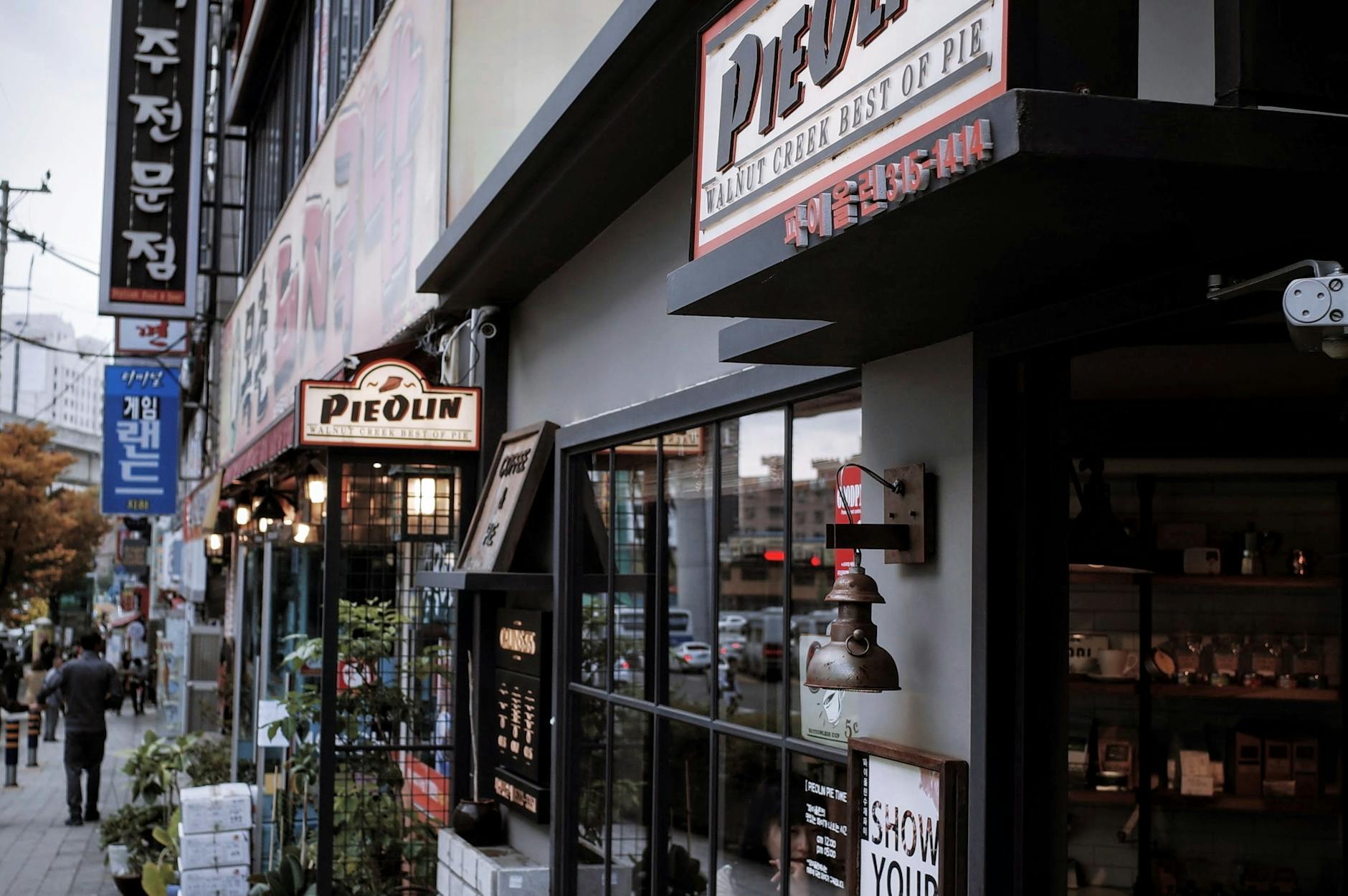
If you only do this once, do it in Hongdae. The streets between Hongik University Station Exit 9 and the pedestrian area are thick with studios — several on every block, most of them 24 hours, and enough variety of brand that you can pick one on aesthetics rather than proximity. It is also where the activity makes most sense in context: you do it at eleven at night after eating, on the way to somewhere else. Our Hongdae guide covers what else is on those streets.
Seongsu — the design-conscious version
Seongsu has fewer studios but better ones, in keeping with the neighbourhood: larger self-studio spaces, more considered interiors, and a higher proportion of the full-room format rather than the curtained booth. If you want the twenty-minute version with a proper backdrop, this is where to look. See our Seongsu-dong guide.
Myeongdong — the convenient one
Plenty of branches, easy to find, and busy with visitors rather than locals. Perfectly good, slightly less atmospheric, and the obvious choice if you are staying nearby — see the Myeongdong guide.
Gangnam and Konkuk University
Gangnam Station’s underground and surrounding streets have a solid concentration, and the area around Konkuk University Station is a genuine student-district cluster with the same density as Hongdae and a fraction of the tourists. Both are worth knowing if you happen to be nearby.
The K-pop connection
A significant part of why these studios exploded is idol collaboration. Groups release limited-run frame designs — their logo, their photocards, their comeback artwork — which run for a few weeks and then disappear. Fans hunt specific branches for specific frames, and the Life4Cuts and Photoism apps and social accounts announce which locations have which collaboration.
If you are in Seoul partly for K-pop, this is worth ten minutes of checking before you pick a branch, because a frame tied to a group you actually like turns a nice souvenir into a good one. Our K-pop and Korean culture guide covers the wider fan infrastructure in the city.
Practical notes
- Bring a friend. These work solo — plenty of people do it alone — but the format and the frame count assume two or more.
- Wear something with contrast. The lighting is bright and flat, and all-white or all-beige outfits wash out.
- The floor is often marked. There will be a line or a sticker showing where to stand for the framing to work.
- Take the digital copies. Scan the QR code before you leave. This is the single most common regret.
- Strips fade. Thermal-printed photos lose contrast in sunlight over months. Keep them out of a window if they matter to you.
- Hairstyling and props. Many studios have a mirror, a hair straightener, a hairdryer and a basket of props by the entrance, all free to use. Nobody tells you this; use them.
- Peak times. Friday and Saturday evenings after nine in Hongdae mean waiting. Weekday afternoons are empty.
What to do with the strips afterwards
Koreans do not put these in an album. The strip goes into the clear window of a phone case, onto a photocard binder page, into a diary, or clipped to a bag. If you want to do it properly, buy a photocard sleeve — they sell for a few hundred won in any stationery shop and in the Daiso branches that are on almost every high street — and the strip fits neatly inside.
Stationery and small souvenirs of exactly this kind are one of the things Seoul does unusually cheaply and unusually well; our what to buy in Korea guide covers the wider category, and a Daiso visit is one of the more reliably enjoyable half-hours in the city.
Is it worth doing?
For five thousand won, yes, almost without qualification — it is among the cheapest and most characteristic things you can do in Seoul, it takes a quarter of an hour, and you leave with a physical object rather than another phone photo. It belongs on any budget itinerary and it makes a better souvenir than most things you can buy.
The one honest caveat: if you are travelling alone and dislike having your photograph taken, this will not convert you. It is a social activity built around a group performing for a camera, and doing it out of obligation produces four photographs of someone waiting for a countdown to finish.

Frequently Asked Questions
How much does a Korean photo booth cost?
Around ₩4,000–6,000 for a standard four-cut session and ₩6,000–8,000 for six or eight cuts. Larger self-studio rooms with a full backdrop and a longer slot run from about ₩15,000 up to ₩30,000.
Do the machines have English?
Many do, via a language toggle on the first screen, though not all. The flow is visual enough to follow without it: choose layout, pay, choose frame, shoot, select, retouch, print.
Can I pay with a foreign card?
Usually yes — most machines take international cards and mobile payment. Carry a few ₩1,000 notes as backup for older cash-only units.
What is Life4Cuts?
Life4Cuts (인생네컷) is the original and largest chain, and its name has become the generic Korean term for the whole category. Photoism, Photo Signature, Harupict and PIXX are the main alternatives.
Do I get digital copies?
Yes. A QR code appears on screen after printing — scan it immediately to download high-resolution files and any video clip. The link expires within minutes and cannot be recovered afterwards.
Where are the most photo studios in Seoul?
Hongdae, by a wide margin, with several on nearly every block between the station and the pedestrian streets. Seongsu, Myeongdong, Gangnam and the Konkuk University area are the other main clusters.
Are they open late?
Most are 24 hours and unstaffed, which is a large part of the appeal — the usual Korean pattern is to go after dinner or at the end of a night out.
Can I do it alone?
Yes, and people do. The four-cut format and the two printed strips assume a pair, but nothing stops a solo session and no one is watching.
Can I turn the skin smoothing off?
Yes. The retouch screen has a level slider, usually 0 to 4 or 5, and the default is often set high. Drop it to 0 or 1 if you would rather look like yourself.
Final Thoughts
Self-photo studios are the rare Seoul activity that is genuinely local, costs almost nothing, needs no booking and works at midnight. They are also the thing visitors most often notice and never try, because the machines look intimidating and the screens are in Korean. They are not intimidating. Walk in, tap four, tap a colour, pull a face six times, turn the retouching down, scan the code.
For more of the small, specific things Seoul does that nowhere else does, our unique experiences guide and the wider things to do in Seoul page are the places to start.
Photo Credits
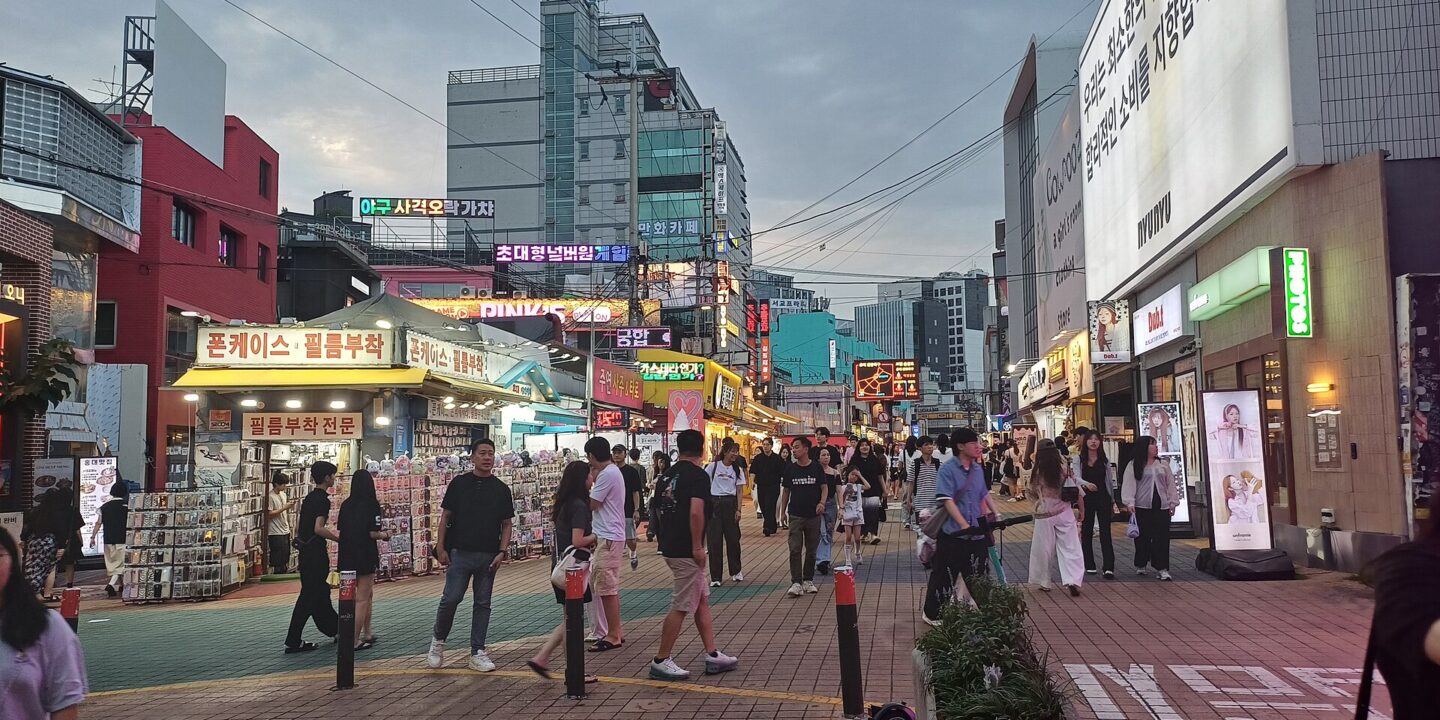
Hongdae street at dusk: 20260829 마포구 홍대로드4 by Striker9498, CC0, via Wikimedia Commons.
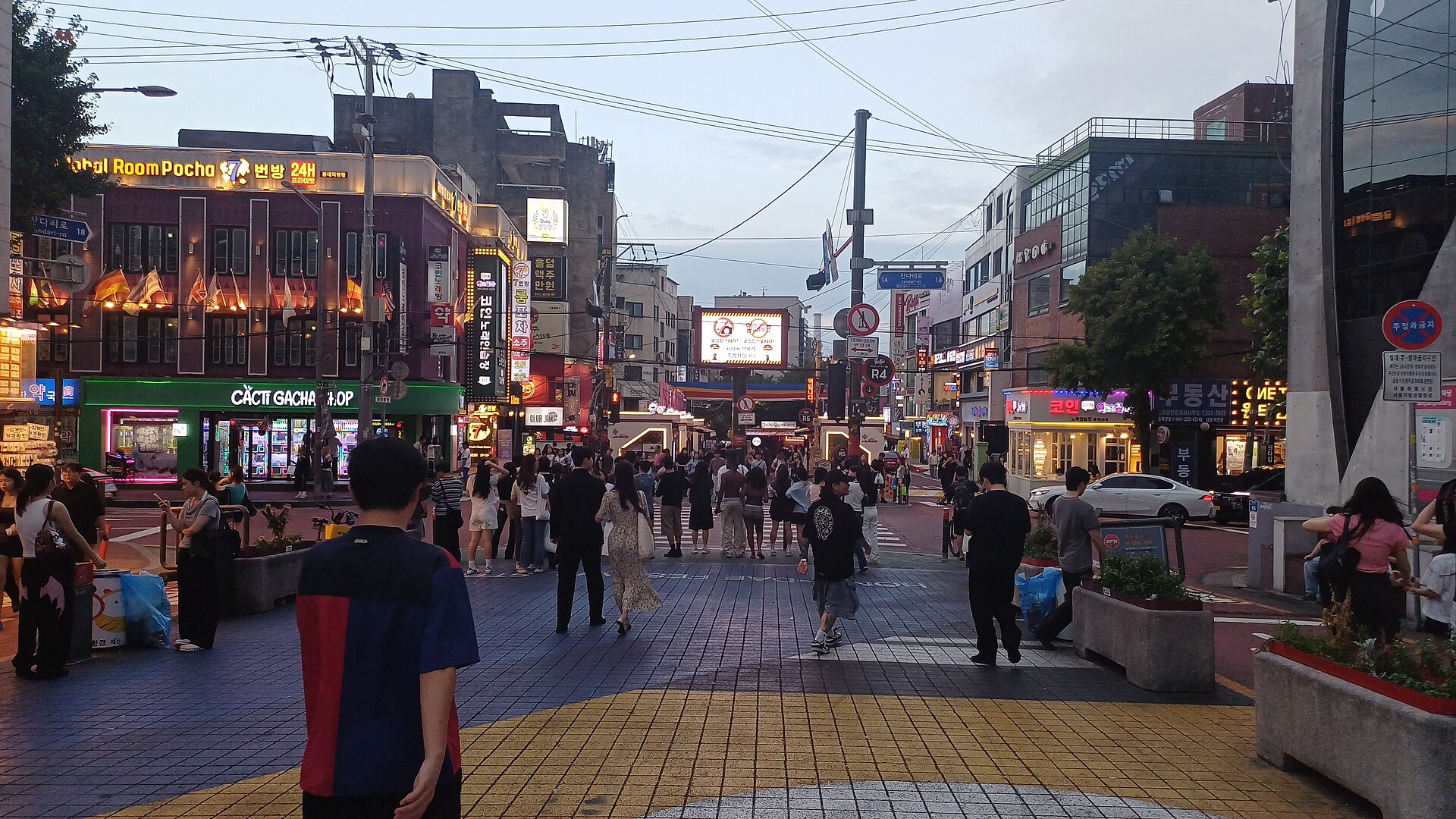
Hongdae crossroads in the evening: 20260829 마포구 홍대로드6 by Striker9498, CC0, via Wikimedia Commons.